
Caister-on-Sea
On a stormy November night in 1901, the Caister lifeboat went out and nine men did not come home. The official inquiry asked the survivors why, given the conditions, they had pressed on. The reply, attributed to lifeboatman James Haylett, became the village's epitaph: 'If they had to keep at it 'til now, they would have sailed about until daylight to help her. Going back is against the rules when we see distress signals like that.' A monument in the village cemetery carries the words 'Caister men never turn back.' The village has carried them too, for more than a century.
Roman Beginnings
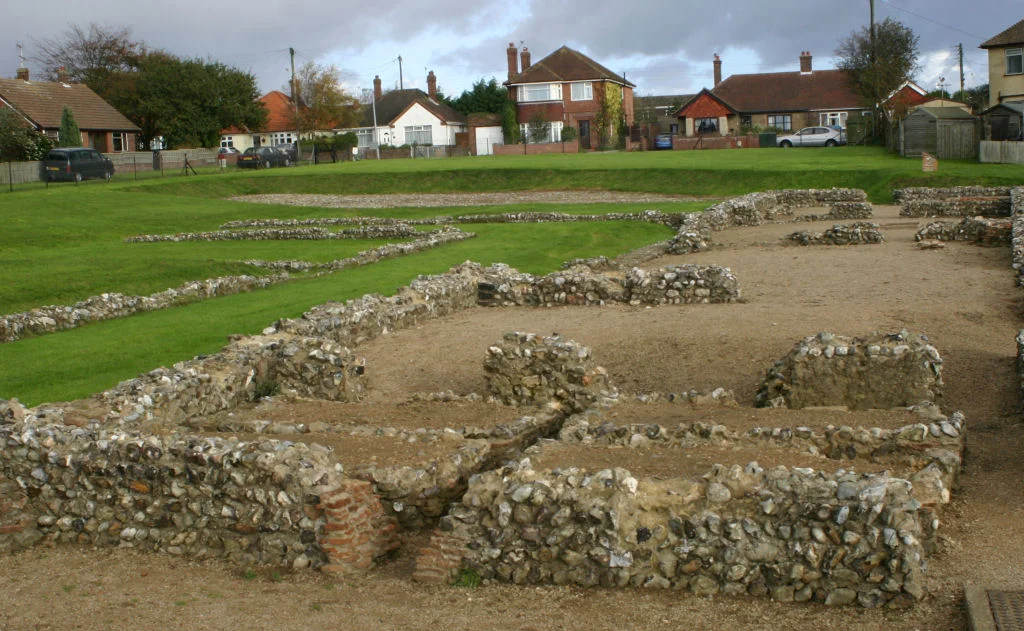
Around 200 CE the Romans built a fort here, on what was then the northern arm of a wide estuary. Their soldiers and sailors watched the river mouth for raiders. Later in the third century, when the Saxon Shore fort at Burgh Castle rose on the southern bank, Caister's military role diminished. But people stayed. In the 1950s, when the land was excavated ahead of a housing development, archaeologists uncovered a building with a hypocaust heating system, painted wall plaster, and pieces of female jewellery. The structure wasn't military. It might have been an officer's house. It might, the polite suggestion goes, have been a 'seamen's hostel' - a brothel - serving the men of the garrison. The site appears to have been abandoned in the fifth century. South of it, 150 Saxon burials were later found. The Roman remains are now Caister Roman Site, managed by English Heritage, free to enter.
The Lifeboat Disaster
There has been an offshore lifeboat at Caister since 1791, first run by a beach company salvaging ships wrecked on the notorious local sandbanks. The RNLI took over from 1856 to 1969. The 1901 disaster, when nine crew were lost during a rescue attempt in heavy seas, defined the village's identity in a way few events have for any English community. The monument unveiled in 1903 stands in the village cemetery; Historic England listed it Grade II in 2020. A pub called the Never Turn Back is named after the incident. The current Caister lifeboat is independent of the RNLI - the village resumed offshore lifeboat operations on its own after the RNLI withdrew its station. The phrase has outlasted its origin. The men it commemorates are remembered by name.
The Oldest Holiday Camp in Britain
In 1906, the Caister Socialist Camp opened on the coast - the oldest holiday camp in the United Kingdom. The idea was simple and radical: working people deserved seaside holidays too, and could organise them collectively. The camp expanded across both sides of the road through the 1950s and early 1960s, with a dining room, paper shop, sports facilities and tourist chalets. Property developers carved off half of it for housing in the 1970s. A new holiday camp opened in the 1980s under Ladbrokes ownership, then passed to Warner's in the 1990s. It still operates as a Haven park near the beach. A holiday tradition that started with socialism in 1906 is now mass-market caravan tourism - but it is still the oldest of its kind in the country.
Holy Trinity and the Largest Font
Caister's parish church is dedicated to the Holy Trinity and dates from the 13th century. Inside is East Anglia's largest medieval font - a massive stone basin that survived centuries of restoration and damage. Stained glass by Paul Woodroffe commemorates the men killed in the 1901 lifeboat disaster. Another window by Alfred Wilkinson depicts Christ the Shepherd. A set of royal arms, hard to date precisely, may come from the reign of George III or may be repurposed work from Charles I's time. Caister Castle, built in the 15th century by Sir John Fastolf, lies just inland - reachable by a short drive through the parish boundary into West Caister. Holy Trinity sits in the middle of all of it: Roman fort to the south, lifeboat memorial to the north, castle tower to the west, North Sea to the east. The village holds together by remembering exactly where it stands.
From the Air
Caister-on-Sea sits at 52.651 N, 1.733 E on the Norfolk coast immediately north of Great Yarmouth. The coastline and beach are the dominant features from altitude; the Roman fort footprint is visible as a square outline in the southwestern part of the village. Norwich Airport (EGSH) is 18 nm west, London Stansted (EGSS) about 79 nm southwest. Best viewed at 1,500-2,500 feet flying along the Norfolk coast.
Nearby Stories
- Redgrave and Lopham Fens 2.7 km away
- Cley next the Sea 4.8 km away
- East Dereham Windmill 7.1 km away
- Dunwich 12 km away
- Cromer Lighthouse 18 km away
- Battle of Lowestoft 58 km away
- Southern Bight 62 km away
- SM U-97 90 km away