
Efteling
Walk through the entrance gate at Efteling and the first thing you notice is what is missing. There is no central plaza dominated by a corporate castle. There is no parade route designed for crowd capture. There is no mascot waving in primary colours. Instead the forest closes in immediately - a real forest, sixty-five hectares of mature Dutch trees that the park was built around rather than cleared away - and the architecture you do see is hand-drawn rather than computer-modeled. Anton Pieck's gables lean a little. His shingles curl. His paint is intentionally weathered. Efteling is what a European theme park looks like when no one has ever heard of California.
Built Inside a Real Forest
The Dutch did not invent the theme park, but they did invent a particular kind of it. In 1933 a Catholic foundation built a sports complex in the woods outside Kaatsheuvel; in 1952 that complex added a small attraction called the Sprookjesbos, the Fairy Tale Forest, and almost by accident the country acquired what would become one of Europe's most-visited parks. The site is roughly 20 percent larger than Disneyland Paris and draws around five and a half million visitors a year, putting it just behind the Disney resorts and Europa-Park in Germany among European theme parks. The park is divided into five 'realms' that translate roughly as Fairy, Travel, Rough, Alternative, and Fantasy, each named with a poetic Dutch suffix - Marerijk, Reizenrijk, Ruigrijk, Anderrijk, Fantasierijk - that no marketing department in America would have approved.
Anton Pieck's Hand
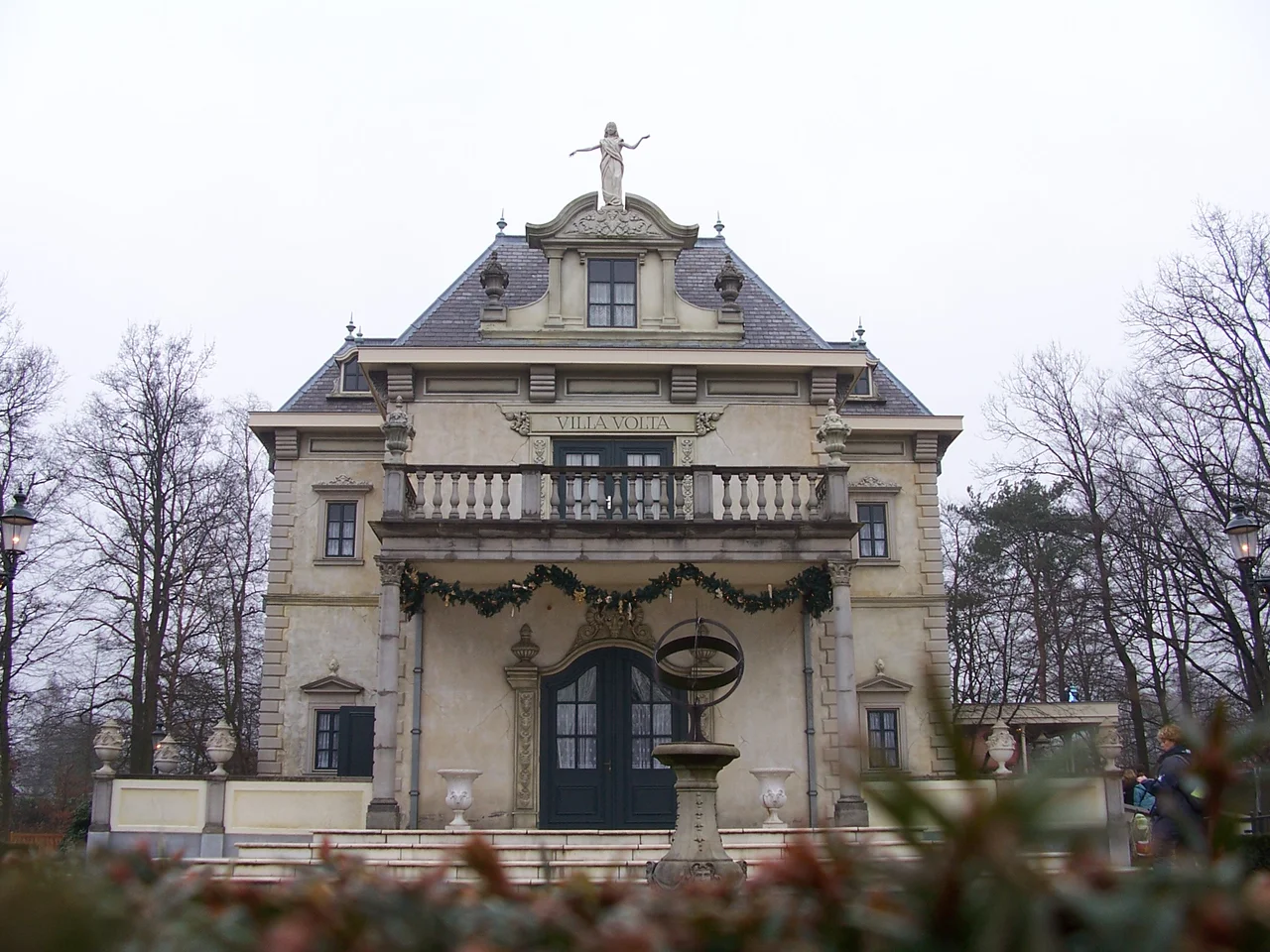
The reason Efteling looks the way it does has a name: Anton Pieck. He was a Dutch illustrator with a nostalgic style somewhere between Brueghel and a Christmas card, known for cobblestoned streets, snug interiors, and gas lamps glowing in fog. In 1950 the park's founders asked the inventor Peter Reijnders to build a fairy-tale forest, and Reijnders asked Pieck to design it. The collaboration produced something European theme parks had never really had: a unified visual style based on a single illustrator's hand, executed in real wood, real plaster, and real iron rather than fibreglass moulds. Pieck's influence still constrains the look of new attractions decades after his death. There is no Pixar character meet-and-greet. No Marvel ride. No global film franchise grafted onto the trees.
Thrills, Cautiously
Efteling did not always have rollercoasters. The Haunted Castle in 1978 was the park's first 'large-scale' attraction, and in 1980 the park finally yielded to the realities of teenage attention spans and started building thrill rides. The Python coaster came with two loops and two corkscrews - four inversions in total - and was, briefly, the largest rollercoaster on the European mainland. Then in 1987 the management course-corrected and decided that every future big attraction would have to be themed around fairy tales or myth - the rule that still applies today. Joris en de Draak is a wooden racing coaster based on Saint George and the dragon, two trains racing as Fire and Water. De Vliegende Hollander is a Flying Dutchman dark-ride that finishes with a water splash. Baron 1898 is a dive coaster with an almost-vertical drop telling the story of a fictional gold-mining baron, Gustave Hooghmoed - whose surname literally means 'high pride' in Dutch, because Efteling will not let a thrill ride forget the moral. The Pagode flying temple lifts you for a view of the green canopy from above.
Holle Bolle Gijs Wants Your Paper
The most beloved character at Efteling is not a princess and not a pirate. He is a fat sculpted boy named Holle Bolle Gijs - Hollow Bulging Gijs - who sits with his mouth wide open at various points around the park and shouts 'Papier hier!' in a deep amplified voice. Children stuff trash into his mouth, he makes a gobbling sound, and he politely thanks them. The mechanism dates from the 1950s and was originally conceived by Henk Knuivers as a solution to litter. It worked. It still works. Other park traditions are equally specific to this corner of Brabant: on Anton Pieck square stand three historic vending machines shaped like a chicken, a goose, and a little blacksmith, which come briefly to life when you insert a coin and produce a small surprise toy. The choice of toy is not yours to make.
Around the World, On the Way Home
Some of the rides are pure Pieck and Reijnders. Others borrow from further afield. Fata Morgana takes you on a boat through an Arabian city pulled from the 1001 Nights, past a busy market and a pasha on his throne, with audio-animatronics dense enough that long-time fans claim they still notice new details. Carnaval Festival is the park's answer to Disney's It's a Small World, with the dolls and the staging unmistakably Dutch in execution. Pandadroom is a 3D cinema reminding visitors to care for the planet. The Steam Train is a real steam train that runs between two of the realms. And the food is, in the park's own assessment, 'not Efteling's strong point' - but you can bring your own picnic in, which is a remarkable concession by theme-park standards, and Het Poffertje serves authentic Dutch poffertjes, those tiny puffed pancakes with butter and sugar that no one outside the Netherlands makes properly.
From the Cockpit
Efteling sits in the village of Kaatsheuvel, in the green centre of North Brabant province, roughly between Tilburg to the south and 's-Hertogenbosch to the east. From the air, look for a large block of mature forest surrounded by polder farmland, with a distinctive lake (the Aquanura water-show basin) in front of the main entrance. Coordinates 51.65°N, 5.05°E. Best viewed at 2,000-4,000 feet, ideally in summer when the foliage masks the rides and the park reads almost as pure woodland. Nearest airport: Eindhoven (EHEH) 35 km southeast; Rotterdam The Hague (EHRD) 55 km west.
From the Air
Located at 51.6503°N, 5.0481°E in Kaatsheuvel, North Brabant province. Visible as a large block of mature forest in the polder landscape, with the Aquanura lake near the entrance and the distinct silhouette of the Pagode flying tower above the canopy. Recommended viewing altitude 2,000-4,000 feet. Visual landmarks: the towns of Tilburg (10 km S) and Waalwijk (2 km N). Nearest airports: Eindhoven (EHEH) 35 km SE; Rotterdam The Hague (EHRD) 55 km W.
Nearby Stories
- Feyenoord 5.4 km away
- Heinz Struning 6.8 km away
- Moerdijk 7.5 km away
- Neder-Betuwe 8.7 km away
- Volkel Air Base 9.3 km away
- Kapellen 9.9 km away
- Campine 12 km away
- Limburg (Netherlands) 25 km away