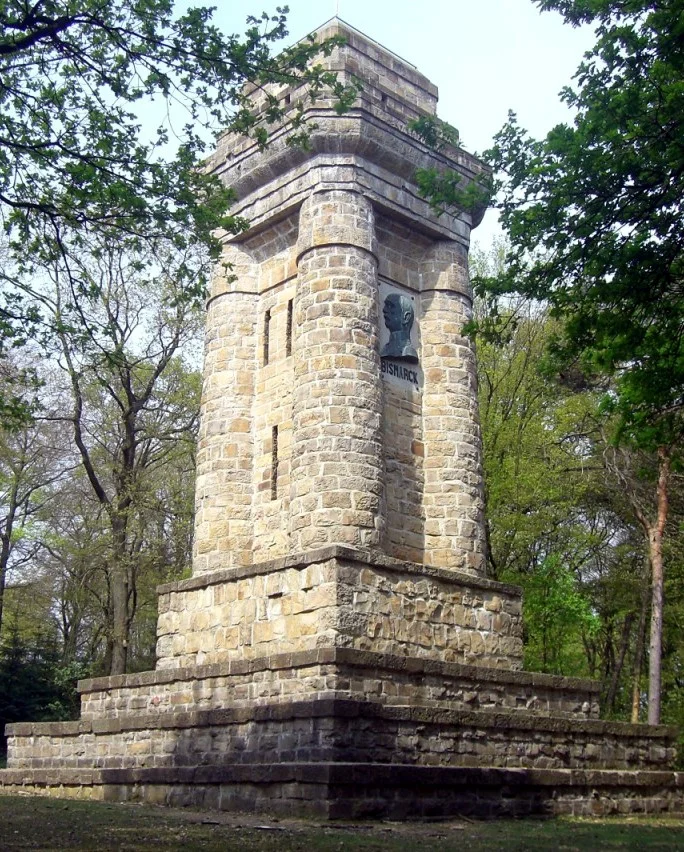

Bismarck Tower (Viersen)
When Otto von Bismarck died in 1898, a strange architectural movement broke out across the German Empire. The Deutsche Studentenschaften, the patriotic German student associations, decided that what the founder of the Reich needed was towers. They ran a competition. They got 317 designs back. The winner was a Dresden architect named Wilhelm Kreis, whose design he called Goetterdaemmerung, the Twilight of the Gods. Variants of that one design rose on hilltops all over Germany over the next two decades. Roughly 240 Bismarck towers were eventually built. The Viersen tower, completed in 1901 on the highest point in town, has a particular Rhineland twist: building it cost a Catholic priest his job, because in the Rhine Province, where most people were Catholic, Bismarck was not yet a hero.
An Argument About a Tower
The idea came up at a Viersen birthday party in 1899 for Kaiser Wilhelm II. The town's most influential citizens, the patriotic ones, decided to honor the late chancellor. Mayor Peter Stern threw himself behind the fundraising. In the end 104 citizens donated about 36,000 marks. Then the trouble started. The Viersen pastor Lorenz Richen, speaking for the local Roman Catholic clergy, delivered a passionate speech against the project. His reasoning was specific and historical: Bismarck had spent the 1870s in open conflict with the Catholic Church through the Kulturkampf, fighting Catholic influence in the school system and elsewhere, and Catholics in the Rhine Province remembered. Richen asked Catholic families not to hang flags along the patriotic procession route. He lost his job as school inspector for saying so. The foundation stone was laid in front of several thousand people anyway.
Goetterdaemmerung in Greywacke
Wilhelm Kreis's winning design was meant to be solemn. Three pedestals rising one above the other, then four massive columns at the corners with diameters of 1.80 meters, then an architrave with a projecting cornice, and on top of all that an iron brazier for the fire. The Viersen tower is a slightly slimmer version, built from cuboid greywacke quarried in the Wiehl Valley. Total height: 18.22 meters. Twelve steps up to an iron door on the west side, which the Duesseldorf architect Josef Kleesattel decorated with the Bismarck family arms and the family motto, In trinitate robur, in trinity there is strength. The Berlin sculptor Arnold Kuenne added a bronze relief of the chancellor to the eastern face. Sixty steps lead up the narrow inner stair to the viewing platform.
The Beacon, Every April 1st
On the inauguration night the iron brazier was lit for the first time. After that, every year on Bismarck's birthday, April 1st, the keepers lit it again. The flames rose four to five meters above the tower and burned for about two hours, visible across the lower-lying countryside along the Niers. It was the kind of public ritual that the Wilhelmine empire excelled at: collective, repeated, performed in front of an audience that knew it was being shown what to believe. The annual lighting continued until the outbreak of World War I in 1914. The empire that built the towers did not survive the war. The towers mostly did. The brazier on Hoher Busch went cold and stayed that way.
Closed for Decades
By the end of the 1970s the structure was unsafe and the tower was closed. Restoration was needed; restoration cost money. It took until 2001, when the city of Viersen, the local savings bank, and county funding pulled together about 370,000 euros under the Euroga regional landscape program. The repointing alone made a difference: the crumbling cement mortar in the joints was replaced with a modern material that would not produce the white efflorescence that had been staining the stone. The tower reopened in 2003. Today it is listed as a historical monument for scientific, artistic, and historical reasons. The original view, once described as reaching far over the low lands along the Niers, is now blocked by tall trees that have grown up around the hilltop in the century since the tower was built.
Postcards and Ham Radios
Since 2006 the licensed radio amateurs of Viersen have looked after the tower. They run an exhibition inside it of historical postcards on the theme Bismarck Towers Around the World, gathered from sister monuments all over Germany and the former empire. The tower is open the first and third Sunday of each month from April through September, and at other times by appointment for groups. Climbing the sixty interior steps to the platform gets you to where the iron brazier used to be. Looking out, you do not see what people in 1901 saw. The view they built the tower for is gone, swallowed by the trees that grew while no one was looking. What is left is the stone itself, the bronze relief of a chancellor most Rhinelanders did not particularly want to honor, and a building that has outlived both the empire that praised it and the priest who refused to.
From the Air
Coordinates 51.2628 N, 6.36975 E, on the Wilhelmshoehe hilltop in the Hoher Busch woodland northwest of Viersen city centre, at 84.94 m above sea level (the highest point in Viersen). The 18.22-meter greywacke tower sits in mature forest and is best identified by the hill itself rather than the tower alone; from low altitude you can pick out the stone block against the trees. Recommended altitude 1,000-2,500 ft AGL. Nearest major airports: Duesseldorf Moenchengladbach (EDLN / MGL), 4 nm southeast; Duesseldorf International (EDDL / DUS), 14 nm east; Weeze (EDLV / NRN), 22 nm north. Class D and C airspace overlap around Duesseldorf; check NOTAMs and TMA boundaries before low-level overflight.
Nearby Stories
- Rhine-Herne Canal 3.5 km away
- Limburg (Netherlands) 4 km away
- Raceway Venray 7.1 km away
- 1999 Wuppertal Schwebebahn Accident 7.2 km away
- Rheinisches Braunkohlerevier 7.3 km away
- South Limburg 10 km away
- European Transonic Wind Tunnel 15 km away
- Vetera 17 km away