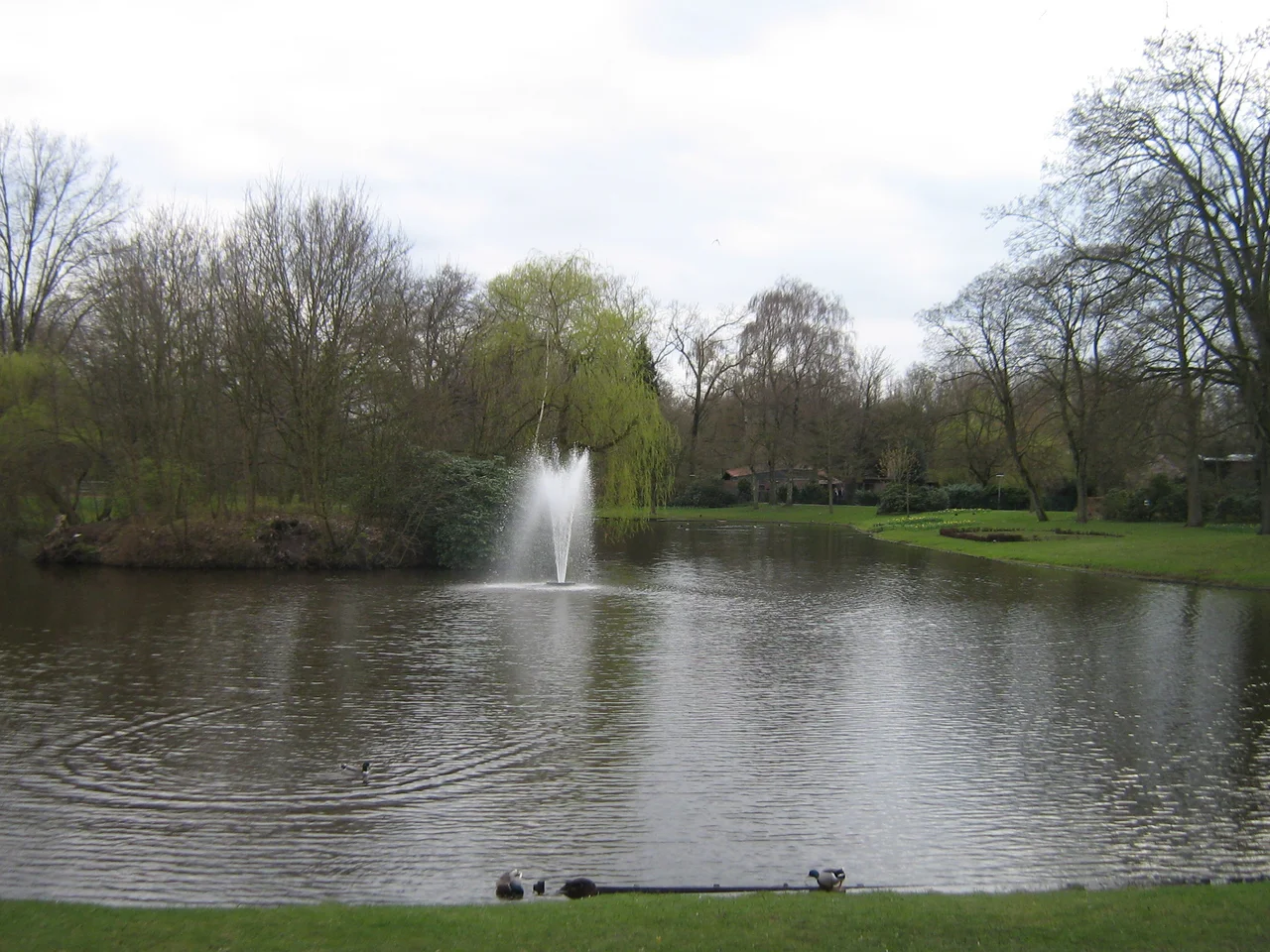

Gronau, North Rhine-Westphalia
Gronau got its town rights on 27 December 1897. That same December, in a Dutch-funded textile mill on the edge of town, looms were running three shifts. Twelve kilometers up the road sat Enschede, a Dutch cotton city built on the same trade. A border ran between them, but the cotton did not care - and neither, much, did the Dutch investors who had been driving the Gronau textile boom since 1854. The town existed because the border was porous and the looms were hungry. When the looms stopped, in 1980, almost everything else had to change.
Cotton, Dutch Money, and Eight Decades of Boom
The first textile factory opened in Gronau in 1854, and the population followed the spindles. Dutch investors put up much of the capital - this was an industrial town that thought of itself as half a Twente town, and traded that way. By 1875 railway lines ran from Gronau to Munster, Dortmund, and Enschede. By the First World War the town had a new town hall, a district court, schools, hospitals, an indoor swimming pool, waterworks, an electricity plant, and a city park - all of it paid for by cotton. And then, in 1980-1981, M. van Delden & Co. - the firm that had started it all in 1854 - went bankrupt. The textile era simply ended.
Reichspogromnacht in Wallstrasse
On the night of 9 to 10 November 1938, the synagogue on Wallstrasse was desecrated as part of the coordinated nationwide pogrom the Nazis called Reichskristallnacht. Most of the Jewish residents of Gronau and the neighboring district of Epe were eventually deported to extermination camps and murdered. A Jewish cemetery survives in Gronau today as a place of remembrance. In Epe, the former synagogue is being rebuilt as a cultural center - an attempt, decades late, to remember what was destroyed and the people who were taken.
The Boy Who Sang in German
Udo Lindenberg was born in Gronau in 1946 - a year of food rations, occupation zones, and stunned silence about what had just happened. He grew up in a town where the German rock and pop scene barely existed yet, where rock music was something that came from somewhere else and was sung in English. Lindenberg changed that. Starting in the 1970s, he insisted on singing rock in German - and not the polished German of the Schlager hits, but slangy, sardonic, streetwise German. He became one of the defining voices of German popular music and a one-man argument that you could be both rock and Deutsch. Today Gronau honors that heritage with a rock and pop museum that has become one of the town's main draws.
The Jazzfest That Filled the Vacuum
When the mills closed, the town needed reasons to exist beyond cotton. The Jazzfest Gronau, launched in 1989, has become one of them. The program reads like a serious jazz festival in any major capital: Jan Garbarek, McCoy Tyner, Klaus Doldinger's Passport, Al Di Meola, Avishai Cohen, Al Jarreau, Maceo Parker, Gregory Porter, Ron Carter. Annual attendance runs between 12,000 and 18,000 including open-air events, and roughly two-thirds of those visitors come from outside Germany - many of them driving over from the Netherlands, just as their grandparents drove over to buy and sell cotton.
The Plesiosaur in the Backyard
In 1912 someone digging in Gronau pulled up the skeleton of a Cretaceous plesiosaur - a long-necked marine reptile that swam here when this whole corner of Europe was warm shallow sea. The fossil now lives in the Geological-Paleontological Museum in Munster, where it has been studied as Gronausaurus wegneri, named in part for the town that produced it. The plesiosaur and the textile mill are roughly the two poles of Gronau's identity: a stretch of fenland flat enough that the sea once covered it, and industrious enough that, for 130 years, looms covered it instead.
From the Air
Coordinates 52.213 N, 7.042 E. Gronau sits hard against the Dutch border, with Enschede just 10 km to the west. The Dinkel river meanders through town from south to north. Recommended viewing altitude 2,500-4,000 ft AGL to pick out the river, the artificially-created Lake Driland north of town, and the dense town center. Nearest airports: Enschede Airport Twente (EHTW) immediately west across the border; Munster/Osnabruck International (FMO/EDDG) about 50 km southeast. Border crossing zone - watch Dutch/German FIR boundary at the edge of town.
Nearby Stories
- Hardenberg 4.5 km away
- COVID-19 protests in the Netherlands 6.9 km away
- St. Ludger Church, Billerbeck 8.3 km away
- Tecklenburg Castle 9.8 km away
- Stalag VI-C 12 km away
- Achterhoek 20 km away
- Warendorf 20 km away
- Quakenbrück 20 km away