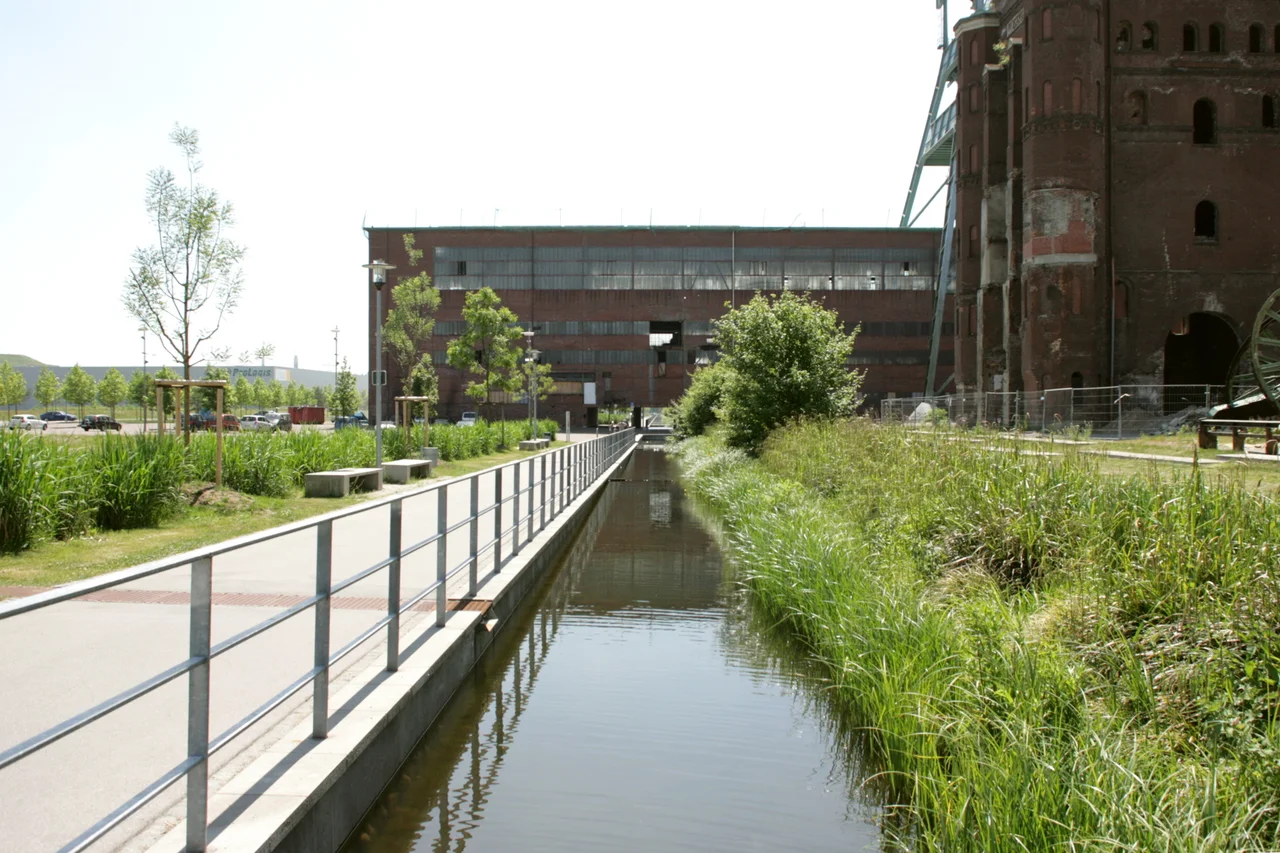

Ewald Colliery
The Malakow tower at Shaft 1 was built to be advertising. A stone fortress dressed up to look like a Crimean War redoubt, it was the kind of structure a colliery used to announce itself - heavy, imperial, visible from the road. So they painted the word EWALD across one side of it in giant letters. Then the plans for the site changed. The road went the other way. Ewaldstrasse ended up running past the wrong face of the tower. The lettering still survives, nearly 140 years on, and it still faces the wrong direction. Travelers along the street see only blank Crimean stonework. The advertisement faces the back of the property, talking to nobody.
Going Down 624 Meters
Sinking began in 1872, in an area where coal had been suspected but never proven. The first vein opened in 1876 at 464 meters down, and production started the next year. Faults in the rock kept forcing the engineers to sink deeper, and by 1884 Shaft 1 was the deepest in the entire Ruhr at 624 meters - more than half a kilometer of vertical pit driven through black shale and sandstone with the muscles of men who, in those first years, were almost impossible to recruit. The colliery sat far from anywhere. Only the daring went underground in 1877. Shaft 2 followed in 1888-92, then a Resse pair in 1895, then a fifth in the Katzenbusch, then Shaft 6 in 1911. A seventh central shaft was started during the Second World War to push production for the war machine - the German army's hunger for coal was bottomless - and was only finally completed in 1949 with a distinctive double-headed headframe.
The Wrong Side of Things
If anything defines the Ewald story it is bad luck and good iron. The mine was merged with Schlagel and Eisen in 1989 and with the Hugo Colliery in 1997. For a brief stretch, the consolidated Ewald-Hugo operation ran twenty-one shafts - one of the largest pit configurations in Europe. Then the German government's long slow exit from black coal arrived. On 28 March 2000, the last shift went down. The final closure followed in spring 2001. A 129-year run ended. The three surviving structures - the wrong-facing Malakow tower at Shaft 1, the steel box headframe at Shaft 2, and the double headframe at Shaft 7 - now stand in a landscape that is itself made of mining. The adjacent Hoppenbruch and Hoheward heaps form the largest dump landscape in Europe, roughly 220 hectares of waste rock shaped into hills.
Lighthouses on a Dead Sea
When closure was announced in 1999, the city of Herten and the mining company started planning the second life before the first had even ended. They called it Project Group Ewald and aimed for a thousand new jobs. The architects, Cino Zucchi with Martin Halfmann and Peter Koster, decided the old headframes should be left standing as what they called Leuchtturme - lighthouses - visible from kilometers away, the way they had always been. A drainage canal cuts through the redesigned grounds in a sinuous arc the locals nicknamed Das Blaue Band, the Blue Ribbon. The fifty-two-hectare site is now spliced into the much larger 750-hectare Hoheward landscape park. Of the listed colliery buildings, seventy percent have been let to new occupants. Twenty companies and a thousand jobs arrived within a decade of the last cage ride to the surface.
From Coal to Hydrogen
The northern end of the site became the Hydrogen Competence Center H2Herten. In 2009, the construction began on the Blue Tower - a demonstration plant using staged reforming to make hydrogen-rich substitute natural gas from biomass, intended to deliver thirteen megawatts at full output. A visitor center for hydrogen and fuel cell technology opened that October. A wind-powered electrolysis plant supplies the center with green hydrogen. The first companies to lease industrial buildings - IdaTech Fuel Cells and Masterflex - are deliberately in the energy game. The symbolism is not subtle. The pit that brought up fossil carbon for a century and a quarter now hosts the experiments that are supposed to replace it.
Travesty in the Boiler House
The most surprising thing about Ewald might be what happens after dark. In October 2009, the theater entrepreneur Christian Stratmann opened the RevuePalast Ruhr inside the former boiler house, running a travesty cabaret in a space that used to feed flame into the colliery's steam plant. The German broadcaster ARD records its Sportschau Club from the underground bar there. The Kustom Kulture Forever festival - one of the biggest hot-rod and tattoo shows in Europe - takes over the site each year. The Extraschicht, the regional Night of Industrial Culture, has used Ewald as a hub three times. The Herten tourist office moved into the old wages-and-lighting hall in 2010, the very building where miners used to pick up their pay and pick up the lamps that would light their way down. The miners are gone. The lamps still come on in the evenings.
From the Air
Ewald Colliery stands in Herten, just south of the city of Recklinghausen, at 51.5719 degrees North, 7.1483 degrees East. From altitude the site is unmistakable: three surviving headframes - the squat fortress block of the Malakow tower, a slender steel box at Shaft 2, and the distinctive double-A frame at Shaft 7 - rising from a green plain framed by the conical Hoppenbruch and Hoheward slag heaps to the south. The nearest commercial airport is Dortmund (EDLW / DTM), about 25 km east-southeast. Dusseldorf (EDDL / DUS) is 50 km southwest. Veltins-Arena sits about 9 km south.
Nearby Stories
- Engels-Haus 6.9 km away
- Hochschule Niederrhein 7.7 km away
- Wesel Station 8.6 km away
- Gerleve Abbey 10 km away
- Hamm (Westfalen) Hauptbahnhof 11 km away
- Oude IJsselstreek 20 km away
- Warendorf 21 km away
- Atta Cave 26 km away