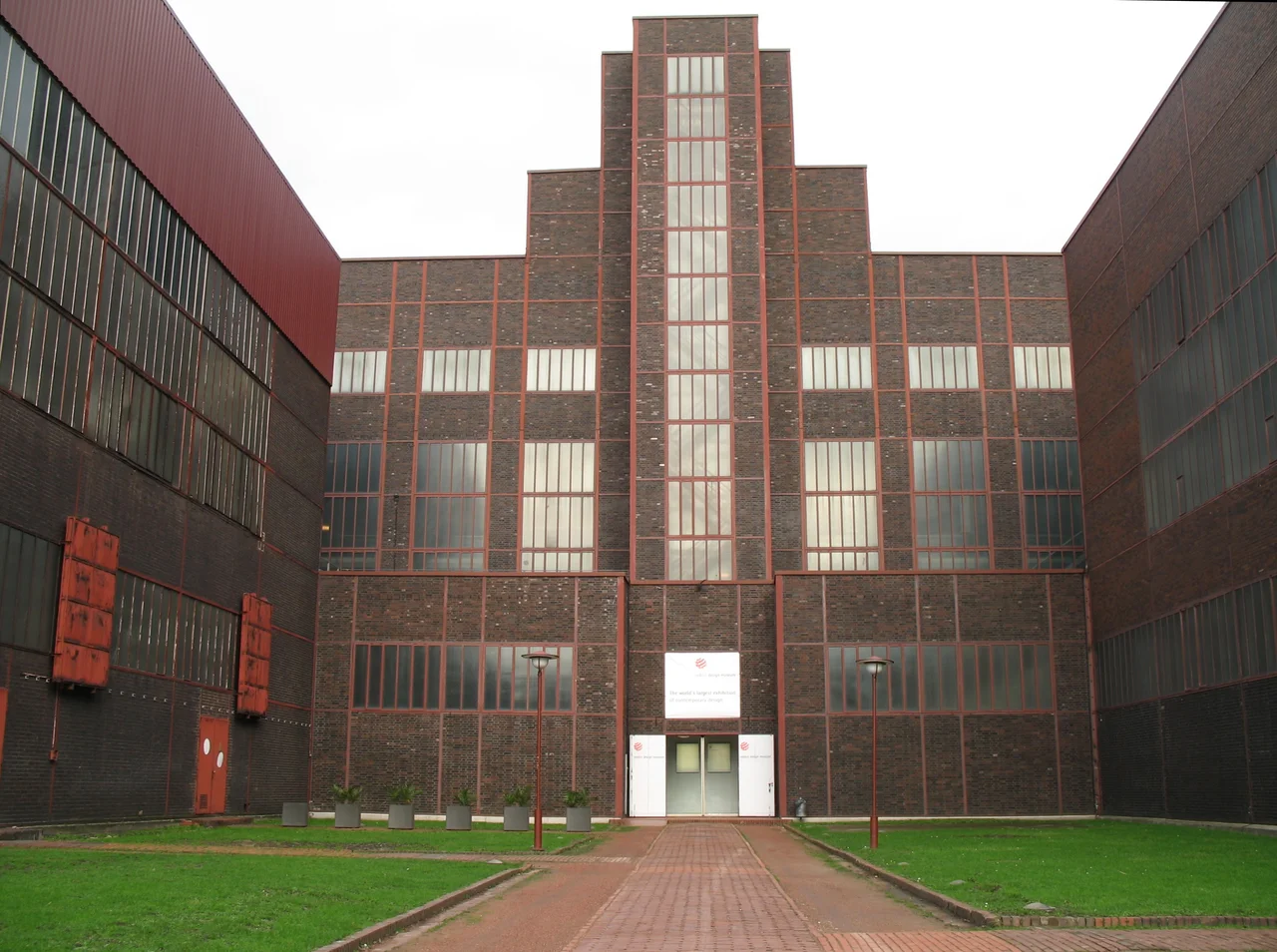

Zollverein Coal Mine Industrial Complex
Fritz Schupp and Martin Kremmer were architects, but in 1928 they were given a contract that was effectively engineering: design a complete coal-mining shaft complex from scratch, the new Shaft 12 for the Zollverein colliery in Essen. They built it in red brick and exposed steel, in the spare, rectilinear language of the New Objectivity movement that grew out of the Bauhaus. When it opened in 1932 it was the largest, most modern, and most productive hard-coal mine in the world. It also happened to look like a piece of monumental industrial sculpture. *Die schoenste Zeche der Welt*, the local nickname goes - 'the most beautiful coal mine in the world.' For once, the marketing is fair.
Bauhaus Underground
The first coal mine on the Zollverein premises opened in 1847 and pulled coal from 1851 onward, but the mine that the world remembers is Shaft 12. Schupp and Kremmer's design rejected the chaotic pile-up of buildings that characterized most 19th-century collieries. They organized the surface installations on a strict grid, with each function in its own clean-edged structure. The double winding tower above Shaft 12 - the symbol of the entire complex - rises 55 meters in exposed steel, painted dark, with the two great winding wheels visible on its sides. The supporting buildings are red brick with industrial-scale steel windows. The whole composition is symmetrical, severe, deliberately unromantic. In 1932, when most industrial architecture was apologizing for itself behind classical facades, Schupp and Kremmer just showed what coal mining actually looked like, at scale, and trusted the geometry to do the work. It did.
The Productive Years
From 1932 onward, Zollverein was an industrial machine of extraordinary scale. After the 1957-1961 expansion that added the Zollverein Coking Plant, the two halves of the site became among the largest of their kind in Europe. At peak the coking plant employed around 1,000 workers and produced up to 8,600 tons of coke per day on what was called the *dark side* of the operation. The *white side* - the chemical works - extracted ammonia, raw benzene, and coal tar as byproducts. In 1968 the complex passed to Ruhrkohle AG (RAG), Germany's largest mining company, which consolidated it with the nearby Bonifacius and Holland mines in 1974, and with Gelsenkirchen's Nordstern mine in 1982. The last layer worked on Zollverein territory, the *Floez Sonnenschein* coal seam, was opened in 1980 and yielded around 3.2 million tons. It was not enough.
23 December 1986
On 23 December 1986, the last shift came up from Shaft 12. Zollverein closed. It was the last active coal mine in Essen. The coking plant kept running until 30 June 1993, then it closed too. The miners who walked off that final shift in December 1986 were the last in a continuous line that stretched back to 1851 - five generations of men who had spent their working lives in the dark below Essen. The Ruhrgebiet was full of mines closing in the 1980s, but Zollverein was different: it had been the showcase mine, the architectural one, the one foreign visitors were taken to see. When it closed, the political question became immediate. What do you do with a 100-hectare industrial complex that everyone agrees is beautiful but no one wants to mine?
Saved, Strangely
The state of North Rhine-Westphalia did something almost no government does with closed industrial sites: it bought the place in late 1986, almost immediately after the last shift came up, and declared Shaft 12 a heritage monument. The obligation was to preserve the site in its original state and to slow the effects of weathering. The Bauhuette Zollverein Schacht XII was founded in 1989 to manage it; the Stiftung Zollverein replaced that in 1998. The coking plant, sold off in 1993, was nearly demolished - negotiations to sell it to China collapsed, and demolition crews were lined up - but a state cultural project pulled it back from the edge and listed it as a heritage site in 2000. On 14 December 2001, UNESCO inscribed both Shaft 12 and the coking plant on the World Heritage List. The site that had nearly disappeared became one of the most-protected industrial monuments in the world.
The Mine That Became a Design Museum
Today Zollverein holds the Ruhr Museum - the regional museum of the Ruhrgebiet, in the former coal washery, with 6,000 exhibits tracing the area from the formation of coal 300 million years ago to the present. The Red Dot Design Museum occupies the converted boiler house, displaying contemporary product design beneath the original industrial ironwork. The coking plant's cooling-water channel becomes an ice-skating rink in winter. The Schupp-and-Kremmer winding tower above Shaft 12 has appeared as a Civilization VI wonder representing the Ruhr Valley, and as a setting in Anthony Doerr's 2014 Pulitzer Prize-winning novel *All the Light We Cannot See*. Shaft 12 itself cannot be visited - it has been backfilled with concrete and the remaining space is now part of the central Ruhr's mine-water drainage system, with pipes running through what used to be the cage shaft. The colliery beneath the most beautiful coal mine in the world is now functionally a giant drain. The architecture above it has never looked better.
From the Air
Located at 51.49 N, 7.04 E, in northern Essen at the edge of the dense Ruhrgebiet urban fabric. From altitude, the unmistakable signature is the dark double winding tower of Shaft 12 - 55 meters tall, four-legged, with the twin winding wheels visible. The coking plant lies just east, an extended bank of brick-and-steel ovens. The whole complex covers around 100 hectares; even at high altitude the geometric grid of buildings is clearly artificial against the surrounding city. Nearest major airport: Duesseldorf (EDDL), 35 km southwest; Dortmund (EDLW), 30 km east. The site lies under common arrival corridors for EDDL traffic from the north.
Nearby Stories
- Burg Castle (Solingen) 4.1 km away
- Düren-Neuss railway 9.6 km away
- Operation Chastise 9.7 km away
- Krefeld Zoo 10 km away
- Festspiele Balver Höhle 13 km away
- Lembeck Castle 16 km away
- Haldern Pop 18 km away
- Warendorf 35 km away