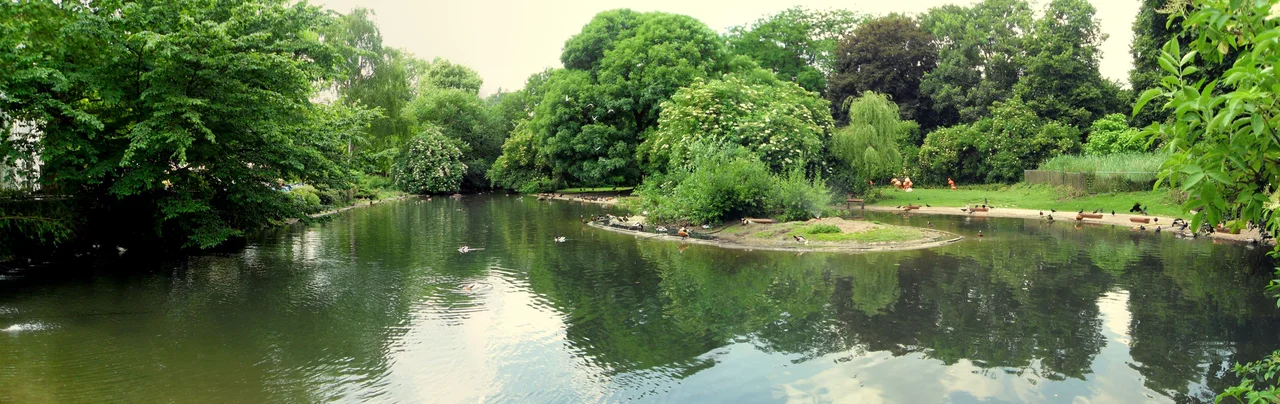

Krefeld Zoo
Shortly after midnight on New Year's Day 2020, the Monkey Tropic House at Krefeld Zoo caught fire. By the time the flames were extinguished, more than thirty animals were dead - among them two western lowland gorillas, five Bornean orangutans, and one chimpanzee. Massa was forty-eight. Boma was forty-six. Suria was three. The cause was three paper lanterns, launched into the cold sky over the Lower Rhine by a sixty-year-old woman and her two adult daughters who said they had not realised the lanterns were illegal in Germany. They turned themselves in the next day, in tears.
A Small Zoo in a Quiet Park
Krefeld is not a famous city. It sits on the western edge of the Ruhr, an old silk town with quiet streets and a park called the Grotenburg, where in May 1938 a modest Tierpark opened in half the park's acreage. The first director, Heinrich Janssen, came from the natural history museum next door. A few hundred animals lived in forty enclosures. Air raids between 1940 and 1945 destroyed parts of it; two badgers and a deer were killed, and the wolves had to be shot when fences came down. After the war the place was rebuilt slowly, on small budgets, by people who cared. By the 1970s it had elephants, rhinos, and orangutans. By 2014 it had a veterinary clinic and a new penguin pool. By 2018, it had Bobóto, a baby gorilla born on New Year's Eve.
The Monkey Tropic House
The Affentropenhaus opened in 1975 - two thousand square metres of greenhouse glass and steel, kept at twenty-six degrees Celsius, the climate of equatorial forest. Gorillas, chimpanzees, orangutans, marmosets, and fruit bats lived inside behind dry moats. Visitors walked among them through a humid green half-light. Many of the apes were old; some had lived there their entire lives. Massa the lowland gorilla was forty-eight, an age few zoo gorillas reach. Charly the chimpanzee was forty-six. The orangutans had names that meant something to the keepers who fed them every morning: Lea, Bunjo, Sungai, Changi, and little Suria. They had been bred under careful European studbooks designed to keep their species from vanishing entirely.
Three Lanterns in a Cold Sky
Sky lanterns - small paper hot-air balloons lifted by an open flame - are sold around the world as romantic New Year ornaments. In Germany they have been banned in most states since the late 2000s, precisely because of what can happen when one drifts unpredictably and lands while still burning. On the night of 31 December 2019, a mother and her two adult daughters in Krefeld bought a set online and lit them just before midnight. At least one came down on the glass-and-steel roof of the Affentropenhaus. Within minutes the structure was a furnace. Firefighters reached the scene quickly but could do nothing to save the animals inside. Only two chimpanzees, Bally and Limbo, survived. The next morning, the three women walked into a police station and confessed. They said, through tears, that they had not known.
What Remains
The zoo is still there. A new gorilla garden, opened in 2012 on the other side of the park, kept two further groups of western lowland gorillas alive - including the silverback Kidogo, who in 2012 had briefly made world headlines by walking a tightrope strung between two trees. The Rainforest House, with its free-flying birds and its sloths moving through the canopy, still operates. Humboldt penguins still nest in the artificial Peruvian coast that opened in 2014. School groups still come to study water in the constructed wetlands the zoo built to clean its own pools. But where the Monkey Tropic House stood, there is now an absence the size of a building - and in conservation breeding records around Europe, a column of empty entries beside names like Massa, Boma, and Suria.
A Place to Visit Carefully
Krefeld Zoo today asks visitors to remember that it is a working ark for endangered species - currently participating in forty-nine breeding programmes, including those for Sumatran tigers, snow leopards, black rhinos, and the otters whose European studbook the zoo itself maintains. In 2006, Davu became the first black rhino born at a zoo in North Rhine-Westphalia; four more followed. The fire of 2020 changed European policy on sky lanterns and how zoos secure their tropical houses. It also changed Krefeld. The city of 230,000 silk-town descendants now shares its zoo's grief as a kind of civic inheritance - a reminder that a small careless choice on a cold night can take, irreversibly, what generations have worked to protect.
From the Air
Krefeld Zoo lies in the Grotenburgpark on the eastern edge of Krefeld at 51.341 N, 6.601 E, about 22 km northwest of Düsseldorf and 60 km north of Cologne. The nearest major airport is Düsseldorf International (EDDL/DUS), 25 km southeast. Smaller traffic uses Mönchengladbach (EDLN) 20 km southwest and Niederrhein-Weeze (EDLV) 40 km northwest. From cruising altitude the zoo appears as a green rectangle inside Krefeld's western suburbs; the bend of the Rhine 7 km east and the silhouettes of Duisburg's chimney stacks are useful landmarks. Best viewed at 1500-3000 ft AGL on clear days.
Nearby Stories
- Krupp Decoy Site 6.2 km away
- Ysselsteyn German War Cemetery 8.2 km away
- Unterburg trolleybus turntable 8.2 km away
- Düren-Neuss railway 8.5 km away
- Mook en Middelaar 10 km away
- Haldern Pop 11 km away
- Maaseik 15 km away
- Gerleve Abbey 33 km away