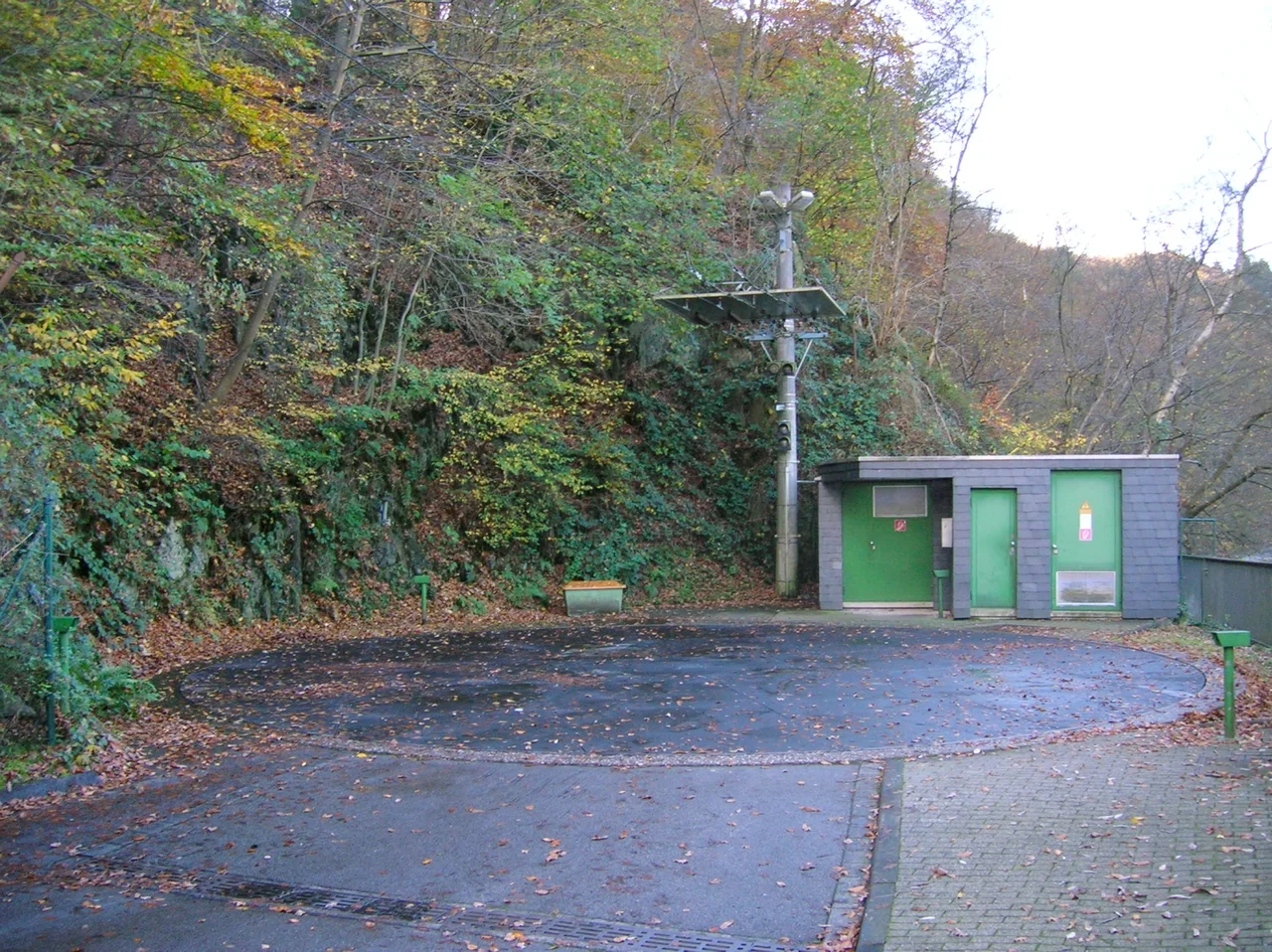

Unterburg trolleybus turntable
Four trolleybus turntables were ever built. Two were in England — Christchurch (1936 to 1969) and Longwood near Huddersfield (1939 to 1940). One was in Guadalajara, Mexico, in operation from 1982 to 1988. And one is in Germany, tucked into the gorge of the Wupper river beneath the medieval mass of Burg Castle, in a district of Solingen called Unterburg. It is twelve meters across, takes forty-five seconds to spin a bus a full half-turn, and as of 2009 is officially out of service. It is also the only one of the four still in existence. If you want to see a trolleybus turntable in working condition anywhere on Earth, you come here.
Why a Disc Instead of a Loop
Trolleybuses are not magnetically reversible. They run forward off two overhead wires, with a pair of poles reaching up from the roof. To send a bus back the way it came, you need either a turning loop — a curve of road and overhead wire wide enough for the vehicle to swing around — or a place to physically rotate the bus. The Wupper valley at Unterburg has no room for a loop. The narrow river runs against a steep slope; the transfer stop at the end of the old tram line was forty meters long and only eight meters wide; the cul-de-sac between river and hillside left no space to turn. So Stadtwerke Solingen did what the English had done at Christchurch and Longwood: they bolted a steel disc into the asphalt and used it to spin the bus.
Forty-Five Seconds
The turning process is precise and not particularly dramatic. The driver pulls the trolleybus onto the disc. The trolley poles, still in contact with the overhead wires, get lowered manually. The driver steps out and into an adjoining control house, presses the remote operator, and the disc rotates one hundred and eighty degrees in about forty-five seconds. No passengers ride during the spin; safety rules forbid it. After the rotation completes, the poles are raised back to the wires with the aid of small fabric devices called threading tufts — used to guide the poles onto the conductors in the correct alignment. The driver climbs back in. The bus rolls off the turntable, now facing the way it came.
The ÜHIIIs and What Came After
When the turntable was installed in 1959 — replacing the prewar tram lines that had connected Burg to Solingen and Remscheid before the bridge over the Wupper was destroyed in the war — the disc was seven and a half meters across. That accommodated the ÜHIIIs trolleybus, the only type then in use on line 3. The mechanism turned by hand crank. In 1968, Stadtwerke Solingen introduced a new three-axle trolleybus called the TS — twelve meters long, too big for the original turntable. Line 3 remained stuck on the obsolete ÜHIIIs vehicles until December 27, 1974, when the turntable was extended to handle the TS. In 1985, the disc was completely rebuilt, expanding to its current twelve-meter diameter. Articulated buses, longer still, could never fit. Line 683 — successor to line 3 — therefore became the last in the Solingen network to run rigid buses.
The Last Day of Spinning
On November 15, 2009, the line converted entirely to modern Swisstrolley articulated buses built by Carrosserie Hess in Switzerland. These vehicles have small auxiliary diesel motors, so they can drive the short distance from the Seilbahn Burg ropeway terminal — where a new bus station had been built — without overhead wires. The Burgbrücke stop, which used to sit in the cul-de-sac with the turntable, was moved across the river. After fifty years, the turntable's job was done. It was renovated as recently as 2004, giving it an expected lifespan of another decade or two, but it had no daily use. Stadtwerke Solingen and the local trolleybus museum have proposed preserving it for special excursions — heritage runs, photography events, the occasional turn for visitors. As of the most recent reports, a final decision is still pending.
An Industrial Footnote
It is easy to drive through Unterburg today and miss the turntable entirely. The disc lies flush with the road surface, ringed by curbs, in a small square at the foot of the chairlift that climbs to Burg Castle above. There are no passengers waiting; no buses spinning; no driver in the control house. But the apparatus is still there, still operational, the last of four such installations in the history of trolleybuses worldwide. Above it rises a medieval castle reconstructed in the 1920s. Below it runs a river that has been carving this valley for ten thousand years. Between the geology and the architecture, an obscure piece of mid-twentieth-century transit engineering quietly continues to exist. The world has only one, and it is here.
From the Air
The Unterburg turntable sits at 51.1375°N, 7.1470°E, in the Wupper valley directly beneath Burg Castle in the Solingen district. From the air, the village of Unterburg appears as a row of buildings strung along a tight river bend, with the dramatic castle on the hillside above. The turntable itself is too small to see from any altitude — but the chairlift cables linking Unterburg to Burg Castle are visible in good light. Düsseldorf (EDDL / DUS) is 25 km northwest; Cologne/Bonn (EDDK / CGN) is 35 km south. For low-altitude VFR pilots, the Wupper gorge is a striking corridor through the Bergisches Land.
Nearby Stories
- Michaelsberg Abbey, Siegburg 0.6 km away
- Krefeld Zoo 5.7 km away
- Langenberg Transmission Tower 5.8 km away
- Düren-Neuss railway 7.6 km away
- Operation Chastise 7.9 km away
- Festspiele Balver Höhle 9.6 km away
- Marienstatt Abbey 14 km away
- Battle of Hurtgen Forest 25 km away