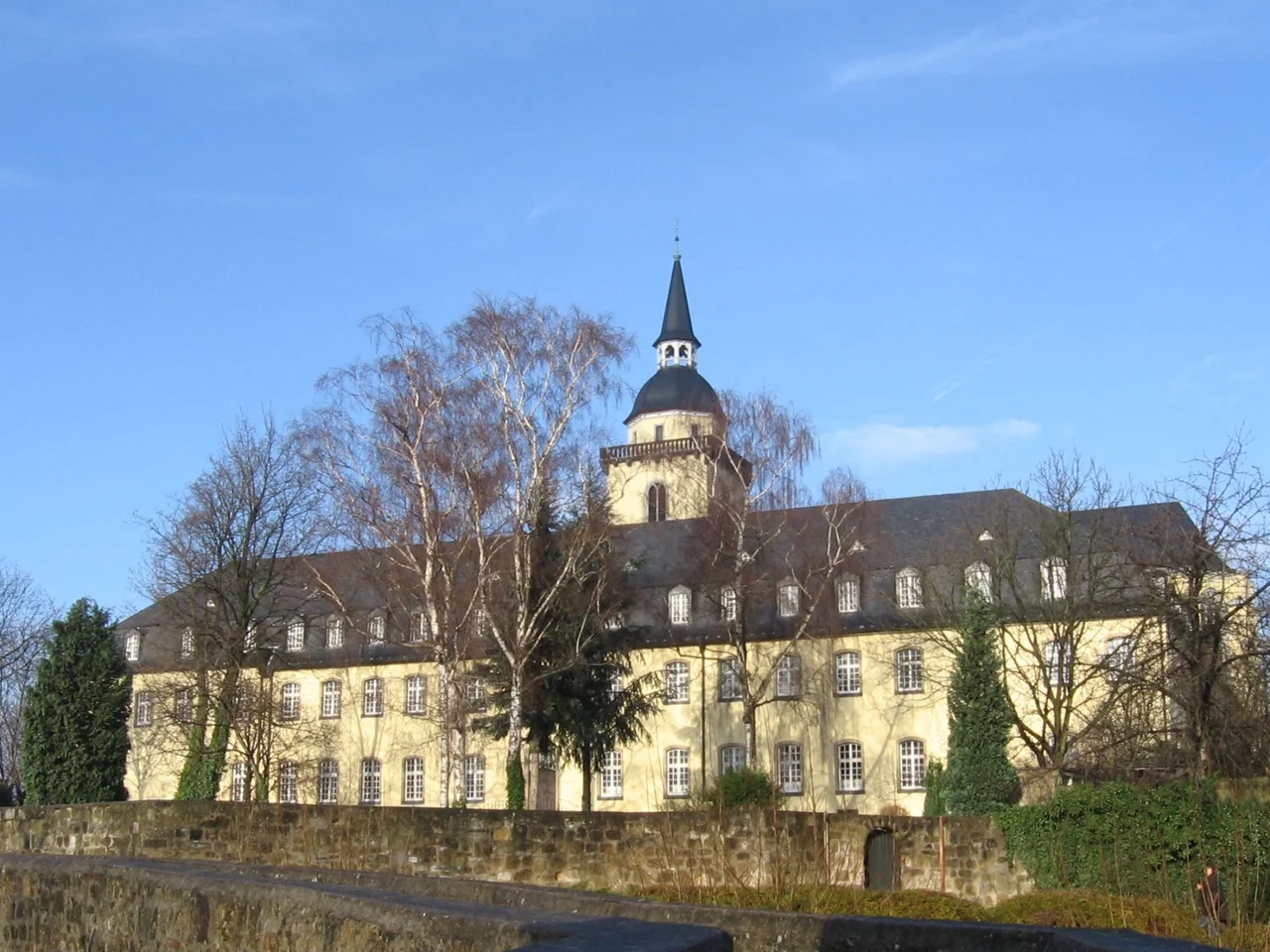

Michaelsberg Abbey, Siegburg
Forty meters of basalt rise above the town of Siegburg, and the whole hill is essentially one building. From the riverbank below, the Michaelsberg looks less like a monastery on a mountain and more like a monastery that is a mountain — a long, white, baroque-fronted abbey that has crowned this rock since 1064. The hill was a fortress before it was an abbey, and an abbey before the town of Siegburg even existed in its modern form. For nearly a thousand years, a community of Benedictines kept the daily office on the summit. Then, in December 2010, they voted to leave.
Anno's Mountain
Before the monks, there was a castle on this hill, built around 800 by the Counts of Auelgau. The rock was called the Siegberg then, named for the river curling beneath it. In 1064 the Archbishop of Cologne, Anno II, took possession of the site and founded a Benedictine monastery dedicated to the Archangel Michael. The mountain took the saint's name and so did the abbey. Anno installed a monk named Erpho as the first abbot, then retreated to the abbey himself in his final years. When he died in 1075, they buried him in the church he had founded. A little over a century later, on April 29, 1183, papal legates canonized him in that same church. His relics rest in the Chapel of Saint Anno to this day.
Discipline and the Lack of It
Benedictine life is supposed to be poor, ordered, and quiet. By the late twelfth century, the Michaelsberg community was none of those things. Their reputation had grown lax enough that a nearby Cistercian abbey — Cistercians being the reformist Benedictines who specialized in austerity — publicly criticized the lifestyle on the mountain. The early founding spirit had dimmed. The abbey persisted anyway, through the rise and fall of empires below. From 1512 to 1803 it functioned as an immediate territory of the Holy Roman Empire — a tiny ecclesiastical state with its own legal standing. Secularization swept that status away under Napoleon.
The Liqueur Years
Monks have always been entrepreneurs. The Michaelsberg community started producing their abbey liqueur, the Siegburger Abtei-Likör, in 1504, and the recipe survived war, secularization, and most of the twentieth century. Production lapsed for stretches but resumed in 1952. In 2004 the monks added a beer called Michel to the line. The label showed the archangel; the bottles sold in the gift shop. For a small religious community paying the bills on a 900-year-old mountain abbey, it was rational economics. The drinks vanished from production when the abbey itself closed.
The Vote to Leave
By 2005, only thirteen monks and a novice remained. The financial picture was uncertain, the buildings expensive, the vocations not arriving. In December 2010 the community voted to close the abbey, effective the following June. The remaining twelve monks scattered to other monasteries. The Archdiocese of Cologne took back the property. For the first time since Anno II's foundation 947 years earlier, no Benedictines lived on the Michaelsberg. The abbey church remained open to the public, except for the crypt. In 2012, six Discalced Carmelite friars from India announced they would open a small priory in part of the renovated building — a quiet reversal, religious life returning to the mountain in a different habit and a different language.
A View Over the Sieg
Today the abbey has been recast as a conference and event venue, with the church still consecrated and the historic core still walkable. Visitors climb the path up the Michaelsberg the way pilgrims have for nine centuries, past the same boundary stones, into the same baroque facade that has watched Siegburg through plague, war, and reconstruction. The view from the terrace runs west toward Bonn and Cologne, with the Rhine valley spreading out beyond. Anno II still lies in his chapel inside. The hill that was a fortress, then a monastery, then a brewery, then a museum-in-waiting, has not yet finished changing shape.
From the Air
Michaelsberg Abbey crowns the Michaelsberg at 50.7957°N, 7.21092°E, about 40 m above the town of Siegburg in the Rhine-Sieg district. Look for the long white baroque facade sitting on an isolated wooded rock, with the town clustered around its base and the rivers Sieg and Agger joining nearby. Cologne/Bonn airport (EDDK / CGN) is roughly 11 km west-northwest — close enough that approach traffic into Cologne sometimes routes within visual range. Bonn-Hangelar (EDKB) lies just south of the hill.
Nearby Stories
- Marienstatt Abbey 5.7 km away
- Baumwollspinnerei Ermen & Engels 14 km away
- Düren-Neuss railway 15 km away
- Operation Chastise 15 km away
- Battle of Hurtgen Forest 22 km away
- Zwingenberg Castle 147 km away
- Basilica of Saint-Pierre-aux-Nonnains 153 km away
- Fort Jeanne d'Arc 169 km away