
Düren-Neuss railway
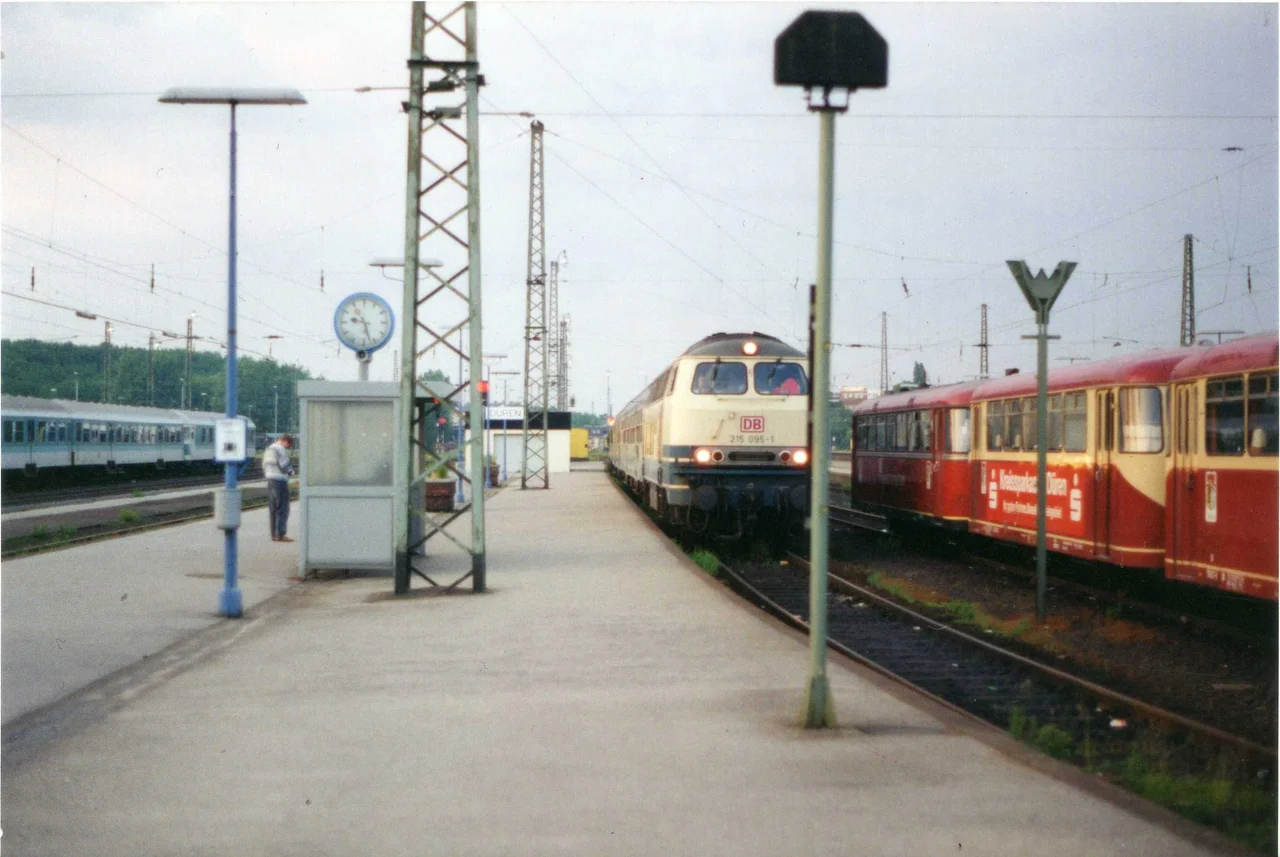
On the evening of 27 May 1995, the last passenger train pulled into Düren station from Bedburg. The platform loudspeaker did not pause for the occasion. It simply announced: Düren, hier Bahnhof Düren, Gleis 19. Verspätet eingefahrener Nahverkehrszug endet hier. Late-arrived commuter train ends here. Twenty-five kilometres up the line, at Bedburg and Elsdorf, the same train had passed through to cheering crowds, speeches, and the kind of emotional public farewell Rhinelanders give to things they have loved for generations. A few months later, the rails between Düren and Bedburg came up, and within a few years a great deal of the land they had crossed was gone, dug away by one of the largest lignite mines in Europe.
The Cross-Connection
The Neuss-Düren line opened on 1 September 1869, built by the privately owned Rheinische Eisenbahn-Gesellschaft (the company would be nationalised in 1880). Its purpose was practical: link the two main Aachen-bound lines, the northern route from Düsseldorf through Mönchengladbach and the southern route from Cologne, with a single cross-country track running north to south through the Rhenish lowlands. The line came first, the towns adapted around it. Grevenbroich station, where the new Düren-Neuss line crossed the later Mönchengladbach-Cologne main line, ended up oriented north-south because the Düren-Neuss tracks reached it first; the east-west line, built between 1889 and 1899, had to swing through a long S-curve to meet the platform. By the time the Second World War broke out, about half the trains on the Düren-Neuss line carried on to Düsseldorf Hauptbahnhof, and on Sunday mornings a pair of excursion trains ran from Düsseldorf to Heimbach in the Eifel hills, calling at every station that mattered.
An Accident That Shouldn't Be Forgotten
Early on the morning of 5 September 1937, a special pilgrim train left Rommerskirchen carrying eight hundred people bound for Kevelaer, one of the great Marian shrines of the Lower Rhine. The train derailed in Holzheim station. Seventeen pilgrims were killed. Eighteen more were seriously injured. The cause is buried in old railway files; the result is part of the line's long quiet history of people moving across the Rhineland for work, for school, for prayer, for a day out, and occasionally not arriving where they meant to.
Forty Years of Compromise
After the war the timetable was rebuilt slowly, but the Düren-Neuss line was always slightly inconvenient. It was mostly single-track. Two stations between Bedburg and Grevenbroich were regularly skipped not for speed but to let trains clear sections before opposing services arrived. Through the 1950s and 60s a Saturday motorail service to Avignon trundled across the line behind a fast Class 03 steam locomotive, because the route was the only one available where neither the parallel main line via Cologne nor the line via Mönchengladbach had yet been electrified. From the mid-1970s to 1988, an ore train weighing more than 1,000 tonnes rumbled several times a week from Neuss to the smelter at Weisweiler, hauled mostly by diesels and occasionally rerouted via Cologne so it could use overhead wires. Until at least 1993, battery-powered accumulator railcars still slipped between the cities, the strange near-silent traction Germany kept alive longer than anyone else.
The Mine Takes the Line
The end of the southern half came not from declining passenger numbers but from coal. Beneath the Rhenish lowlands lie enormous lignite seams, sometimes 150 metres thick, and from the 1960s onward the Garzweiler and Hambach open-cast mines began to grow. Lignite extraction is brutal to anything on the surface: villages are bought, demolished, and dug up; rivers are diverted; old rail lines are simply unmade. Between Gustorf and Bedburg the line was relocated in 1976 to skirt one mine; the stations at Harff and the briefly-rebuilt Kaster were abandoned in the same wave. By the early 1990s the Düren-Bedburg section was sitting on top of the planned eastward expansion of the Hambach surface mine, and Deutsche Bahn knew it had seven years left. Passenger service ended on 27 May 1995. Freight ended on 31 December 1995. The line was formally closed on 2 June 1996. The Düren-to-Elsdorf section was dredged away into the mine pit; the Elsdorf-to-Bedburg section was lifted and dismantled.
What Survives
From Bedburg north to Neuss the line still works, parts of it now run as the hourly RB 38 between Cologne and Bedburg, with class 628 diesel railcars usually coupled in four-carriage sets. Neusser Eisenbahn freight trains still carry gypsum, lime and brown coal dust between Neuss and Gustorf, supplying RWE's power stations. Düren station itself, once the meeting point of state railway lines running in six directions, still has its heritage-listed turntable from the days when locomotives had to be turned around to head north. The platforms that once served the Bedburg trains (tracks 17 to 19) are gone, but you can still trace where they stood. The line through Elsdorf is being converted into a park for cyclists and walkers. The lignite mines themselves are now winding down. Whether the line will ever return is a question for the next century.
From the Air
Düren-Neuss line, approximately 51.09 N, 6.58 E at the Grevenbroich crossing point. The surviving northern segment runs along the Erft river from Bedburg to Neuss through visibly flat agricultural land. Look for the massive open scars of the Garzweiler and Hambach surface mines just east and south of the abandoned southern alignment; these are visible from cruising altitude. Düsseldorf (EDDL) is 25 km north-northeast. Cologne/Bonn (EDDK) is 35 km southeast.
Nearby Stories
- Kunstmuseen Krefeld 3.9 km away
- Krupp Decoy Site 4.8 km away
- Doppelkirche Schwarzrheindorf 8.1 km away
- Hombourg, Belgium 9.5 km away
- Unterburg trolleybus turntable 12 km away
- Wessem-Nederweert Canal 13 km away
- Schevenhutte Quarry 13 km away
- Ysselsteyn German War Cemetery 17 km away