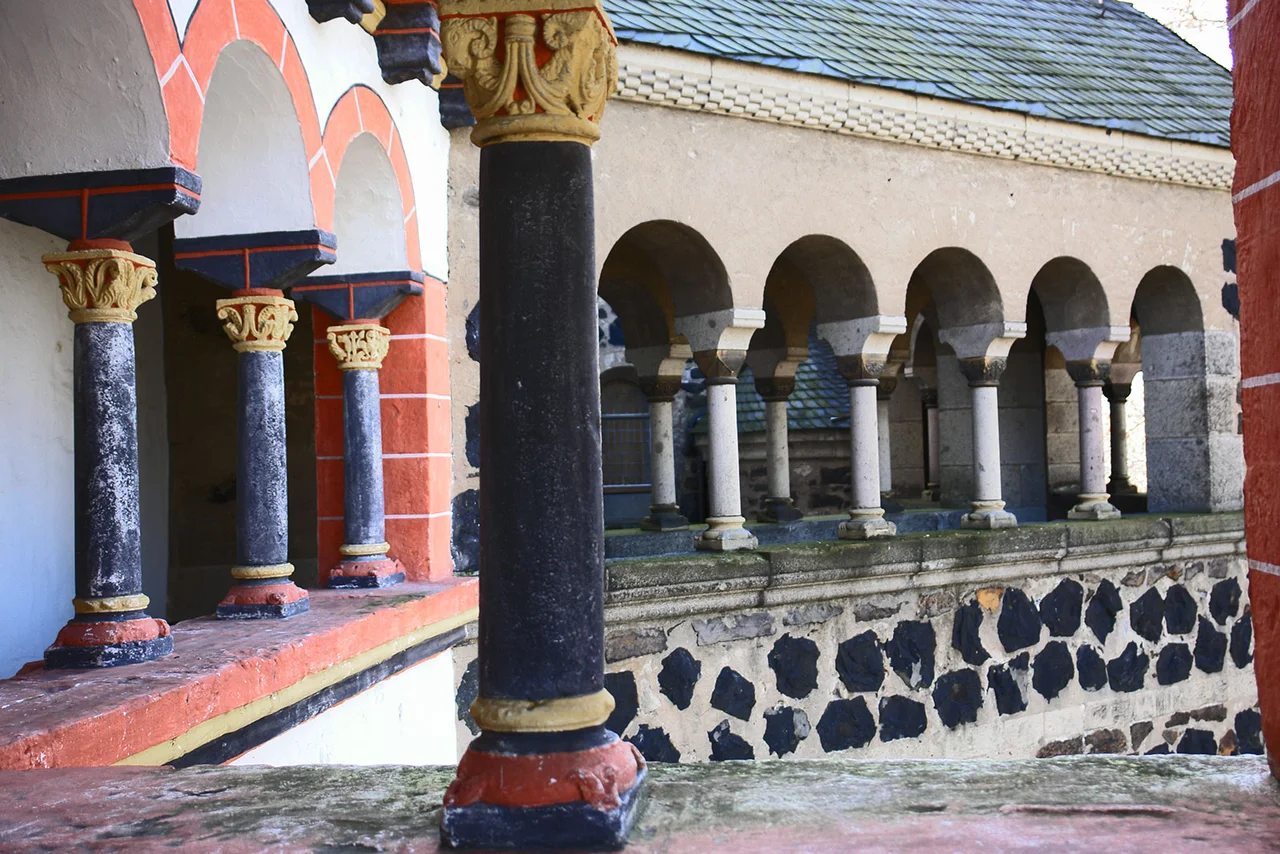

Doppelkirche Schwarzrheindorf
Two churches occupy the same building at Schwarzrheindorf, one above the other. The lower church, dedicated to Pope Clement I, is where the commoners attended Mass. The upper church, dedicated to the Virgin Mary, was reached only from an external staircase and was reserved for the noble members of the religious community - the count's family, and later the noble canonesses. Inside the upper chapel, Arnold of Wied, the archbishop who built the place, and his sister Hadwig are painted on a wall lying face down on the ground, beneath Christ in Majesty. A nobleman who could afford to commission an entire double church chose to be depicted prostrate.
Arnold's Chapel
Arnold of Wied was provost of three of the most important churches in the Rhineland - Limburg Cathedral, Cologne Cathedral, and the Basilica of Saint Servatius at Maastricht in what is now the Netherlands. He came from the Wied family, who owned a castle adjacent to the church site at Schwarzrheindorf on the right bank of the Rhine north of Bonn. Archaeological work on the ground around the chapel has confirmed the castle's footprint. The Doppelkirche was probably built as his private chapel, dedicated in 1151 in the presence of King Conrad III of Germany. The same year, Arnold became archbishop of Cologne - one of the most powerful ecclesiastical positions in the Holy Roman Empire, with the right to vote for the king. He held it for only five years before he died in 1156. After his death, his sister Hadwig of Wied turned the buildings into a Benedictine monastery for nuns. Hadwig was already abbess of Gerresheim and Essen Abbey at the time. Two of her other sisters joined the new community. The Doppelkirche, originally a count's chapel, had become a women's religious house run by one of the most well-connected families in the Rhineland.
The Architecture
The Doppelkirche was originally designed as a Zentralbau - a centrally planned building without a nave - following the example of the Palatine Chapel at Aachen, which Charlemagne had built around 800 and which set the architectural template for German imperial chapels for the next several centuries. It has a tall crossing tower and what is called a dwarf gallery: a row of small open arches running around the upper part of the building, encircling not just the apse but both transepts as well. This is unusual. The Romanesque carved capitals on the gallery columns are closely related to capitals on the Basilica of Saint Servatius at Maastricht, where Arnold had previously sponsored an extensive building campaign as provost. The same stonemasons - or stonemasons trained by the same workshop - travelled with the work. The dwarf gallery is reached only by an external staircase, which is the architectural feature that made the double-church arrangement possible. Nobility climbed up. Commoners stayed in the church below.
The Class System Built In Stone
The upper church was the gallery. The noble residents of the religious community - originally Arnold's family, later the female canonesses who replaced the Benedictine nuns in the centuries after - could attend Mass without ever mixing with the local population. They came up the outer staircase, into the upper church dedicated to the Virgin Mary, and worshipped above. The commoners worshipped in the lower church, dedicated to Pope Clement I. Both groups heard the same Mass said at the same altar; both received the same sacraments. They simply did not have to occupy the same air. The medieval Rhineland was a deeply hierarchical society, and the Doppelkirche makes the hierarchy architecturally explicit. There are very few well-preserved double churches surviving anywhere from the High Middle Ages. This is one of them. After the monastery became a noble stift - a collegiate body for unmarried noble women - in the later medieval period, the same vertical class division continued. The stift was dissolved in 1803. The church was used for secular purposes for the next sixty-five years until it became a regular parish church in 1868.
The Hidden Frescos
The most extraordinary feature of the building is that it still has its original interior. The twelfth-century frescos covering the walls of both churches are largely intact. They were hidden under a layer of white plaster for a few decades in the early nineteenth century and rediscovered in 1863, when restorers chipped through the plaster and found a complete program of medieval painting underneath. The subject matter follows the teachings of two important twelfth-century theologians - Rupert of Deutz, who had founded the influential Benedictine monastery just down the Rhine, and Otto of Freising, the historian-bishop whose chronicle of the world the Hohenstaufen emperors had read attentively. In the upper church, Christ in Majesty - the Majestas Domini - looks down from the apse. Below him, painted on the floor of the picture program, Arnold of Wied and his sister Hadwig are shown stretched out face down, a deliberate iconographic gesture of humility on the part of the most powerful man in Cologne. The recent decision to plaster the building's exterior white was made on the evidence that this is probably what the twelfth-century church originally looked like. The frescos inside, however, were never meant to be hidden.
From the Air
The Doppelkirche stands at 50.7507 degrees North, 7.1150 degrees East, on the right (eastern) bank of the Rhine in the Schwarzrheindorf neighborhood north of central Bonn. Nearest airport is Cologne Bonn (EDDK / CGN), 18 km north. The building is best identified from the air by its compact central plan with a tall crossing tower and a small white plastered exterior - distinctive against the surrounding suburban residential streets. The Beethovenhalle and old town are about 3 km southwest across the Rhine.
Nearby Stories
- Marienstatt Abbey 5.7 km away
- Baumwollspinnerei Ermen & Engels 14 km away
- Düren-Neuss railway 15 km away
- Operation Chastise 15 km away
- Battle of Hurtgen Forest 22 km away
- Zwingenberg Castle 147 km away
- Basilica of Saint-Pierre-aux-Nonnains 153 km away
- Fort Jeanne d'Arc 169 km away