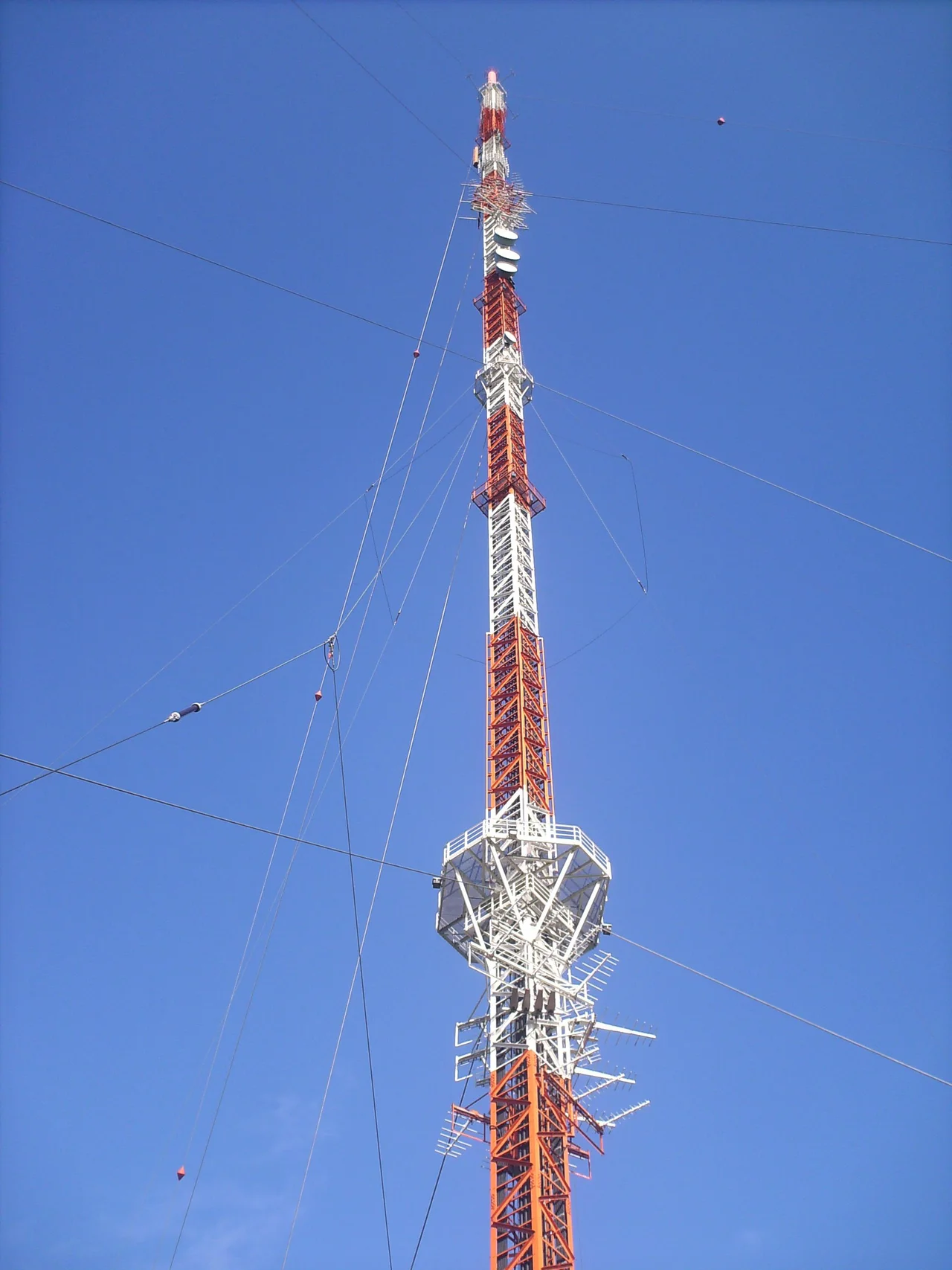

Langenberg Transmission Tower
On 15 January 1927, a transmitter went on the air in the village of Langenberg in the hills above the Ruhr. It pushed 60 kilowatts through a wire stretched between two 100-meter steel towers, and from that night forward the radio voices of western Germany had a home. Nearly a century later, the tower is still there - a different tower, the fifth or sixth iteration depending on how you count - and the broadcasts continue. The history of the site reads like a melodrama: tornado, sabotage, war, collapse, rebuild, collapse, rebuild. Everything that can go wrong at a radio mast has gone wrong here, and the music has barely stopped.
The Tornado of 1935
The first replacement came quickly. In 1934, the original T-aerial was scrapped and a single 160-meter wooden-framework tower took its place. Power doubled to 100 kilowatts. Then on 10 October 1935, a tornado tore through Langenberg - a real tornado in the German hills, rare and devastating - and brought the wooden tower down. A triangular three-mast aerial went up in December of the same year. In 1940 a 240-meter insulated guyed steel mast joined the array. Five years after that, in the closing days of the war, SS-Postschutz troops dynamited the entire installation on 12 April 1945 to keep it out of Allied hands. By the end of April 1945, central Europe's largest broadcasting site was a tangle of steel.
Red Star, Removed Same Day
Even in the calm years, the politics found the place. In the early 1930s, with Weimar Germany unraveling, communist underground groups in the Ruhr tried more than once to hijack the line from the broadcasting studio to the Langenberg transmitter. The plan was straightforward: intercept the audio feed and substitute their own propaganda, broadcast at 100 kilowatts across western Germany. Each attempt failed. But one group did manage to climb a tower and attach a red star to the top - a small, symbolic act of broadcasting defiance. Technicians spotted it and removed it the same day. The episode is a useful reminder that radio transmitters have always been political infrastructure: whoever holds the mast holds the voice that reaches every kitchen radio in the region.
The 1586 Frequency
After the war, the British occupation forces rebuilt. Two triangular aerials on six 50-meter masts went up first, then in 1948 a 160-meter mast for AM, then in 1949 a 120-meter mast, then in 1952 a 210-meter mast for FM and TV. By the mid-1960s the AM transmitter had been pushed up to 800 kilowatts and tuned to 1586 kHz, a frequency so clear that night-time listeners in the United States picked up the signal - West German radio crossing the Atlantic on a single hop of the ionosphere. The Geneva Frequency Plan of 1975 took that clear channel away and moved the station to 1593 kHz, which other broadcasters were using, and interference problems followed. In compensation, WDR got a second medium-wave frequency at 720 kHz, but only for daytime use.
Collapse, Twice
In 1988 the site was reorganized around a single new 301-meter guyed steel mast, replacing both the 95-meter AM mast and the 210-meter FM/TV mast. For a while this was the tallest structure in Germany, with a cage aerial wrapped around its lower sections for medium-wave broadcasting. The shorter 160-meter mast stayed in service. Then in 1996, during renovation work, an auxiliary guy rope tore. On 2 September 1996 the 160-meter mast collapsed. After the collapse, the AM transmitter was throttled back to 20 kilowatts. A replacement 170-meter mast was planned, construction began in 1999, and engineering problems delayed it until July 2000. Once it was inaugurated, AM power could climb back up to 85 kilowatts. The 301-meter mast still stands, doing FM and digital TV duty alongside its shorter neighbor.
Why a Hill in Velbert
The Langenberg site exists because of geography. The Westdeutsche Funkstunde, in 1926, was looking for a hilltop that could blanket the Ruhrgebiet with a clean AM signal - and the ridge above Velbert, at roughly 300 meters elevation, was the highest practical site in the western Rhineland with road access and electrical infrastructure. From here, signals reach Duesseldorf, Cologne, Essen, Dortmund, and on a clear night much of the Netherlands and Belgium. Westdeutscher Rundfunk - WDR, one of the largest broadcasters in Europe - operates the station today. Stand at the base of the 301-meter mast and look up: the guy wires sweep outward, the central steel framework climbs into haze, and the same site that survived a 1935 tornado, an SS demolition, a 1996 collapse, and a brief red-star occupation is still pushing music and news into every car radio between the Rhine and the Lippe.
From the Air
Located at 51.36 N, 7.14 E, on the Hordt ridge above Langenberg in Velbert, at roughly 300 meters elevation. The two masts are visible from very long distances - the 301-meter Hordt mast is one of the tallest structures in North Rhine-Westphalia and dominates the southern horizon when approaching the Ruhrgebiet from above. At night, look for the standard red obstruction lights climbing the masts. Nearest major airport: Duesseldorf (EDDL), 22 km west. The mast lies along common arrival routes for EDDL traffic from the east.
Nearby Stories
- Burg Castle (Solingen) 4.1 km away
- Düren-Neuss railway 9.6 km away
- Operation Chastise 9.7 km away
- Krefeld Zoo 10 km away
- Festspiele Balver Höhle 13 km away
- Lembeck Castle 16 km away
- Haldern Pop 18 km away
- Warendorf 35 km away