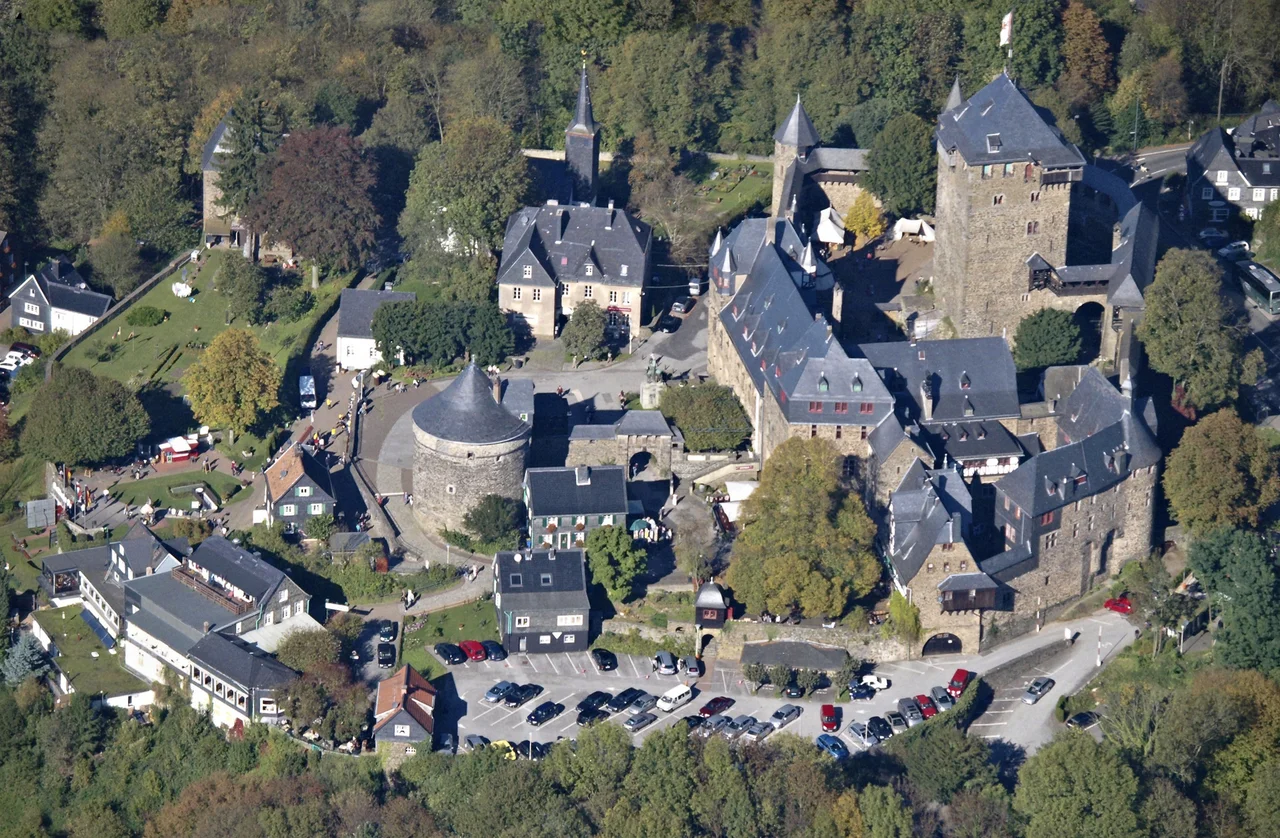

Burg Castle (Solingen)
There is a whole region of Germany — the Bergisches Land — that takes its name from a single noble family, and that family took its name from a single mountain, and on that mountain stands the castle. The Counts of Berg built Schloss Burg above the Wupper river sometime after 1133, abandoned their old seat at Berge near Altenberg, and from this hilltop ran a dynasty that would eventually rule Düsseldorf, marry into the Tudors, and survive almost every catastrophe except an electrical fire in November 1920. Burg is the rare medieval castle whose name is shorthand for an entire landscape, and the entire landscape is shorthand for a family that has been gone for centuries.
From Berge to Berg
Count Adolf III of Berg made the move shortly after 1133. The family's old castle at Castle Berge in Odenthal, near what would become Altenberg Abbey, was abandoned for a new site on a steep mountain above the Wupper. The new castle's first name was Castle Neuenberge — Newmountain — and in Latin documents it appeared as novus mons or novi montis castrum. Adolf VI of Berg died in 1218 during the siege of Damietta in Egypt, part of the Fifth Crusade. He left no son. His younger brother, Archbishop Engelbert I of Cologne — who would become Count Engelbert II of Berg — fought two feuds with Duke Waleran III of Limburg to secure the inheritance. Then, between 1218 and 1225, he built the great palas, the hall block that made Burg into a true noble residence rather than a fortress.
An Archbishop Murdered by His Cousin
Engelbert II of Berg was, by the standards of his time, almost unimaginably powerful. He was simultaneously Archbishop of Cologne, Count of Berg, chief administrator to the Holy Roman Emperor Frederick II, and guardian and tutor of the future king Henry VII of Germany. Men with that much influence accumulated enemies, and Engelbert accumulated his with particular speed. On November 7, 1225, his own cousin, Friedrich von Isenberg, killed him in an ambush near Schwelm. The murder shocked Christendom. Friedrich was executed the following year — broken on the wheel in Cologne. A monument to Engelbert by the sculptor Paul Wynand was placed at Burg in 1929. He had built much of the castle that today commemorates his violent end.
Worringen and a Wedding
Sixty years after Engelbert's death, Count Adolf VIII of Berg fought at the Battle of Worringen on June 5, 1288 — the decisive Limburg-succession battle that ended Cologne archbishopric power along the lower Rhine. The defeated Archbishop Siegfried II of Westerburg was brought to Burg as a prisoner. Adolf VIII used the moment to elevate his town of Düsseldorf to a city, taking control of Rhine traffic. Burg remained the family's main residence into the fourteenth century. In 1380, King Wenzel made the count of Berg a duke; five years later, the capital of the new Duchy of Berg moved down to Düsseldorf. Burg shifted to a hunting castle and ceremonial seat. In 1496, the child Maria of Jülich-Berg was engaged to John of Cleves; their wedding fourteen years later at Burg merged the duchies into Jülich-Cleves-Berg. Their second daughter, Anne of Cleves, would briefly marry Henry VIII of England before being unceremoniously divorced.
Two Fires and a Restoration
The Thirty Years' War caught up with Burg in 1632, when Swedish soldiers laid siege. In 1648, after the war ended, Imperial troops methodically demolished the castle's defenses — keep, walls, gates. Partial rebuilding in 1700 turned what remained into local administrative offices. By 1849 the structure was so derelict it was sold to be scrapped. Then in 1882, the architect Gerhard August Fischer of Barmen proposed a full reconstruction based on sixteenth-century drawings. From 1890 onward a committee oversaw a twenty-four-year restoration, with painters from the Kunstakademie Düsseldorf decorating the interior. The Battery Tower went up in 1914. Then, on the night of November 26, 1920, a great fire destroyed much of the rebuilt castle. They rebuilt it again, between 1922 and 1925, with paid admissions covering the costs. The Burg you visit today is the second reconstruction, foreshadowing in some ways the rebuilding ethics of the Bauhaus era then taking shape down the Rhine.
Burg Today
Schloss Burg is now the largest reconstructed castle in North Rhine-Westphalia and a major tourist attraction. It houses the Museum of the Bergisches Land, a memorial to the deportations of the twentieth century, and the Memorial of the German Eastern Provinces — preserving bells from Königsberg and Breslau as relics of vanished communities. The castle church is a favorite for weddings. Hiking trails radiate out into the surrounding forests. Down at the foot of the mountain lies the village of Unterburg, where you can buy the Burger Brezel — a local pretzel specialty with its own monument to the pretzel bakers. A chairlift connects village to castle. And the name itself, Schloss Burg, is a small linguistic joke: Schloss means representative palace and Burg means fortification, so the full name reads roughly palace-castle. A tautology in one direction and an oxymoron in the other, perfectly capturing a building that has been both for almost nine hundred years.
From the Air
Burg Castle sits at 51.1376°N, 7.1528°E, above the Wupper river in the Solingen district, with the village of Unterburg tucked into the gorge below it. From the air, look for the dramatic slate-roofed castle on a wooded mountain spur, with the river curving sharply around its base. The Wupper valley is one of the most distinctive features of the Bergisches Land terrain. Düsseldorf airport (EDDL / DUS) is 25 km northwest. Cologne/Bonn (EDDK / CGN) is 35 km south. For VFR pilots, the castle is a striking visual landmark when transiting between Düsseldorf and the Sauerland.
Nearby Stories
- Michaelsberg Abbey, Siegburg 0.6 km away
- Krefeld Zoo 5.7 km away
- Langenberg Transmission Tower 5.8 km away
- Düren-Neuss railway 7.6 km away
- Operation Chastise 7.9 km away
- Festspiele Balver Höhle 9.6 km away
- Marienstatt Abbey 14 km away
- Battle of Hurtgen Forest 25 km away