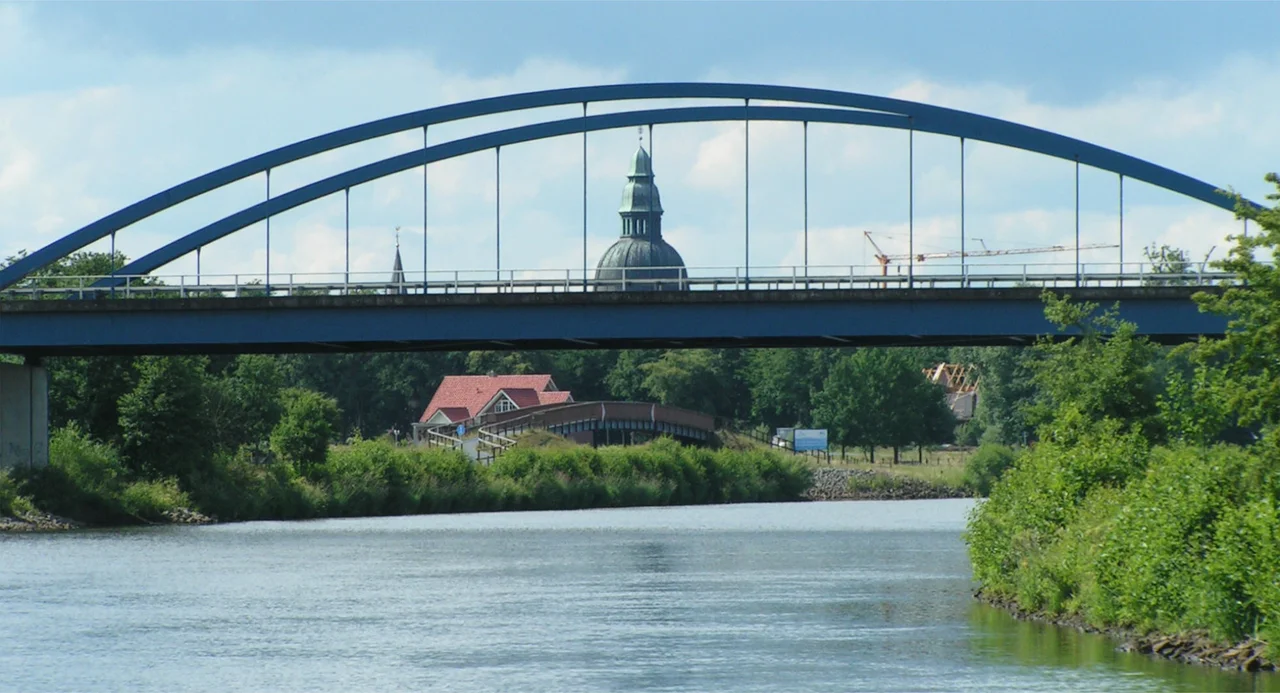

Haren, Germany
On 19 May 1945, eleven days after the German surrender, every German family in the small Emsland port town of Haren was given a few hours to pack and leave. The Polish 1st Armoured Division, attached to the British Army, moved them out to surrounding villages and moved roughly four thousand Polish displaced persons in. By the end of the day, the streets had been renamed in Polish, the town had a Polish mayor, and the welcome sign read Lwów — the name of a Polish city far to the southeast that Stalin had just annexed. Within a few months, under Soviet pressure, the name was changed to Maczków, in honor of the Polish general whose troops now occupied the place. For three and a half years, Haren was not Haren. It was a Polish town in northern Germany, occupied by people who had nowhere else they were allowed to go.
A Thousand Years on the Ems
Haren first appears in writing around the year 890, in a register of properties belonging to Corvey Abbey in faraway Westphalia. By 1150 there were two settlements — Neuharen and Altharen, New Haren and Old Haren — clustered on opposite sides of a castle that the Bishop of Münster bought from Duchess Jutta von Ravensberg in 1252. The town was almost destroyed during the Thirty Years War, then rebuilt as a river port on the Ems, where its citizens spent the next three centuries trading grain and other goods downstream. By 1935 there were 205 ships registered to Haren. The town's identity as a port survived two world wars, but its identity as a German town did not survive May 1945.
The People Who Needed Somewhere
At the end of the war, more than three million Polish citizens were stranded in occupied Germany. Most were displaced persons — DPs in the bureaucratic shorthand — and most had been brought to Germany against their will. Some had been forced laborers in German factories and farms. Some had survived German concentration camps. Some were former prisoners of war, including members of the Polish Home Army who had fought in the Warsaw Uprising of 1944 only to be marched into German captivity when the rising collapsed. Now the war was over. Poland was in the process of becoming a Soviet satellite, with its prewar eastern half annexed by the USSR and its borders shifted westward. Returning home was, for hundreds of thousands of these Poles, neither obviously safe nor obviously possible. They needed a place to gather, organize, and decide. The Allied authorities decided to give them one.
Evicting Haren
Haren happened to lie inside the British occupation zone, in a sub-sector administered by General Stanisław Maczek's Polish 1st Armoured Division. That made it the most convenient place to set up a Polish civilian enclave. The order to clear the town came down to the German residents — perhaps a thousand families — with very little notice and no real appeal. They left their homes carrying what they could and were resettled in nearby villages where local farmers and townspeople had to make space for them in already crowded households. Their loss was real. The houses had been theirs for generations. The Polish families moving in had also lost everything, and for many of them the trauma was fresher and more violent, but the German residents of Haren were also paying a price they had not personally chosen. Both groups deserved more than the chaos of postwar Europe was able to give them.
Maczków: A Polish Town in Germany
The new arrivals named the town Lwów at first, after the city in southeastern Poland that the Soviet Union had just absorbed. The name was a quiet protest. Under Soviet diplomatic pressure, it was changed to Maczków, after General Maczek, whose troops were physically responsible for the enclave. The streets took Polish names — Legionów Street, Artyleryjska Street, an Ujazdowskie Avenue borrowed from Warsaw. The Polish residents elected a Polish mayor, opened a Polish school and a folk high school, set up a Polish fire brigade and a Polish Catholic rectory. The rectory registered 289 weddings and 101 funerals during the enclave's three years. Four hundred and seventy-nine babies were born holding birth certificates that named Maczków as their place of birth — a town that, by the time those babies could read their own papers, no longer existed under that name.
Britten and Menuhin in the Concert Hall
Maczków was not only a refugee processing center. It became, briefly, one of the most vital Polish cultural centers in Europe. With hundreds of thousands of Poles administered by the 1st Armoured Division in northwestern Germany, the enclave published daily newspapers — Dziennik and Defilada eventually reached ninety thousand copies. The renowned director Leon Schiller ran a theater. Concert halls operated. In 1947, the English composer Benjamin Britten and the violinist Yehudi Menuhin performed there together, on a tour Menuhin organized specifically to play for displaced persons in the aftermath of the camps. It was an act of moral attention: two of the great musicians of the century, walking into a German town renamed for a Polish general, to play for Polish survivors of Nazi Germany. The audience that night had earned every note of it.
Going Home, On Both Sides
By autumn 1946 the Polish soldiers of the 1st Armoured Division were being demobilized and shipped to the United Kingdom, which had agreed to take them in rather than return them to a Soviet-aligned Poland. The civilian DPs of Maczków began making their own decisions — some returned to Poland under repatriation programs, some emigrated to Britain, Canada, Australia, the United States, or other Western countries that opened limited quotas. By the end of 1948, the enclave was wound up. The town was handed back to its German residents and renamed Haren. The Germans returned to homes that had been lived in by other people for three years. The Poles dispersed across continents, carrying birth certificates that listed a place no map would ever show again. Haren today is twinned with the Polish town of Międzyrzecz, a small civic reminder of the years when this Emsland port spoke Polish.
From the Air
Coordinates 52.79 N, 7.24 E, on the Ems River in the Emsland district of Lower Saxony, very close to the Dutch border. View from 2,500 to 4,000 feet — the town stretches along the east bank of the Ems, with the Haren-Rütenbrock canal (built by French POWs after 1871) visible running eastward. The river is the dominant landscape feature; the port facilities and waterfront are still active. Look for the historic core where Altharen and Neuharen merged in 1956. Nearest airports: Groningen Eelde (EHGG) to the northwest, Münster/Osnabrück (EDDG) to the south. Terrain is flat Ems valley, near sea level (5–15 meters), maritime climate with frequent low cloud and rain.
Nearby Stories
- Museum de Oude Wolden 4.3 km away
- 1977 Dutch Train Hijacking 4.8 km away
- Westerbork 5.6 km away
- Wietmarschen 5.8 km away
- Vriezenveen 17 km away
- Cloppenburg (district) 18 km away
- Alfsee 18 km away
- Bad Zwischenahn 21 km away