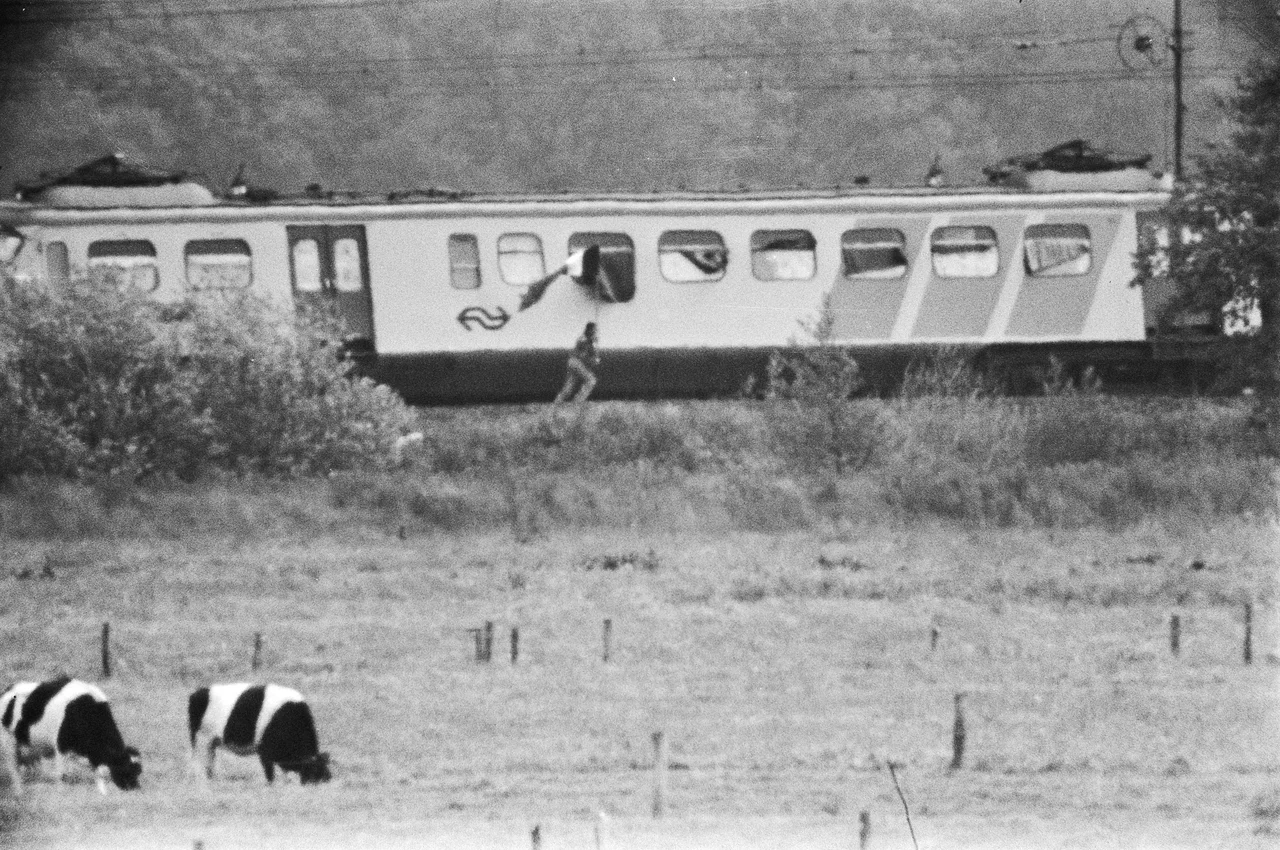

1977 Dutch Train Hijacking
It was a Monday morning, just after nine. The train from Assen to Groningen, pulling its weekday load of commuters, students and shoppers, crossed a stretch of flat farmland near the village of De Punt when someone pulled the emergency brake. Nine young men, all of them Dutch citizens born to Moluccan families, stood up with automatic weapons and announced that the carriages now belonged to the Republic of South Maluku. Behind covered windows, in the heat of a Drenthe spring, fifty-four passengers would spend the next twenty days listening to negotiations they could not hear and waiting for a resolution no one knew how to reach.
The Quarrel That Started in Java
To understand the train, you have to start with a colonial army that no longer existed. The Royal Netherlands East Indies Army was disbanded on 26 July 1950 after Indonesian independence, but its Moluccan soldiers, who had fought on the Dutch side, were considered loyalists by the new republic and refused permission to return to their home islands. The Netherlands evacuated them and their families to camps in the Dutch countryside, with the promise that the arrangement was temporary and that the dream of an independent South Maluku would soon be revisited. It never was. By the 1960s the Dutch government had quietly shifted to a policy of permanent resettlement, leaving the older generation feeling stranded and the second generation, born in unfamiliar towns under a grey northern sky, increasingly bitter. The hijackers of 1977 were almost all of that second generation.
Twenty Days at the Edge of a Field
About forty passengers, including the train crew, were released in the first hours. The remaining fifty-four were forced to help paper over the windows so that no one outside could see in. Warning shots were fired to encourage compliance. Twenty kilometers away, a parallel cell of Moluccan militants had taken roughly a hundred children and teachers hostage at a primary school in Bovensmilde the same morning, and the country watched both crises with held breath. The 1977 general election campaign was suspended. The Den Uyl cabinet refused most of the demands, including the release of imprisoned Moluccan activists and a Boeing 747 to fly the hijackers out. Two pregnant hostages were released as a goodwill gesture on 5 June. The hijackers, increasingly frayed by exhaustion and the failure of their plan, threatened more than once to start killing everyone on board. Two well-respected community mediators, including Josina Soumokil, the widow of the Moluccan independence leader Chris Soumokil, walked back and forth between the train and the crisis team.
The Assault
On the morning of 11 June, six Lockheed F-104 Starfighter jets thundered over De Punt at low altitude while demolition charges went off near the train. The noise was meant to disorient the hijackers in the seconds before Dutch marines, drawn from the secret counter-terror unit later known as M-Squadron, stormed the carriages. The assault lasted minutes. When it ended, six of the nine hijackers were dead. Two of the hostages, Hans Prins and Bert Bierling, were also killed; in the chaos and the dim light behind papered windows, the marines could not tell quickly enough who was who. The surviving hijackers were arrested, tried, and sentenced to between six and nine years in prison. An accomplice received a one-year sentence.
Wounds That Outlived the Day
The deaths did not end the story. In 2007 around six hundred people attended a memorial for the dead hijackers, an event that itself stirred old arguments. In 2013 the journalist Jan Beckers and the former hijacker Junus Ririmasse argued that three, and possibly four, of the dead had still been alive when the marines went in, and had been executed at close range. In November 2014 reports surfaced that Justice Minister Dries van Agt had allegedly ordered military commanders to leave no hijackers alive. A government investigation that same month rejected the specific claim of summary execution but concluded that unarmed hijackers had been killed by marines during the storming. In 2018 a Dutch court ruled that the state did not owe damages to the families of two killed hijackers, a ruling upheld on appeal on 1 June 2021. The Moluccan community in the Netherlands, then and now, holds many of these conclusions in painful suspense.
Standing at De Punt
Today the spot is unmarked by anything dramatic. Trains still pass on the same line between Assen and Groningen, slowing as they curve through a meadow where, for three weeks in the spring of 1977, the country could speak of almost nothing else. The Moluccan community remains a quietly distinct strand of Dutch life, with its own churches and neighborhoods in places like Bovensmilde, Assen and Vught. The Republic of South Maluku still has a government in exile, with no territory and no obvious path home. Hans Prins and Bert Bierling lie in their hometowns. The young men who hijacked the train lie in theirs. The land between Assen and Groningen, flat and unmoved, holds the memory of all of them.
From the Air
Located at 53.12 N, 6.63 E on the rail line between Assen and Groningen, near the village of De Punt in the municipality of Tynaarlo. From cruise altitude the area reads as flat farmland and small stands of forest crisscrossed by the A28 motorway and the parallel rail corridor. Nearest airports: Groningen Airport Eelde (EHGG) immediately to the northwest, Munster/Osnabruck (EDDG) about 130 km southeast. The Drentsche Aa nature reserve lies just east of the rail line.
Nearby Stories
- Hooghalen train crash 2.6 km away
- Winschoten 2.7 km away
- Visquard 5.7 km away
- Ypey Mole, Ryptsjerk 7.4 km away
- Zuiderduintjes 11 km away
- Buren, Friesland 12 km away
- Weerribben-Wieden National Park 15 km away
- Bourtange moor 15 km away