
Meyer Werft
Imagine building a cruise ship the size of an aircraft carrier in a hangar so big that the weather inside it has to be managed. Now imagine you finish, the customer is delighted, and you realize the only way out is a river barely wider than the hull, ending 36 kilometers later in the open sea. That is the everyday problem at Meyer Werft, the shipyard founded in 1795 in Papenburg, Lower Saxony, and run for seven generations by the same family. Some of the largest passenger ships afloat - Disney Wishes and Royal Caribbean Quantum-class and Norwegian Breakaways and Princess Royals - were assembled indoors here, then nudged stern-first down the Ems past cows and church steeples and bicycle riders, while thousands of spectators line the dikes to watch what people in Papenburg simply call die Überführung. The conveyance.
Seven Generations on the Same River
Willm Rolf Meyer founded the yard in 1795 as a builder of small wooden vessels. Papenburg was then a peat colony, a chain of canals dug through bogland with the Ems as its main outlet. There were once more than twenty shipyards along these waters. By the time Josef Lambert Meyer began building iron vessels in 1874, the family was already three generations in. The Second World War caught the yard repairing ships for the Kriegsmarine - a chapter the company does not romanticize. After the war, the surviving yards along the Ems closed one by one. Meyer Werft did not. It moved into roll-on/roll-off ferries, gas tankers, livestock ferries, container ships, and eventually the type of vessel that has defined it ever since: the modern luxury cruise ship. Today around 3,300 people work at the Papenburg yard, and the Meyer family is still at the table.
The Halls You Can See From Space
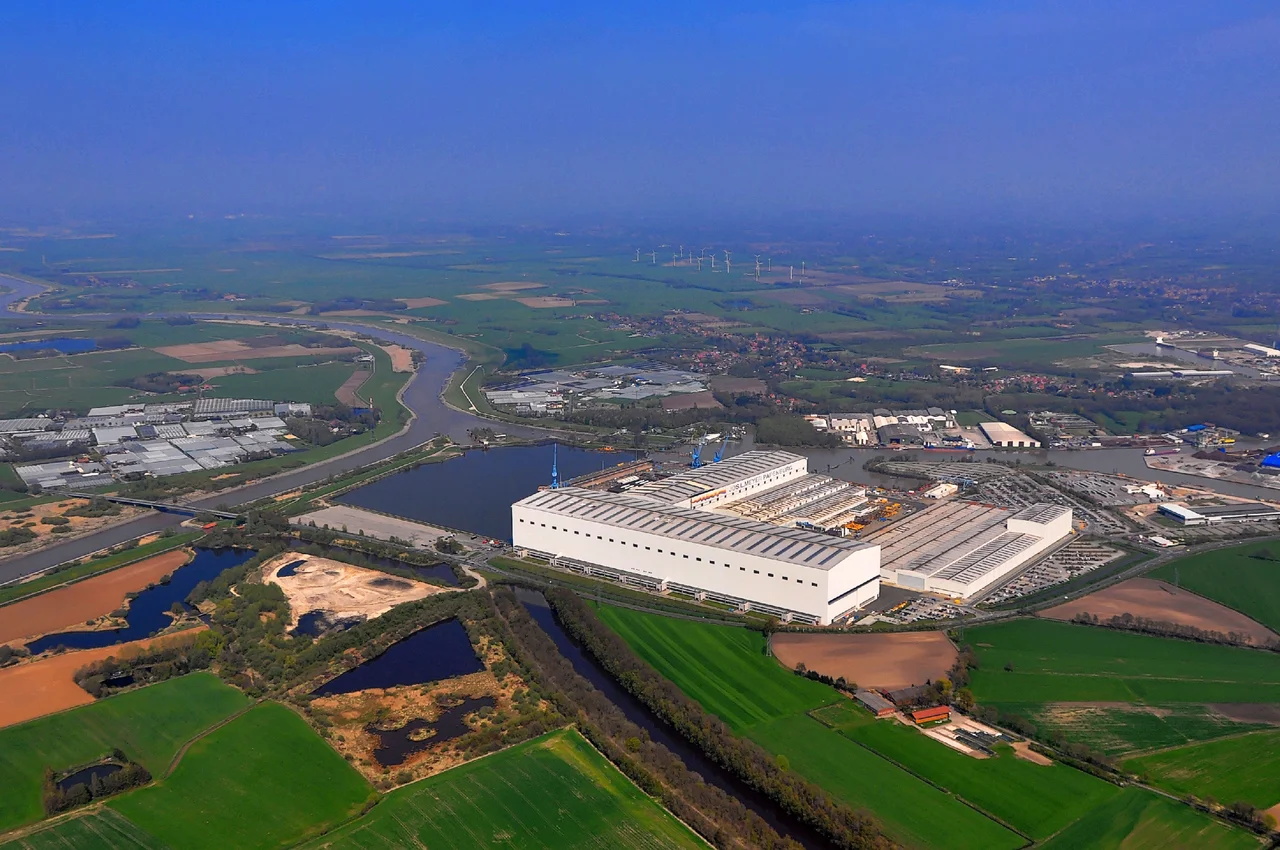
Meyer Werft does almost all its assembly indoors. The first covered dock, inaugurated in 1987, was 370 meters long, 101.5 meters wide, and 60 meters high. In 1990-91 it was extended by another hundred meters. In 2004 a second covered dock was built. The Dock 2 hall is now among the largest enclosed buildings on Earth by usable volume - announced to be extended eventually to a full 504 meters long, 125 meters wide, and 75 meters high, to compete with shipyards in Asia. Inside those halls, sections of hull are welded together under controlled climate conditions, free of rain, snow, and the long Lower Saxon winter. The pace is industrial: when both docks run at capacity, the yard can produce three cruise ships a year. From outside, the buildings are flat-roofed white rectangles. From inside, they are weather systems.
The Conveyance
Building the ship is the half people don't see. Delivering it is the half they do. Each finished hull must travel about 36 kilometers down the Ems to the Dollart bay where it can finally turn and meet salt water. The river, however, is barely wide enough for the ship. The cruise liner is towed stern-first, walked rather than sailed, through curves and under bridges and beneath the high-voltage Ems powerline crossing - which has to be shut off because the ship's funnels are too tall to fit under live cables. Before the Ems barrage was completed in 2002, the trip could only be made on high tides, with brutal timing margins. The barrage, a movable barrier downstream, now lets engineers dam the river to raise the water level on demand. The transit still takes the better part of a day. Spectators camp along the dikes. Cars line the country roads. Children are taken out of school. Each conveyance is its own event.
A Family Yard Becomes a National Question
The COVID-19 pandemic hit the cruise industry harder than almost any other sector. Orders thinned. Energy and materials prices climbed. By 2024 Meyer Werft needed around €2.6 billion to finish the ships already on its books and could not raise it from banks. The German federal and state governments were asked to step in. Chancellor Olaf Scholz declared the shipyard systemically relevant in mid-August 2024 and signaled willingness to help. On 16 September 2024, contracts were signed: the federal government and the state of Lower Saxony together took roughly 80 percent of the company for €400 million, with a credit guarantee package of around €2.6 billion behind it. The justifications were a mix of jobs - thousands of them in a structurally weak region - and a quietly stated military argument that Papenburg's enormous halls could, if Europe ever needed them to, also build naval ships beyond the range of Russian short-range missiles in Kaliningrad. A week after signing, German auditors discovered that Meyer Werft had not been producing monthly financial statements at all. The state had effectively bought a company without anyone fully knowing the numbers.
What the River Holds
Underneath the rescue plans and the cruise contracts and the great white hulls inching down the Ems, the Papenburg yard remains what it has been for two and a quarter centuries: a place where families spend whole working lives. Many Meyer Werft employees are second, third, or fourth-generation shipbuilders. Their grandparents built ferries; their fathers built tankers; they build floating cities. The yard is now an anchor site on the European Route of Industrial Heritage, an admission that the present is already history. On a normal day, you can stand at the visitor center and look across the basin at a cruise ship under construction - a Royal Caribbean hull perhaps, scaffolded and half-painted, dwarfing the warehouses around it. On the day of a conveyance, you can stand on the dike and watch that ship, finished and unbelievably tall, slide past the steeple of Papenburg's St. Antonius church on its way to a sea it could not, until tonight, see.
From the Air
Meyer Werft sits at 53.10°N, 7.36°E on the south bank of the river Ems in Papenburg, Lower Saxony, about 10 km east of the Dutch border. From altitude the two enormous covered dry docks are unmistakable - flat white rectangles dwarfing the city and visible from far away. Recommended viewing altitude 2,500-5,000 feet. Nearest airports: Groningen Eelde (EHGG) about 55 km west, Bremen (EDDW) about 95 km east, Münster Osnabrück (EDDG) about 110 km south. Follow the Ems channel northwest from the shipyard to see the 36 km transit route the finished cruise ships take through the powerline crossing at Weener to the Dollart bay.
Nearby Stories
- Bourtange moor 3.9 km away
- De Poll 6.7 km away
- Tjaskers in Germany 6.9 km away
- Westerbork 8.2 km away
- Zuiderduintjes 11 km away
- Jever Air Base 15 km away
- Bad Zwischenahn 18 km away
- Cloppenburg (district) 20 km away