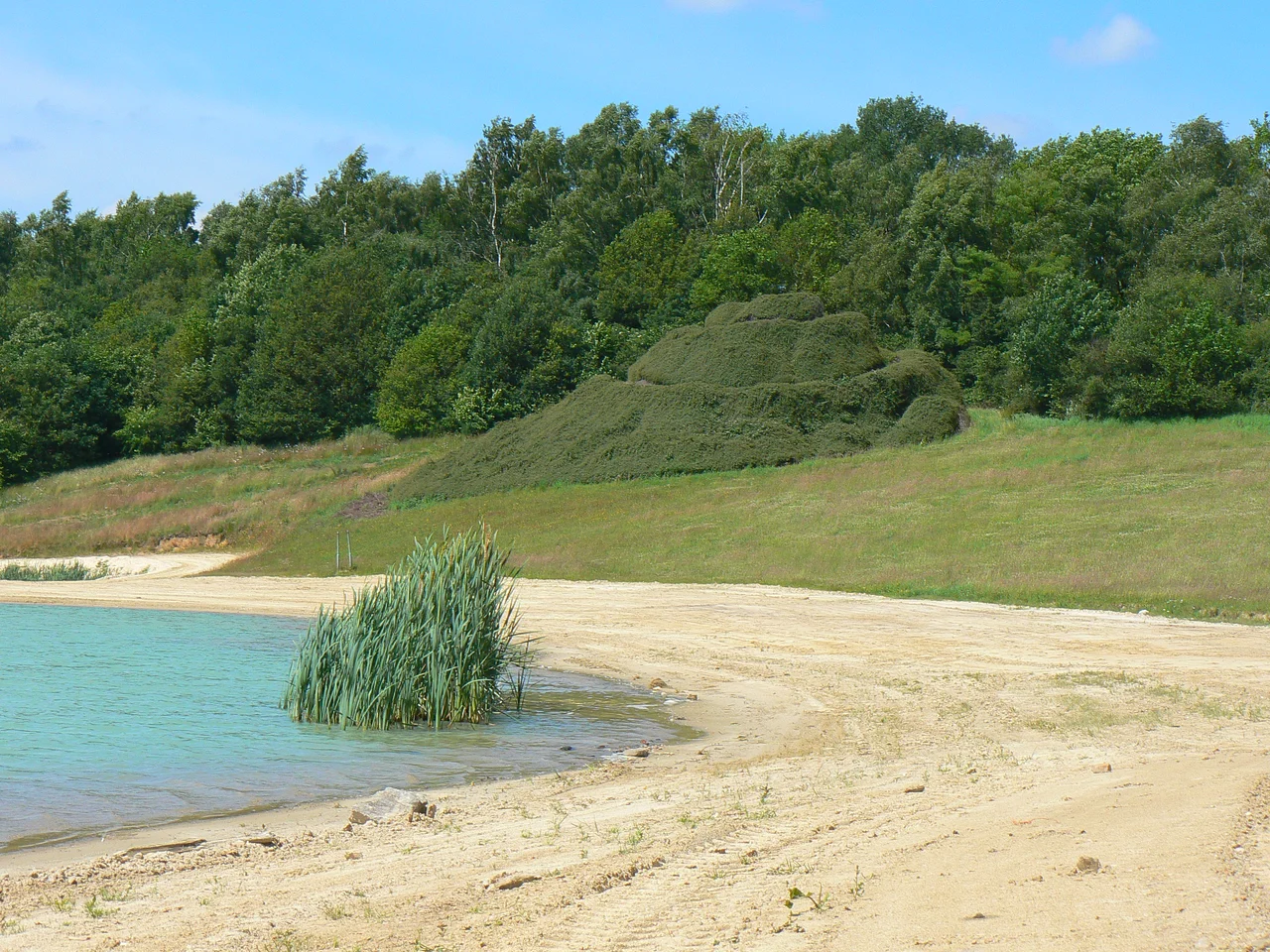

Broken Circle/Spiral Hill
"This is a major work, I want to have good reproductions in magazines. I want the piece to remain forever. Please help!" Robert Smithson wrote that to Wim Beeren, the Dutch curator of the 1971 Sonsbeek exhibition, after finishing the only large-scale earthwork he ever made outside the United States. It sits in a former sand quarry on the edge of Emmen, in the province of Drenthe: a 140-foot circle cut by a canal of yellow and white sand jutting into a flooded pit, and beside it a 75-foot hill spiraling upward in black topsoil and pale sand. He built it the summer after completing Spiral Jetty in the Great Salt Lake, which Smithson had finished in April 1970. Two years later he was dead, killed in a plane crash at thirty-five while surveying another piece in Texas. The Dutch still have his piece. They are still figuring out how to keep it.
Why Emmen
Smithson was fascinated by what he called the constructed landscape of the Netherlands - a country argued out of the sea by dikes and pumps and centuries of stubborn engineering. He was drawn to landscapes that suggested deep time and to landscapes scarred by industry, and he wanted both at once. The De Boer family quarry near Emmen offered them. It was cut into the side of a terminal moraine, a low ridge of glacial debris pushed up by ice sheets during the Saale glaciation. A few kilometers away stood prehistoric stone dolmens - hunebedden - assembled five thousand years ago from boulders the same ice had left behind. The 1953 North Sea flood, which had drowned more than 1,800 Dutch citizens, was still recent memory. Smithson absorbed all of it. He had been working on an unrealized concept called Meandering Canal for the same site, with four oxbow curves and four mounds. The circle and the hill were what remained when he had simplified.
The Accidental Center
When the construction crews started excavating the bed of the Broken Circle canal, they uncovered a glacial erratic - a single huge boulder, dropped by the same ice that built the moraine. It sat exactly where Smithson did not want it. Moving it proved impractical. Removing it would have shifted the entire geometry. So he left it. He took to calling it the accidental center, and in his writing it became a way of talking about the limits of an artist's control over a place. In 2022 an audio documentary about the boulder, narrated by Sonic Youth's Lee Ranaldo, treated it as the work's emotional core: a piece of the Ice Age that decided where the artwork would balance. The boulder is still there. The canal still bends around it.
Centrifugal and Centripetal
Smithson described his two forms as opposites in motion. The Broken Circle in the water, with its straight inner canal slicing the disc and a small jetty extending outward, he called centrifugal - flying apart. The Spiral Hill beside it, climbing inward in a tight curl, was centripetal - drawing together. Together they were meant to decenter the visitor, who walks the hill to look down on the circle and finds that the two forms refuse to settle into a single picture. The scholar Gary Shapiro, in his book Earthwards: Robert Smithson and Art after Babel, described it as the deliberate failure of perspective. You cannot frame both shapes at once. You have to keep moving. Spiral Jetty, finished the year before in Utah, does something similar with a coil that disappears under salt water. Broken Circle/Spiral Hill performs the same trick in a Dutch sand pit, with quarry trucks visible in the distance.
A Gift, Without Instructions
Smithson meant the piece to last. In a 1972 letter he described it as a gift to the Netherlands or the Dutch people. But the practical details - who would mow the slopes, who would pay to dredge the canal, who would replace the sand when the lake water ate it away - he never quite worked out. The De Boer family, who owned the quarry, kept the site for years. The municipality of Emmen planted vegetation on the spiral to slow erosion. Nancy Holt, Smithson's widow and a major artist in her own right, returned in 2011 - the fortieth anniversary - to complete the documentary film the two had begun shooting in 1971 on 16mm stock. The film, Breaking Ground: Broken Circle/Spiral Hill, interweaves footage of the artwork with material on the 1953 North Sea flood that had partly inspired it. Today the site opens to the public on a small number of days each year, and the foundation tasked with its preservation continues to figure out what permanent means for an artwork made of sand.
From the Air
Broken Circle/Spiral Hill sits at roughly 52.81 degrees north, 6.93 degrees east, just east of Emmen on the edge of the Drenthe plateau. From the air the work is hard to miss: a perfect circle of pale sand, bisected by a narrow canal, set into a small dark lake in the floor of an abandoned sand quarry, with the round green spiral of the hill rising beside it. The Dutch-German border lies about 12 km east. The A37 motorway runs just south of the site and forms a useful navigational reference. Nearest airports: Groningen Airport Eelde (EHGG) lies 60 km north, Bremen (EDDW) sits about 130 km east across the border. Recommended viewing altitude 2,000 to 4,000 feet for a clear read of both the circle and the spiral against the green of the surrounding pasture.
Nearby Stories
- Veendam 1.7 km away
- Dalfsen Train Crash 6.3 km away
- Nuis, Netherlands 7.4 km away
- Drenthse Veenkolonien 8.8 km away
- Hans Philipp 9.8 km away
- Börger 13 km away
- Leer, Lower Saxony 17 km away
- Rheine 31 km away