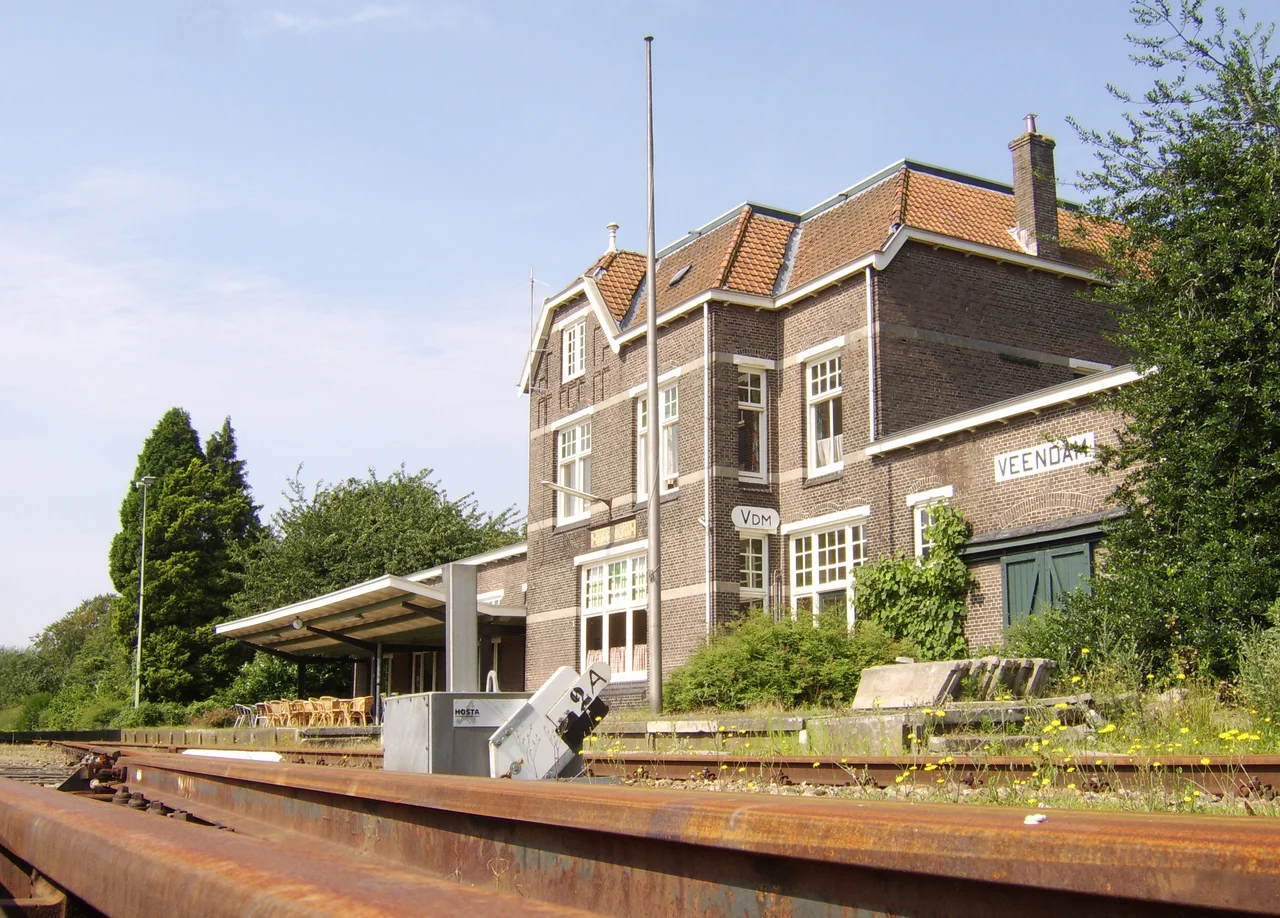

Veendam
Holland America Line has christened four of its ships Veendam. The first sailed in 1888. The most recent, retired only in 2020, carried twelve hundred passengers on Caribbean and Alaskan cruises for nearly thirty years. There is something faintly comic, and faintly proud, about an inland Dutch town - 27,000 people, surrounded by farmland, fifteen kilometres from the nearest piece of saltwater - being honoured four times over by a shipping line. But Veendam was never quite the landlocked place it now looks. For most of the nineteenth century it ran a serious merchant fleet, and Lloyd's Register chose it, along with Amsterdam and Rotterdam, as one of its first three offices on the European mainland.
Wildervanck's Bog
Adriaan Geerts Wildervanck founded Veendam in 1648 as a peat colony - one of dozens being cut into the great bogs of eastern Groningen during the seventeenth century. His scheme was unusual in one respect. Where most peat colonies followed the standard pattern of a single straight canal lined with houses, the Munte River cut through Wildervanck's chosen ground and forced his two main canals, the Oosterdiep and the Westerdiep, to diverge in the middle of town. The result was a fork rather than a ribbon, with a small open basin between the two canals at the centre. Centuries later, that fork is why Veendam's centre still feels spacious and green - a quirk of seventeenth-century hydrology that the town now markets as Parkstad, the Park City.
From Peat to Ocean
Peat made Veendam, and the canals built to ship peat to the cities made it useful for other cargoes when the peat was gone. By the early nineteenth century, Veendam skippers were sailing through the Wadden Sea and out into the North Sea - first along the coast, then across to England, then south to the Mediterranean and east to the Baltic. Boat builders followed. Sail-makers, rope-walks, chandlers, ships' carpenters - the supporting trades of a maritime town set up shop in a place that did not, strictly speaking, have a harbour. In 1868 Lloyd's Register, the British marine insurance and classification society, established offices in Amsterdam, Rotterdam, and Veendam. That third name was the surprising one.
The Other Industry
Iron and steel killed off Veendam's wooden shipbuilding by the late nineteenth century. The bigger yards moved to Rotterdam. What replaced shipping, on the peat-rich soil left behind by the colonies, was potato starch. The cooperative now known as Royal Avebe traces its origins directly to this period - farmers organising themselves against the private starch barons who controlled the market. The Veendam plant remains the cooperative's headquarters today. Metalworking, container handling, and other agro-industrial businesses grew up alongside. The town's inland container terminal is now one of the largest in the Netherlands. A peat village turned into a sea town turned into an industrial node, layer by layer.
The Football Club That Was
SC Veendam was founded in 1894, turned professional in 1954, and for most of its life played in the Eerste Divisie - the second tier of Dutch football. Two short seasons in the Eredivisie was as high as the club ever climbed. Their home was a stadium called De Langeleegte, which translates roughly as 'the long lowland', a Groningen-dialect joke about the flat country it sat on. The stands held about 6,500. In 2013, the club went bankrupt and dissolved. Towns are entitled to mourn the death of small football clubs in their own way: not because the club was famous, but because for a century the team had been the place where the town turned up on Saturdays. The Langeleegte stadium still stands. The fans, mostly, have not.
People from Here
Anthony Winkler Prins, born in nearby Voorst but for many years a pastor in Veendam, edited the Winkler Prins - the Dutch general encyclopedia that remained the standard reference work in Dutch households for over a century. Addeke Hendrik Boerma, born in nearby Annerveenschekanaal in 1912 and educated at secondary school in Veendam, became the first Executive Director of the World Food Programme in 1962. Hendrik de Cock, the minister whose 1834 secession triggered the Afscheiding split in the Dutch Reformed Church, lived and worked here. More recently the town has been claimed by athletes: Renate Groenewold won speed-skating silver at the 2002 and 2006 Winter Olympics; Henk Grol took judo bronze at the 2008 and 2012 Summer Games. For a town its size, Veendam keeps showing up on medal tables and reference shelves with surprising frequency.
Getting There Again
Veendam's railway station closed to passengers in 1953. Freight kept running on the line, but for almost sixty years if you wanted the train you went to Zuidbroek and caught it there. The station reopened in 2011, with passenger service back to Groningen city via Zuidbroek. In 2025 the Dutch government confirmed the Nedersaksenlijn, the Lower Saxony Line, which will extend rail south from Veendam through Stadskanaal and on into the German border country. Sixty years of waiting, then suddenly two new railway lines in one decade. The town that named its football stadium The Long Lowland is, very slowly, becoming a place trains travel to again.
From the Air
Coordinates 53.10°N, 6.87°E. Veendam sits on the N33 expressway, roughly 30 km southeast of the city of Groningen. From 3,000-5,000 ft the forked layout of the two old canals - Oosterdiep and Westerdiep - is clearly visible, defining the historic core with the green basin between them. The Royal Avebe plant lies on the southern edge of town. Nearest airport: Groningen Airport Eelde (EHGG, 30 km west-southwest). The reopened Veendam railway station is on the north side of the town centre. To the north lies Muntendam; to the south, Wildervank and the long line of peat-colony villages running toward Stadskanaal.
Nearby Stories
- Low-Frequency Array 0.9 km away
- Eemshaven Railway Station 2.9 km away
- Nuis, Netherlands 3 km away
- Upstalsboom 3.4 km away
- Leer, Lower Saxony 7.9 km away
- Schiermonnikoog National Park 8.6 km away
- Börger 9 km away
- Drenthse Veenkolonien 9.9 km away