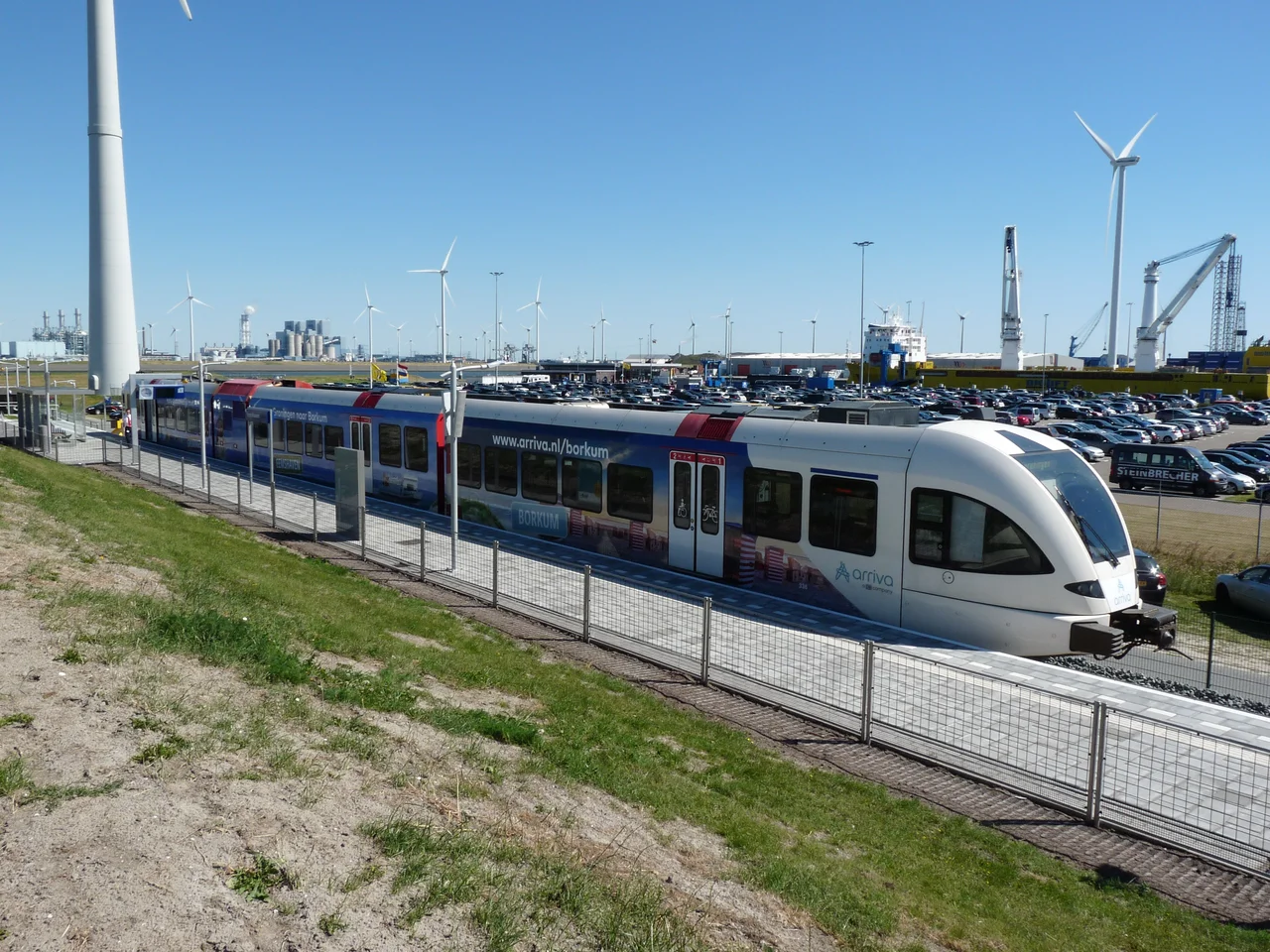

Eemshaven Railway Station
There is no further north you can ride a train in the Netherlands. The line ends here, on a flat patch of industrial ground at the edge of the Eemshaven port complex, where the Dutch landmass dissolves into mudflats and the German island of Borkum sits roughly thirteen kilometers offshore. King Willem-Alexander cut the ribbon in June 2018, three months after the trains had quietly started running. The crowd was small. The station is small. Most of the people who use it are not going to Eemshaven at all - they are passing through, hauling suitcases toward a ferry that will take them somewhere else.
A Line That Was Already There
The railway running from Sauwerd through Roodeschool to Eemshaven did not appear from nothing. The last 4.7 kilometers, from Roodeschool to Eemshaven, had existed since 1978 as a freight spur, carrying cargo to and from the port. For forty years it had clanked along under coal trains and chemical wagons without ever seeing a passenger. Then someone in the province of Groningen did the arithmetic: a few kilometers of new track and some modest platform construction would extend passenger service all the way to a major ferry terminal, killing a duplicate bus route and putting a Dutch province on the map for thru-traffic to the German Frisian Islands. So in 2018, with three additional kilometers of new rail laid to reach the ferry pier itself, the line reopened as a passenger route. The bus to Groningen city was discontinued. Eemshaven became, in railway terms, the end of the line.
Designed for People Who Will Not Stay
Almost everyone who buys a ticket to Eemshaven is on their way to Borkum. The station's primary purpose is to deposit ferry passengers within walking distance of the terminal building, and to scoop them up again on the return trip. There are a few harbor workers who use the trains too, but the schedule has historically discouraged commuting - no trains during rush hours, and a remote location that puts the station nowhere near where anyone wants to live. The platforms are functional, the shelter is modest, and there are no shops. The wind off the Wadden Sea cuts straight across the open ground. Carrier Arriva, which operates the service, eventually committed to running a train every half hour - more often than the original plan, which would have synced trains only to ferry departures. The extra service has made the journey feel less like a stunt and more like a working piece of public infrastructure.
A Royal Inauguration and a Quiet Reality
The official opening was a piece of state theater. Willem-Alexander made the ceremonial speech on 20 June 2018, three months after revenue service had quietly begun on 28 March. Photographs from the day show the king walking the platform with provincial officials, a small honor guard of railway staff, and a few hundred locals braving the chill. The press release language was unselfconsciously grand: the northernmost station in the Netherlands, a new chapter for Groningen, a green alternative to the car. The reality on a typical weekday is gentler. A handful of ferry travelers wheeling roller bags. A handful of high-visibility vests heading into the port. A train sliding back south through the polders toward Roodeschool, Sauwerd, and eventually the city of Groningen, an hour and a quarter away.
Where the Rails Stop
Walk to the end of the platform and you can see exactly where the Dutch passenger network ends. Beyond the buffer stop, a few meters of unused rail, and then nothing - just the gravel of the port and the grey-green expanse of the Wadden Sea beyond. Borkum's lighthouse is visible from here on clear days, blinking from across the water. The trains are short, two or three carriages painted in Arriva's blue and white. They are not glamorous. They were never meant to be. They exist because someone decided that the last fifteen kilometers of Dutch ferry transit should not require a bus, and because the rails were mostly already in place anyway. Practicality made flesh. Or rather, practicality made into steel.
From the Air
Coordinates 53.46°N, 6.83°E, at the western edge of the Eemshaven port complex on the Groningen coast. Recommended viewing altitude 1,500-2,500 ft for the clearest view of the station, the port, and the relationship between rail line and ferry terminal. The Eemshaven port sprawls to the north and east, with massive wind turbines lining the harbor and the coal/biomass power plants of RWE and Nuon visible inland. Nearest airports: Groningen Eelde (EHGG) about 45 km south, Bremen (EDDW) further east. The Wadden Sea here is shallow and tide-dependent - the ferry channel to Borkum runs roughly northeast. Visibility is best on clear winter days when easterly winds clear the marine haze.
Nearby Stories
- Battle of Jemmingen 1.3 km away
- Gaarkeuken Lock 1.8 km away
- Ewiges Meer 3.9 km away
- Organ at the Dorpskerk at Noordbroek 6.7 km away
- Schiermonnikoog National Park 7.5 km away
- German Trawler V 1101 Preussen 19 km away
- HVDC DolWin2 22 km away
- Gemini Wind Farm 36 km away