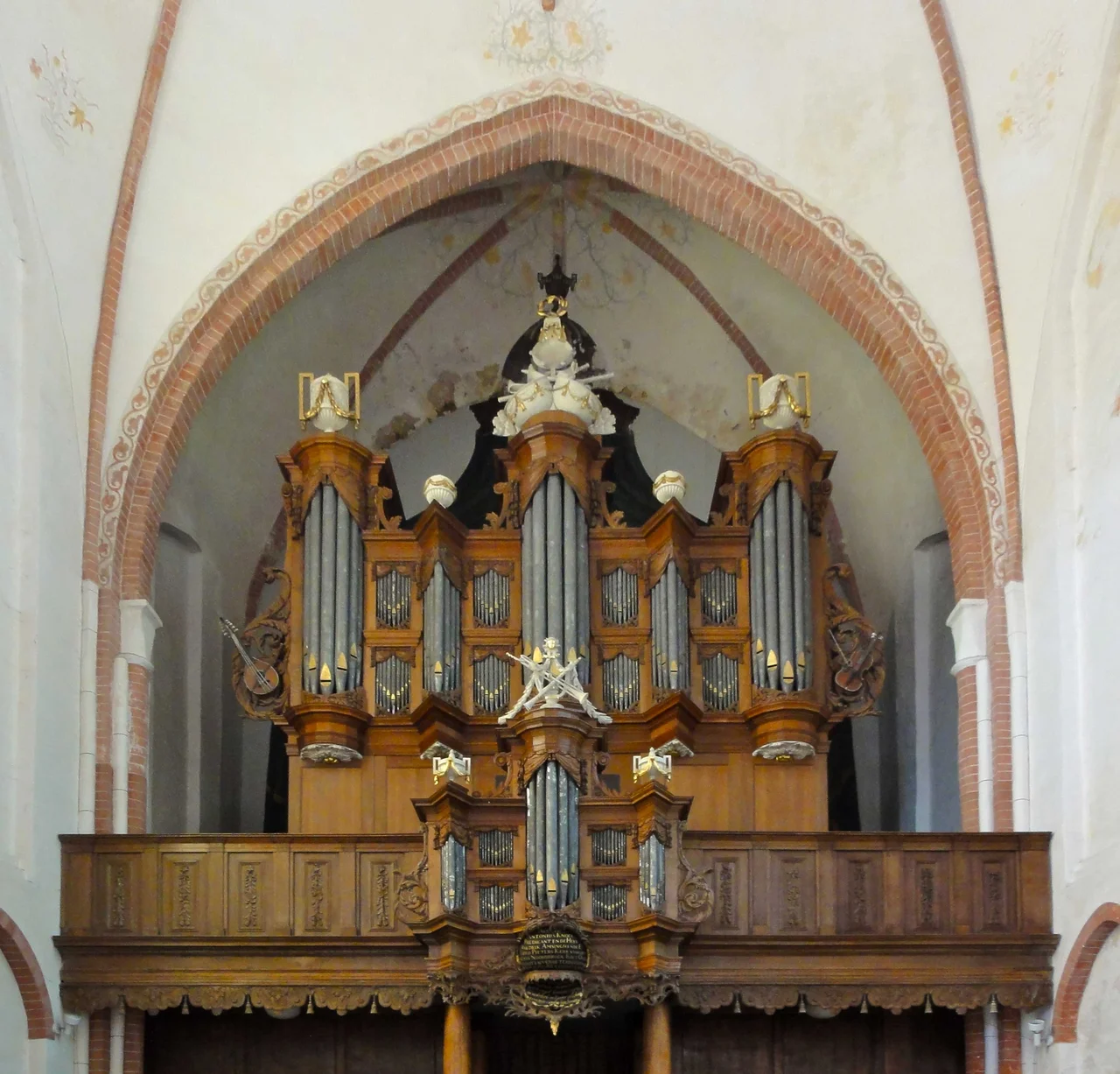

Organ at the Dorpskerk at Noordbroek
Open the wooden doors of the Dorpskerk at Noordbroek on a wet October morning and the silence has shape. The medieval cruciform nave climbs to whitewashed vaults. At the west end, mounted high on a balustraded gallery, stands a five-towered facade of gilded pipes - the only object in the building that looks designed to make a noise. When the organist switches on the blower, the bellows behind it sigh as they have sighed since 1809, and the organ Arp Schnitger built here as his first major Dutch commission is ready to speak.
The Master from Hamburg
Arp Schnitger was the most consequential North German organ builder of the late baroque. From his Hamburg workshop he supplied instruments to churches across the Hanseatic world - Bremen, Lubeck, Stade, and eventually across the Frisian wetlands into the Dutch provinces. His instruments are famous for clarity, for the singing transparency of their principal stops, for reeds that bite without screaming. Johann Sebastian Bach reportedly admired his work. When Schnitger took the Noordbroek commission in 1695, he had just finished rebuilding the great organ of the Martinikerk in Groningen city. Noordbroek's village congregation, by ordering a Schnitger, were buying into something extraordinarily ambitious.
What Schnitger Built
He completed the new organ in 1696. It had twenty stops across two manuals and pedal, with the pedal mechanism mounted behind the main case - the same compact arrangement he had used at Cappel in 1680 and would use again at Uithuizen in 1701. He recycled three high-quality stops from the church's previous organ, an act of frugality common in his work: two flutes in the Rugpositief and a Quint in the Hoofdwerk. The Rugpositief case, hanging out over the gallery edge in three pointed towers, is a smaller echo of the Hoofdwerk behind it. That tiered facade is unmistakably Schnitger - the same architectural language he spoke in churches a hundred kilometres in any direction.
Three Builders, Three Centuries
Schnitger's organ has not stood still. In 1768, Albertus Antonius Hinsz extended it by three stops, lengthened the manual compass, and added rococo carvings under the Rugpositief. Between 1806 and 1809, Heinrich Hermann Freytag rebuilt the whole structure: he raised it onto the present wooden gallery, moved the pedal pipes onto new soundboards flanking the Hoofdwerk, and added a pair of pedal towers with lancet-lipped front pipes in the manner of the early seventeenth century. The result was a five-towered Classical facade with crowning urns - a Schnitger heart inside a Freytag body, the joint visible if you know where to look. Petrus van Oeckelen tinkered with the stops in 1855. The total cost of Freytag's work came to 3,450 guilders. The church paid in instalments.
Bringing the Voice Back
By the 1920s the instrument had been remodeled enough times that its original character was muffled. Plans for a thorough modernization came and went. In the late 1950s, the organologist Cor Edskes and Simon Graafhuis, the parish organist from 1946 to 1983, returned the Rugpositief to its 1809 state - the calibration before van Oeckelen's well-meaning replacements. Flentrop, Veger and van der Putten, and finally Mense Ruiter all took turns through the late twentieth and early twenty-first centuries. In 2003, Ruiter re-tuned the whole instrument to the Kellner temperament, a baroque tuning that lets certain keys sound radiant and others, deliberately, slightly sour. The dark scorch marks on some front pipes are from a church fire - the organ survived.
Why It Still Matters
Twenty-four stops on thirty-three ranks of pipes. Four wedge bellows, the same ones Freytag put in in 1809, still doing the breathing. Mechanical key action, mechanical stop action - everything you press is connected by wood and metal levers to the thing that actually makes the sound. There are perhaps a few hundred surviving Schnitger-derived instruments scattered across Northern Europe, and Noordbroek's is one of the more important. Recordings of it appear regularly on the Arp Schnitger discography. For an hour, on a Sunday or a recital evening, the village of Noordbroek - 1,500 people, a couple of farms, a single grocery - hosts a sound that Hamburg knew in 1696. The air does not forget how to vibrate.
From the Air
Coordinates 53.20°N, 6.87°E. Noordbroek is a small Groningen village 12 km southeast of the city of Groningen. From cruising altitude the cruciform Dorpskerk is just visible - a stone cross-shaped roof rising slightly above a small ring of houses and surrounding farmland. Nearest airport: Groningen Airport Eelde (EHGG, 25 km southwest). Look for the village clustered along the Noordbroeksterweg, with the church at its centre. The N33 expressway runs about 2 km east of the village.
Nearby Stories
- Low-Frequency Array 0.9 km away
- Eemshaven Railway Station 2.9 km away
- Nuis, Netherlands 3 km away
- Upstalsboom 3.4 km away
- Leer, Lower Saxony 7.9 km away
- Schiermonnikoog National Park 8.6 km away
- Börger 9 km away
- Drenthse Veenkolonien 9.9 km away