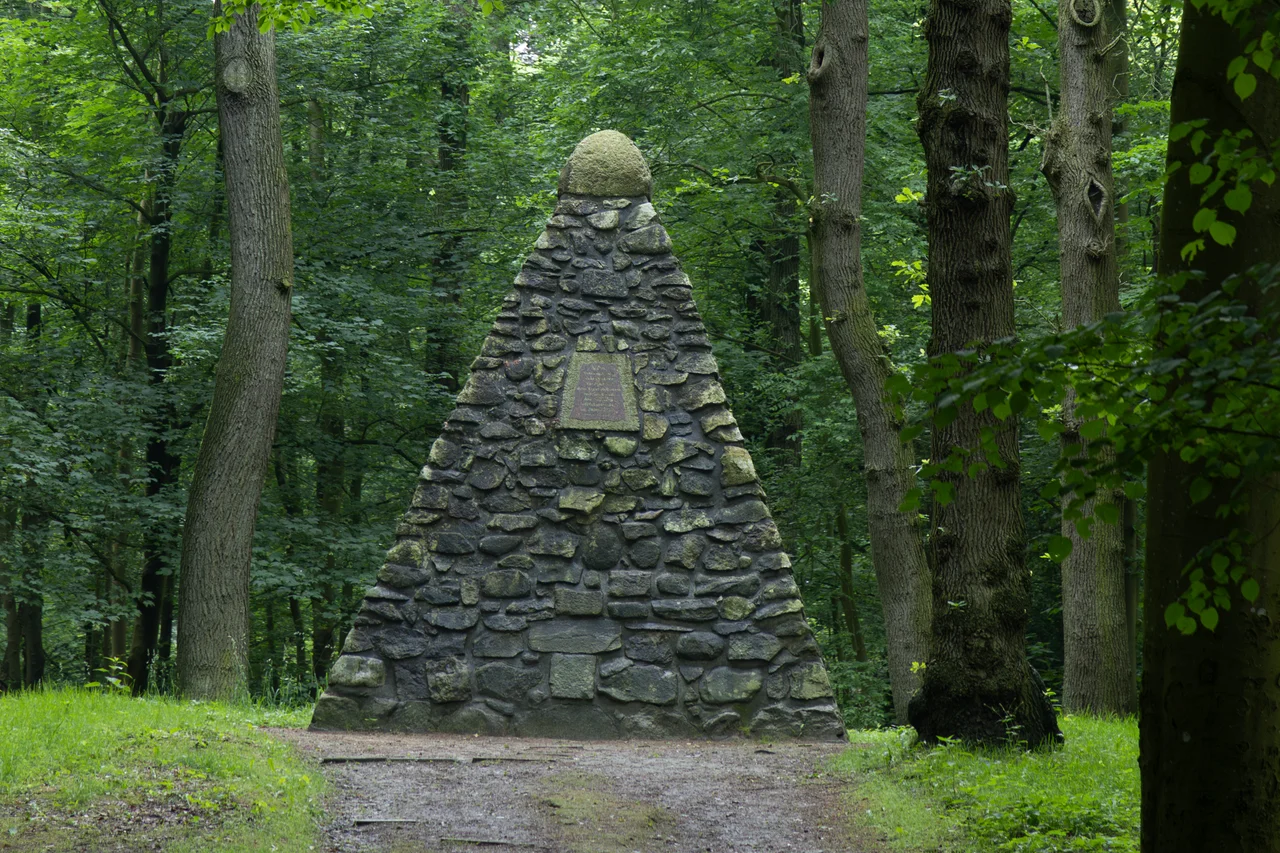

Upstalsboom
Every year on the Tuesday after Pentecost, one redjeven from each of the Seven Sealands made the trip to a low rise of dry ground just outside Aurich. The site was called the Upstalsboom - the tree of Upstal - though no one remembers what Upstal originally meant. Possibly elevated. Possibly dry. They were there to argue: about currencies, about murder fines, about exchange rates, about which mendicant orders could collect alms in which sealand, about whether the Hanseatic League could be resisted or had to be appeased. The Frisians did not have a king. They had this annual meeting under a tree, and a set of statutes ratified there in 1323 that called itself the legal framework for an entire culture. The German historian Ubbo Emmius later called the Upstalsboom the altar of freedom. Some visitors still take small bottles of dirt away from the site.
An Assembly Without a Capital
The Upstalsboom is the only known meeting place where representatives of all Seven Sealands of medieval Frisia actually convened. Other assemblies existed within individual sealands, but the Upstalsboom drew together emissaries from across the Frisian-speaking coast - the lands between the Lauwers River in the west and the Weser estuary in the east, and eventually farther afield as the Central Frisians joined and as Groningen was forced into the league after the Siege of Groningen in 1338. Each sealand sent one redjeven, who served for one year. The decisions reached at the annual meeting had legal force across the participating communities. Comparison has often been made to the Icelandic Thingvellir, the open-air parliament where Iceland's Althing met from the tenth century onward. The Frisian version was smaller and less institutionalized, but it ran on the same principle: a culture without a central authority needed a meeting ground that everyone could agree was neutral.
Statutes Carved into Latin and Old Frisian
On 18 September 1323, the Statutes of Upstalsboom were ratified in Central Frisia in an attempt to revive a league whose legal force was slipping as the Count of Holland pressed his claims into Frisian territory. Three versions of the Statutes survive. Two are in Old Frisian, one in Latin. The Latin version, twenty-four paragraphs long, is believed to be the original. One Old Frisian translation also has twenty-four paragraphs; the other has thirty-six. The Statutes are one of only a handful of legal texts that exist in both Old Frisian and Latin, which makes them important to philologists as well as historians. The 1323 punishments were considered extreme even for the period. When the statutes were reaffirmed in 1361, some of them were scaled back - though one new clause added a forty-mark payment to the heirs of a homicide victim by anyone who concealed a murder across sealand boundaries, twice the usual weregild. The text reads like the work of a coalition of independent communities trying to hold lawlessness at bay with whatever leverage they had.
Burial Mound, Meeting Place
The hill at Upstal was sacred ground long before it became an assembly site. Archaeological evidence shows that members of important Frisian families were buried here as early as the eighth century, hundreds of years before the league is first attested in writing around 1220. By the time the redjevens started meeting here, they were standing on top of bones. That layered significance is part of what made the site usable as a political center: the dead were already there, and the ancestors gave the proceedings a weight no royal charter could provide. The earliest assemblies dealt with payment of fines to local counts. By the thirteenth century the league was caught up in a complicated war between two villages in the Ommelanden, which dragged in Fivelingo, Hunsingo, Groningen, and others. The Upstalsboom League was politically successful and militarily weak. It could not enforce its own agreements when communities defied them - one of the persistent frustrations its statutes try to address.
Free, Until They Weren't
The Frisian freedom period was marked by extraordinarily successful repulsion of foreign invasion. Other than two notable defeats - in 1270 against the Count of Stotel, and in 1289 against the Count of Holland - the sealands consistently beat back the armies that came to subjugate them. They did this without a king, without a standing army, and without the central tax authority that would have made permanent military forces possible. They did it through what contemporary observers called Frisian solidarity, a willingness to fight together that did not require a sovereign to coordinate it. In 1338 the Upstalsboom League entered a military alliance with France against England and the Count of Gelre. By the late Middle Ages the system was breaking down. The growth of Groningen, internal violence, and the rising power of regional chieftains together undid the equilibrium that the annual meeting had once preserved. The Statutes were the league's high-water mark and also the early sign of its decline.
The Pyramid and the Pilgrim's Dirt
In 1883, German nationalism in its romantic-historical mode reached the Upstalsboom. A stone pyramid was erected at the site to memorialize the Frisian freedom period - a modest monument by the standards of the era's commemorative architecture, but a deliberate gesture. The pyramid still stands. Tourists who visit sometimes take handfuls of soil home in small bottles, treating the ground as something between a historical landmark and a relic. The hill itself is unimpressive at first glance: a low rise in the flat East Frisian Geest, easy to miss if you don't know to look. What it remembers is harder to miss once you do - a thousand years of a coastal people who, against all the structural odds of medieval Europe, organized themselves around a tree, an annual Tuesday, and the simple shared belief that they were free.
From the Air
The Upstalsboom site lies at 53.45 degrees north, 7.43 degrees east, on the western edge of Aurich in the East Frisian peninsula. From the air it appears as a low rise within a small wooded patch on the outskirts of town - the surrounding country is the flat agricultural land of the East Frisian Geest, with Aurich's compact urban grid immediately to the east. The 1883 stone pyramid at the summit is the most visible feature. Nearby airfields: Wittmundhafen (ETNT) about 25 km north-northeast, Emden (EDWE) about 30 km southwest, Wilhelmshaven-Mariensiel (EDWI) about 50 km east. Recommended viewing altitude 2,000 to 3,000 feet for a clear read of the site against the town center.
Nearby Stories
- Wilhelmshaven 1.3 km away
- Evenburg 5.4 km away
- Rastede Palace 8 km away
- German Trawler V 1101 Preussen 8.6 km away
- German submarine U-777 8.6 km away
- Wadden Sea 9.8 km away
- Battle of Heiligerlee (1568) 12 km away
- HVDC DolWin2 22 km away