
Evenburg
Colonel Erhard von Ehrentreuter had a gambling problem. He also commanded the Dutch garrison at Emden, and somewhere along the way he had married a Bohemian baroness named Eva. To deal with the debts, Count Ulrich II of East Frisia enfeoffed him with the villages of Loga and Logabirum - giving him land in lieu of money. On that land, between 1642 and 1650, Ehrentreuter built a moated castle and named it after his wife: Evenburg, Eva's castle. The story has everything. A soldier, his foreign-born wife, his vices, and a count quietly bailing him out by handing him villages.
The Colonel's Castle
Ehrentreuter was a man of his century - the long, ugly Thirty Years' War century. Born in 1596, he had served the Dutch as a garrison commander at Emden during the war's final years. He married Eva, Baroness Ungnad of Bohemia, in 1631. He built her a castle from 1642 to 1650, while the war's smoke was still clearing. When Marie, his youngest daughter, married Gustav Wilhelm von Wedel in 1660-something, the Evenburg passed into one of those tangled north European aristocratic networks where everyone served a different king. Von Wedel became a field marshal for the Danish king, governor of Oldenburg Land, and in 1684 - having grown rich in service - he bought the Jarlsberg estate near Christiania (modern Oslo) in Norway. From then on the von Wedels carried the title of Count. They held Evenburg for centuries.
Rebuilt in Neo-Gothic
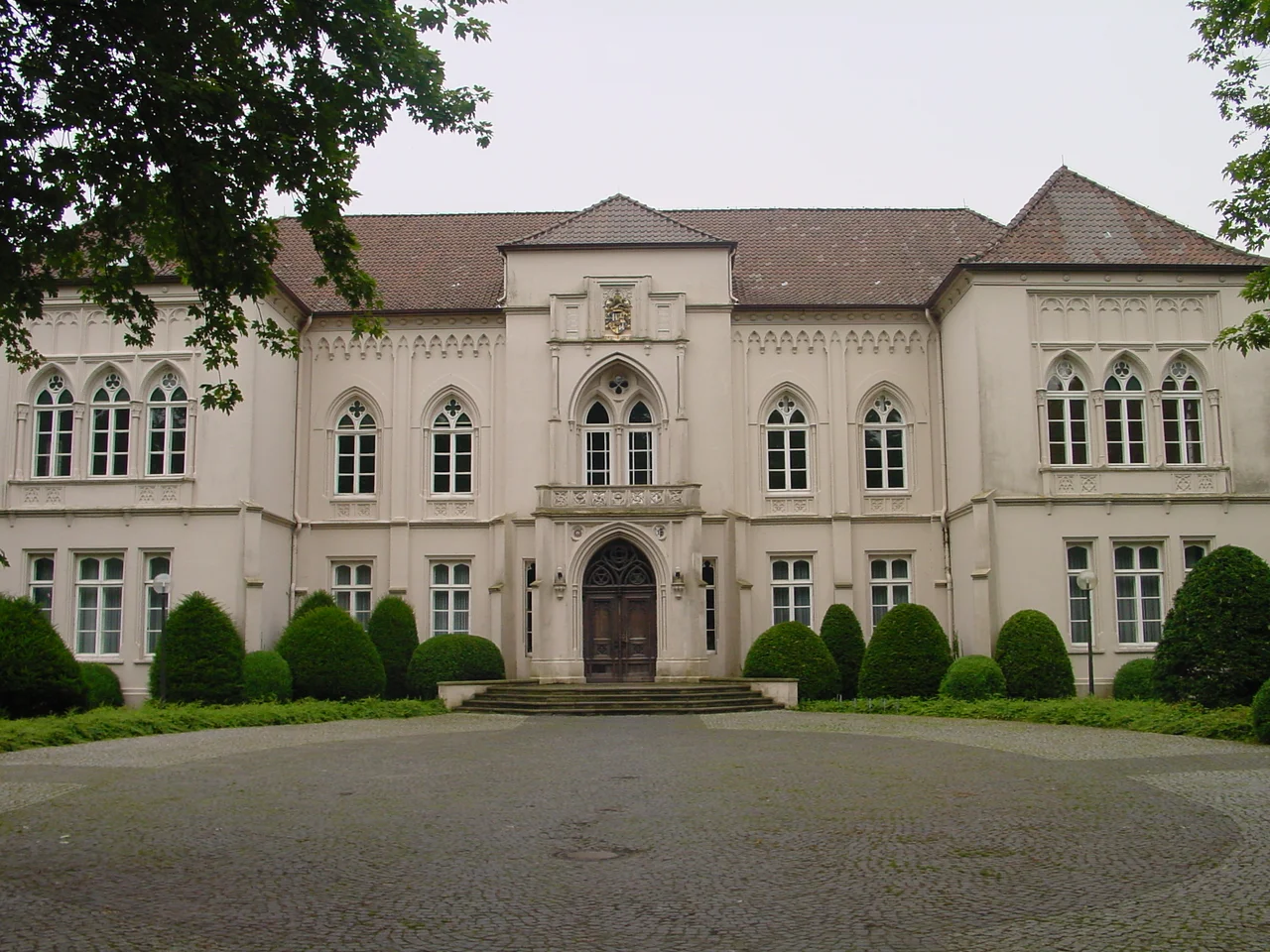
By 1861 the original Dutch-classical castle - one of the earliest examples of that style in northern Germany - was falling apart. Rather than restore it, the von Wedels demolished most of it. The architect Richard Stueve from Hanover designed something new in its place: a Neo-Gothic residence with pointed windows and filigreed roof structures, the kind of romantic medieval-revival fantasy that 19th-century German aristocrats loved. Only the foundation walls and the vault of the old central transept were kept. The Second World War damaged what Stueve had built. The filigreed roofs could not be saved; a simpler covering went on. The von Wedels held on through the Republic and the war, but in June 1975 they sold the castle and its estates to Leer district for about seven million deutschmarks. The district moved schools and offices in - the East Frisian Education Academy, a grammar-school teachers' college, the district media centre.
Park, Bastion, Avenue
The grounds matter as much as the building. A long double avenue runs from the town of Leer straight out to the castle - the kind of axial approach the 17th century loved. The baroque Vorburg of 1703, a small bastion just outside the moat, now houses the district music school; concerts spill out of its hall on summer evenings. The surrounding park is laid out in the English landscape style, with paths wandering down to the Ledadeich, the dike along the River Leda. By 2006 a major restoration had returned the Evenburg to roughly the way it looked in the mid-19th century. The neo-Gothic roof came back. Interior details were rebuilt. It reopened to the public in January 2007. You can tour it now by appointment; the Saal and the bastion host concerts and other events. A gambling-debt castle named for a Bohemian baroness, redesigned in the Romantic Gothic, half-ruined by world war, and saved by a school district. East Frisia in one moated parcel.
From the Air
53.2311 N, 7.4947 E, in Loga just north of central Leer near the River Leda. The long double avenue from Leer to the castle is the unmistakable visual cue from altitude. Nearest airfield is Leer-Papenburg, with very limited service. Emden (EDWE) is the nearest staffed field; Bremen (EDDW) and Groningen Eelde (EHGG) are the closest larger airports. Watch for low cloud from the North Sea even on summer days.
Nearby Stories
- Hümmling 1.9 km away
- Battle of Heiligerlee (1568) 2.7 km away
- Frisia 5.1 km away
- Oldenburg Air Base 5.4 km away
- Lake Bant Tern Colony 8.3 km away
- Low-Frequency Array 11 km away
- Eemshaven Railway Station 14 km away
- Visbek 18 km away