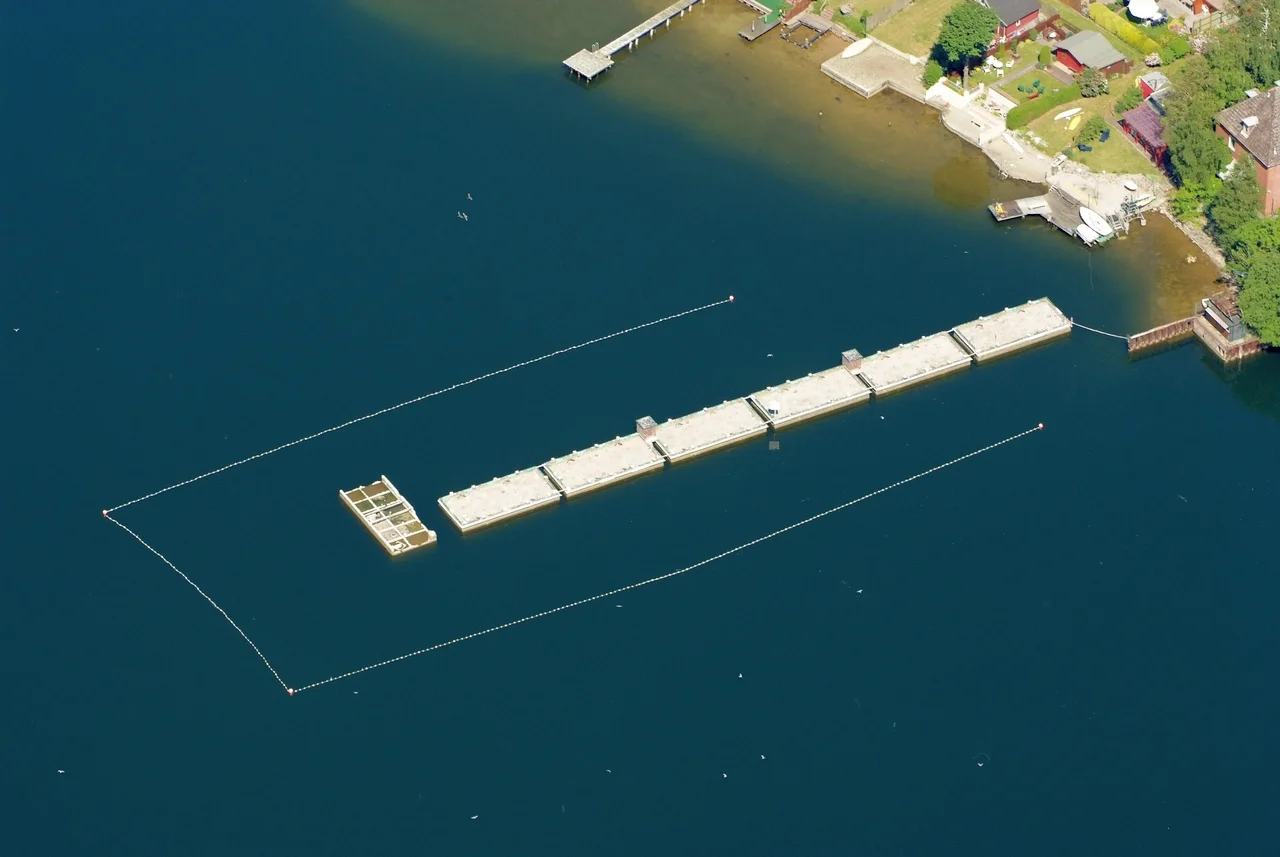

Lake Bant Tern Colony
The terns came back for the concrete. In 1984, researchers in Wilhelmshaven hit play on a tape recorder, and the recorded calls of common terns drifted out across six derelict islands at the edge of Lake Bant. The islands had been built to load torpedoes into German U-boats. The submarines were long gone. But the terns - their old breeding ground destroyed - answered the lure, settled in, and within a few decades made these abandoned military slabs one of the most closely observed seabird colonies on Earth.
A Lure Across the Water
Lake Bant - Banter See in German - is an artificial inlet, dredged into Wilhelmshaven's flat coastal landscape and tied to the wider Jade Bight beyond. The six concrete platforms standing in its shallows once served the Kaiserliche Marine and later the Kriegsmarine as a loading dock for the U-boat harbour that operated from this corner of the city. After the submarines departed, the platforms sat empty, surrounded by water that kept foxes, rats, and stray cats safely on the mainland. To a colonial seabird, that combination is rare and precious: hard, dry ground with no terrestrial predators. The Institute of Avian Research, working out of the Heligoland Bird Observatory, recognized the opportunity. Taped calls did the rest.
A Population on the Scales
From an initial 90 breeding pairs, the colony climbed steeply, peaking at 530 pairs in 2005. Then came thinner years - poor fishing in the Wadden Sea, a string of failed broods - and by 2011 numbers had fallen to about 430 pairs. The terns here live or die on small silver fish: juvenile herring, sprat, and smelt pulled from the rich, muddy shallows of the World Heritage-listed Wadden Sea. When those fish populations crash, the chicks starve. Owls sometimes raid the colony, too, slipping in on summer nights. But the islands themselves remain a fortress, and the colony, even in its leaner years, holds steady at hundreds of nesting pairs.
Five Thousand Named Birds
What makes this colony extraordinary is not its size but its identity. Since 1980, every chick has been ringed. Since 1992, every fledgling - more than 5,000 birds so far - has been fitted with a tiny passive transponder, the same technology that microchips a house cat. Antennas ring the colony and crowd the nests, recording who arrives when, who breeds with whom, and which birds return year after year from West African wintering grounds. Scales hidden among the rocks weigh terns as they land. The result is one of the most detailed population datasets ever assembled for a wild long-lived seabird, accumulated almost entirely without ever needing to catch a bird in the hand.
What the Data Shows
The story the records tell is quietly profound. Terns improve with age. Older, experienced birds arrive earlier in spring, lay sooner, and raise more chicks. Around age fifteen, senescence sets in - the same gradual slowing that humans recognize - but the very oldest birds still leave behind the highest lifetime reproductive totals, simply because they have lived to keep trying. Researchers also draw blood without trapping anyone, using a remarkable ruse: a hungry triatomine bug, native to Mexico, is hidden inside a hollow dummy egg and slipped into a real nest. The bird incubates the fake egg, the bug feeds through tiny holes in the shell, and the blood is later extracted for hormone and genetic analysis. The brooding tern, blissfully unaware, returns to her real eggs the next day.
The Living Monument
The colony is now protected as a natural monument of the city - a designation more often given to ancient trees or glacial boulders than to platoons of nesting seabirds on Cold War-era concrete. Walk the path along Banter See on a June afternoon and you can hear them long before you see them: a sharp, repeated kik-kik-kik rising over the water, punctuated by the splash of an adult tern hitting the surface bill-first, fish in beak, on its way back to a chick that has been waiting on a slab of concrete that was poured for an entirely different war.
From the Air
Coordinates: 53.51 N, 8.11 E. The colony sits in the shallow Banter See, a rectangular inlet on the western edge of Wilhelmshaven. From cruising altitude in clear weather, the lake and its neighbouring Großer Hafen show clearly as dark water cut into the city. Recommended viewing altitude 2,000 to 4,000 feet for the inlet's geometry. Nearest airport: JadeWeserAirport Wilhelmshaven-Mariensiel (EDWI), about 7 km southwest. Bremen (EDDW) lies about 100 km southeast.
Nearby Stories
- Broetje-Automation GmbH 4.4 km away
- Taktisches Luftwaffengeschwader 71 "Richthofen" 5.1 km away
- German Trawler V 1101 Preussen 6.6 km away
- Jümme 7.4 km away
- Großer Knechtsand 7.8 km away
- Worpswede 10 km away
- Stalag X-B 25 km away
- Lilleø 214 km away