
Taktisches Luftwaffengeschwader 71 "Richthofen"
On 21 April 1961, President Heinrich Luebke conferred the honorary name Richthofen on a German jet fighter unit. The date was not accidental. It was the forty-third anniversary of the death of Rittmeister Manfred von Richthofen - the Red Baron - shot down over the Somme in 1918, eighty mostly Allied kills to his name, dead at 25. West Germany was thirteen years into rearmament. Its first jet fighter wing, formed in 1959 with fifty Canadair Sabres at the old RAF Ahlhorn base in Lower Saxony, needed a name that could pull together the contradictory inheritances of German military aviation. Choosing Richthofen was a calculated act of memory: it reached back past Hitler to a First World War pilot the Allies themselves had buried with honors. Today the unit flies Eurofighter Typhoons out of Wittmundhafen Air Base, 25 kilometers north of Aurich, and stands round-the-clock readiness to intercept unidentified aircraft over northern Germany.
Hartmann's Sabre
The wing's early pilots included the highest-scoring fighter pilot in the history of aerial combat. Erich Hartmann - the Black Devil to his Soviet opponents - had recorded 352 air-to-air kills over the Eastern Front during the Second World War, spent ten years as a Soviet prisoner, returned to West Germany in 1955, and joined the new Bundesluftwaffe in time to fly the Canadair Sabre with JG 71 in the late 1950s. Hartmann reportedly considered the Sabre his favorite aircraft to fly; he later moved to the Lockheed F-104 Starfighter, the high-performance jet that would replace the Sabre across the German Air Force in the 1960s and that would also accumulate a notorious accident record. One of the Sabres he flew survives at the Luftwaffenmuseum in Berlin-Gatow, painted with his personal markings - a quiet bridge between two eras of German military aviation that the wing itself had no choice but to span.
Ahlhorn to Wittmundhafen
In 1963 the wing moved north, leaving the inland base at Ahlhorn for Wittmundhafen, the East Frisian airfield that has been its home ever since. Wittmundhafen sits among flat fields and bog land north of the small town of Wittmund, close enough to the North Sea that the runway is regularly tested by the kind of weather that produces low ceilings and crosswinds. The move put the wing in the right geography for its mission. Northern Germany faces the open Baltic to the east and the North Sea to the west, and any unidentified aircraft entering from those directions needs to be met fast. May 1963 saw the first F-104 Starfighters arrive. In 1974 the F-4F Phantom IIs began replacing the Starfighters. Each transition reshaped the base around new airframes, but the runway, the alert hangars, and the quick-reaction posture stayed the same.
The Last Phantom Flight
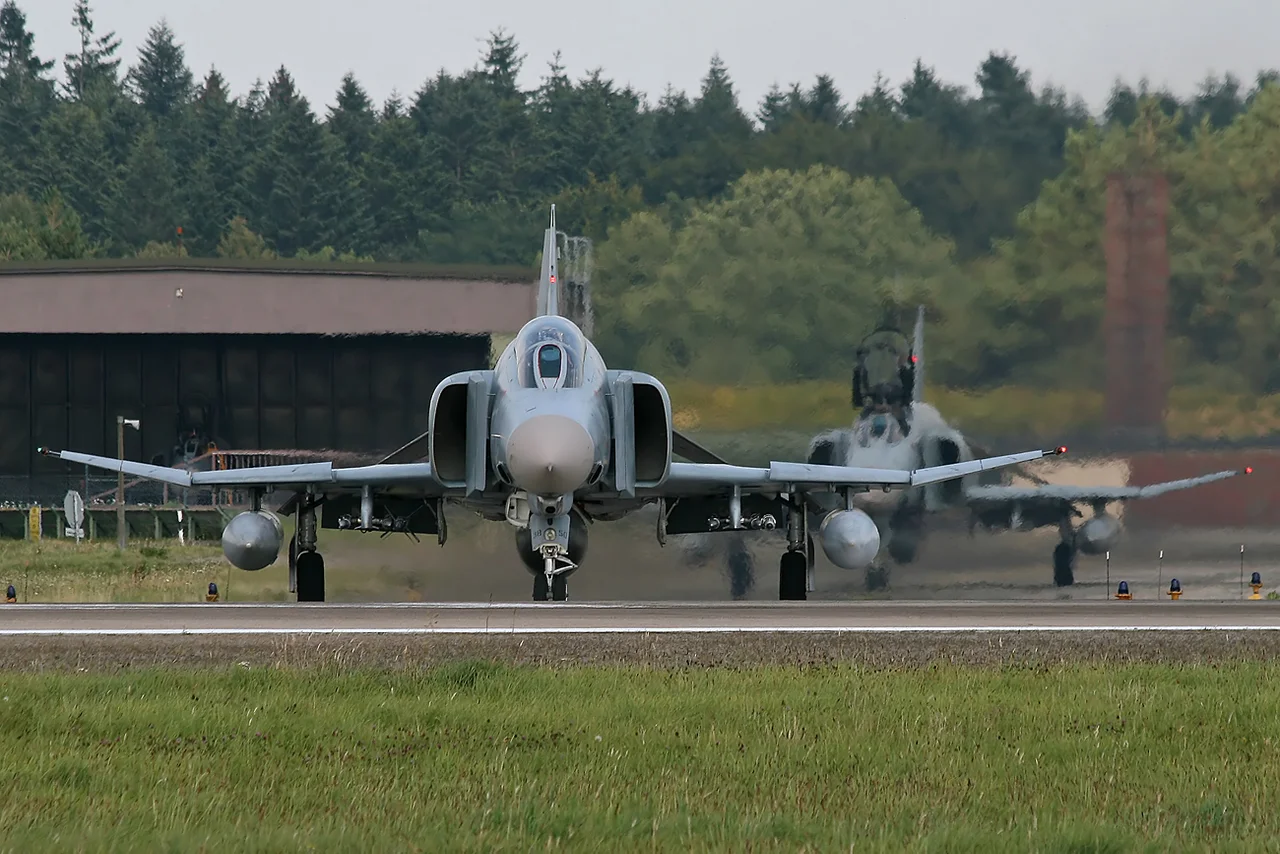
On 29 June 2013, the last F-4F Phantom in German service took off from Wittmundhafen for the last time. The Phantom had served the wing for nearly four decades. It was a Cold War design - twin-engine, two-seat, fast at altitude, heavy and unforgiving at low level - and it had defined an entire generation of NATO air defense in the Federal Republic. For three years before that final flight, JG 71 had operated a mixed fleet, the new Eurofighter Typhoons arriving in 2010 while the Phantoms continued to scramble for Quick Reaction Alert. The final flight retired the type from German service entirely. The wing kept flying. The Eurofighter took over the QRA mission, the alert pilots moved into new cockpits, and the operational tempo stayed the same: twenty-four hours a day, seven days a week, ready to intercept any unidentified aircraft over the northern half of the country.
Sharing the Sky
The QRA mission over Germany is divided between two units. JG 71 covers the north. JG 74 - which completed its own Eurofighter conversion in late 2008 - covers the south. The dividing line runs roughly between Frankfurt and Berlin, with the exact handoff depending on situation and where the alert pair can intercept fastest. Beyond that domestic responsibility, JG 71 has rotated through NATO's Baltic Air Policing missions, deploying to the Baltic States between June and September 2008 and again from November 2009. In June 2010, six of the wing's F-4 Phantoms were sent to Iceland as part of NATO's Icelandic Air Policing rotation, projecting German fighter presence into a sector where the Federal Republic had never operated combat aircraft before. The flying hours add up. In 2007 the wing logged over 7,600 hours, the highest activity of any German Air Force fighter wing for the second year running.
Above Wittmund
From altitude the base looks like every Cold War fighter station: a long single runway, taxiways, the angled lines of hardened aircraft shelters, alert hangars positioned for fast scrambles, ordnance bunkers tucked into earthen berms. The Eurofighter is the quietest fast jet most observers have ever heard - thanks to acoustic dampening of the engine intakes - but its takeoff still rattles windows in the villages on the approach paths. Wittmund itself is a small East Frisian town, the seat of its own district, and the air base has shaped its economy and identity for most of a century. The Red Baron's name flies over a corner of Lower Saxony he never visited, on aircraft he could not have imagined, doing a mission - air defense of a divided continent's western half - that did not exist when he was alive. The continuity is in the squadron number, the inherited honor, and the alert pair sitting on the runway with engines turning.
From the Air
Wittmundhafen Air Base lies at 53.55 degrees north, 7.67 degrees east, north of the town of Wittmund in the East Frisian peninsula. ICAO identifier ETNT. From the air the base shows the characteristic Cold War fighter station layout: single main runway aligned roughly east-northeast/west-southwest, hardened aircraft shelters along the taxiways, alert hangars near the runway threshold. The surrounding land is flat agricultural country, with bog and moor north and east of the base. Nearby airfields: Emden (EDWE) about 40 km southwest, Wilhelmshaven-Mariensiel (EDWI) about 25 km east, Bremen (EDDW) about 110 km southeast. Recommended viewing altitude well above local controlled airspace - the base operates active Quick Reaction Alert flights, so transient general aviation should consult current NOTAMs before approaching.
Nearby Stories
- Wilhelmshaven 1.3 km away
- Evenburg 5.4 km away
- Rastede Palace 8 km away
- German Trawler V 1101 Preussen 8.6 km away
- German submarine U-777 8.6 km away
- Wadden Sea 9.8 km away
- Battle of Heiligerlee (1568) 12 km away
- HVDC DolWin2 22 km away