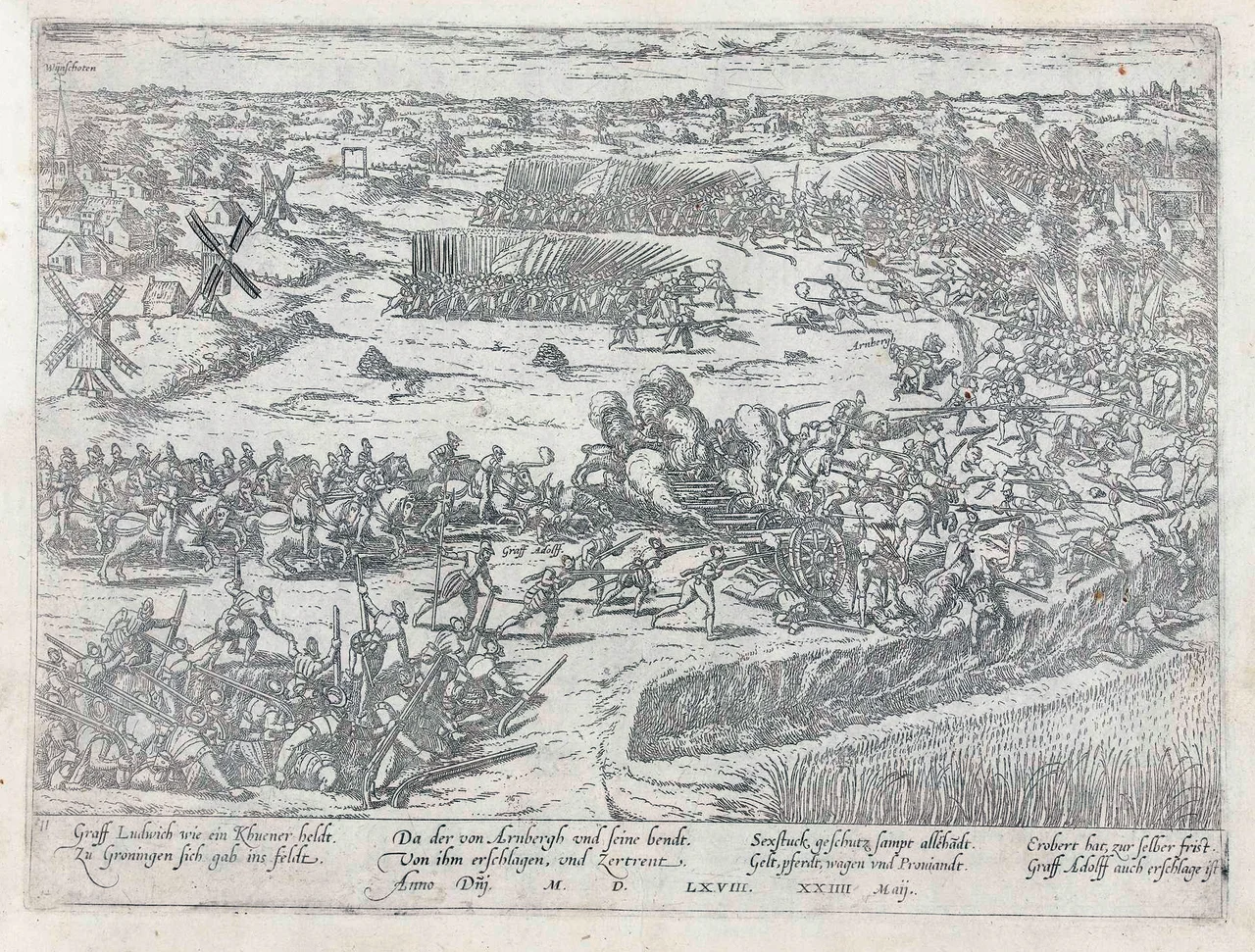

Battle of Heiligerlee (1568)
Graef Adolff is ghebleven, In Vriesland in den slaech. 'Count Adolf has died, in Friesland, in the battle.' The line sits in the fourth verse of the Wilhelmus, the Dutch national anthem, and Dutch schoolchildren have sung it for centuries without always knowing who Adolf was, or where he fell. He was twenty-seven years old. He was the younger brother of William the Silent. He led a cavalry charge across a heath near the abbey of Heiligerlee on a May morning in 1568, drew the Spanish into an ambush, and was killed in the fighting that followed. The battle that took him is generally considered the opening engagement of the Eighty Years' War - a war the Netherlands would still be fighting when his grand-nieces and grand-nephews were dying of old age.
Two Armies, One Monastery
The numbers were close enough that neither side could be confident. Louis of Nassau, William's brother, had crossed into the Spanish-held province of Groningen with 3,900 infantry. His younger brother Adolf rode at the head of 200 cavalry. Facing them was Johan de Ligne, Duke of Arenberg and Stadtholder of Friesland for the Spanish king, with 3,200 infantry and just 20 horse. Aremberg knew his cavalry was thin and chose caution. He pulled back and waited for reinforcements from the Count of Meghem, intending to face the Dutch rebels with overwhelming force. On the morning of 23 May, that plan came apart. Adolf's cavalry rode out in front of the rebel position - visible, taunting, apparently isolated - and Aremberg, against his own better instinct, took the bait.
The Ambush
The ground near the monastery of Heiligerlee was not what it appeared from the Spanish side. Louis had placed the bulk of his infantry where Aremberg could not see them. When the Spanish cavalry pursued Adolf's horsemen forward, the rebel infantry came up out of the dead ground and into their flank. The fighting that followed was short and brutal. Aremberg himself was killed. Roughly 460 Spanish soldiers died on the field. The rebels lost about 50 of their own, captured seven cannon, and walked off the heath with a victory that nobody in Brussels had thought possible. Among the fifty dead lay Adolf of Nassau.
The Cost of Going First
Adolf's body was carried from the field by men who had ridden with him through the morning. He had no children, no political career, no record of military command before this campaign. What he had was a willingness to be the lure - to ride visible and exposed across a heath while three thousand infantry hid behind him, hoping the trick would hold. It held. He paid for it. The Dutch national anthem, written within a generation of his death, names him by his rank and his fate and not much else, because there was not much else to tell. The first verse of the Wilhelmus is sung at every state occasion in the Netherlands. The fourth verse is sung less often. But it is there, and it remembers him.
A Victory That Couldn't Be Held
Heiligerlee was a triumph and a misdirection. Louis of Nassau had broken a Spanish army in open battle, but he had no cities, no siege equipment, no supply lines that could survive a serious counter-attack. The Duke of Alba, the Spanish king's most capable general, marched north with overwhelming force. Two months later, at the Battle of Jemmingen on 21 July, Alba destroyed what was left of Louis's army on the banks of the Ems. The first phase of the revolt was, by any military measure, a failure. The Spanish remained in control of the Netherlands. The rebellion would have to be rebuilt from almost nothing. But something had changed at Heiligerlee that no Spanish victory could undo. The Dutch had learned that the most feared army in Europe could be beaten in the field. The Eighty Years' War would run on that knowledge until 1648.
The Monument and the Heath
Heiligerlee today is a small village in the Oldambt municipality of eastern Groningen, surrounded by some of the flattest farmland in the country. A nineteenth-century monument marks the approximate site of the battle, and a small museum tells the story for visitors who find their way out from Winschoten. The monastery is gone. The heath has been drained and plowed for centuries. What remains is mostly the name itself, recurring at the moments when a country sings about who it is and how it began - in Friesland, in the battle, where Count Adolf died.
From the Air
Heiligerlee lies at 53.16°N, 7.00°E in the Oldambt region of eastern Groningen province, near the German border. The terrain is uniformly flat, agricultural, and crossed by drainage canals. Nearest airport is Groningen Airport Eelde (EHGG), about 50 km west. The town of Winschoten, with its famous three windmills, is just a few kilometers southeast.
Nearby Stories
- Low-Frequency Array 0.9 km away
- Eemshaven Railway Station 2.9 km away
- Nuis, Netherlands 3 km away
- Upstalsboom 3.4 km away
- Leer, Lower Saxony 7.9 km away
- Schiermonnikoog National Park 8.6 km away
- Börger 9 km away
- Drenthse Veenkolonien 9.9 km away