_2010_by_Antony_Gormley_-_View_North_VII.jpg)
Exposure
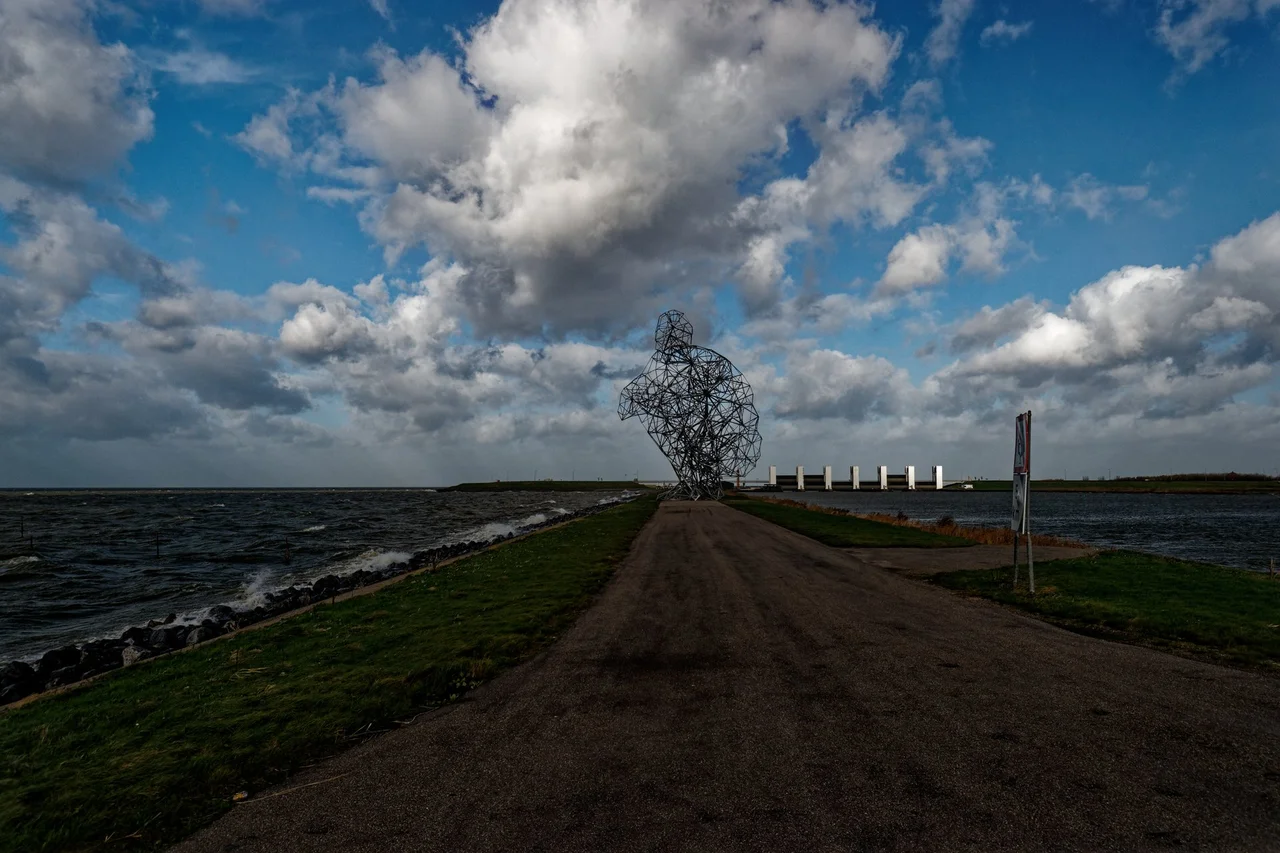
Drive east out of Lelystad onto the Houtribdijk and the first thing you see is a man squatting at the shore, looking out across the IJsselmeer. He is roughly the height of an eight-story building. He is made entirely of steel girders, lashed together with bolts, so that from a distance he reads as solid and from close up he is mostly air. He has been there since September 2010, holding the same pose without flinching, and people who live nearby have stopped finding him strange.
The Sculptor Comes North
Antony Gormley has spent most of his career working through one essential subject: the human body, his own body specifically, as a way of measuring the space around it. The Angel of the North in Gateshead, the cast-iron figures of Another Place wading into the tide at Crosby Beach, the 31 life-sized figures scattered across Manhattan rooftops in Event Horizon - all of them ask the viewer the same question, which is roughly: what is the relationship between a person and the place they occupy? In 2001, the Dutch province of Flevoland set aside money to add a new work to a long-running landscape art program. A few years later, Lelystad approached Gormley. He came north and looked at the dike.
Why Flevoland
Flevoland is the youngest province in the Netherlands and one of the most deliberately built landscapes on Earth. It did not exist as land until the 20th century. The Zuiderzee Works drained huge sections of the inland sea between the 1930s and the 1960s, producing polders where there had been water for a thousand years before. Land art has flourished here precisely because the land itself is a kind of art project - made, measurable, finite. Earlier works in the program include Robert Morris's Observatory, Marinus Boezem's Green Cathedral - a cathedral grown out of living poplar trees - and Daniel Libeskind's Polderland Garden of Love and Fire. Exposure became the sixth in the sequence.
Built Like a Bridge
The numbers are the kind that engineering firms talk about more than artists do. The figure stands 25.64 meters tall - roughly 84 feet - and weighs 60 tonnes. It is made of 5,468 individual pieces of galvanized steel, varying in length and cross-section, joined at 547 nodes by approximately 14,284 bolts. The form was generated from a body scan of Gormley himself, abstracted into a wireframe and then rebuilt at monumental scale by Dutch fabricators. Standing under it, you can see straight through the figure to the sky beyond - the body is a cage of girders, not a shell. From half a kilometer away on the dike, the same cage hardens into the unmistakable shape of a crouching man.
A Pose with a Purpose
The crouch is unhurried, contemplative, with the elbows on the knees and the head lifted to look out across the water. Locals quickly gave the work a less reverent nickname - de Poepende Man, the Squatting or Defecating Man - and the joke has stuck without seeming to bother Gormley, who has always treated the public response to his sculptures as part of the work. The official title is Exposure, and the exposure in question runs in both directions: the figure is exposed to the elements, the salt and the wind, and at the same time it exposes the human form to a landscape engineered at a scale that dwarfs it. A 26-meter person is still small next to the IJsselmeer.
Weathering In
Gormley has said openly that the work is meant to react over time. Galvanized steel does not stay bright; it weathers, dulls, and acquires the slow gray of structures that live outside. The bolts loosen and are checked. Birds nest in the figure. Algae and lichen colonize the lower members. The dike itself, the Houtribdijk, was built between 1963 and 1975 to separate the IJsselmeer from the Markermeer - one more line in the long Dutch argument with water. Exposure stands at the start of that line, facing the older sea. Twenty years from now it will look different. A hundred years from now, if it is still there, it will look different again. That is the point. A figure made of 5,000 pieces of steel, doing nothing but crouching, becomes a slow clock for a landscape that thinks in centuries.
From the Air
Exposure stands on the Markerstrekdam at the western end of the Houtribdijk, near the Houtribsluizen locks at 52.52N, 5.43E. Lelystad Airport (EHLE) is just 5 km southwest of the sculpture. Amsterdam Schiphol (EHAM) lies 50 km west across the IJsselmeer. From altitude, follow the long straight Houtribdijk running northeast from Lelystad toward Enkhuizen; the sculpture sits at the dike's southwestern foot.
Nearby Stories
- Zaanstreek-Waterland 0.5 km away
- Veluwsche Stoomtrein Maatschappij 5.3 km away
- Hattem 6.3 km away
- Giethoorn 6.8 km away
- Onze Lieve Vrouwetoren 7.2 km away
- Windpark Noordoostpolder 10 km away
- Battle of Woerden 13 km away
- Battle of Krabbendam 14 km away