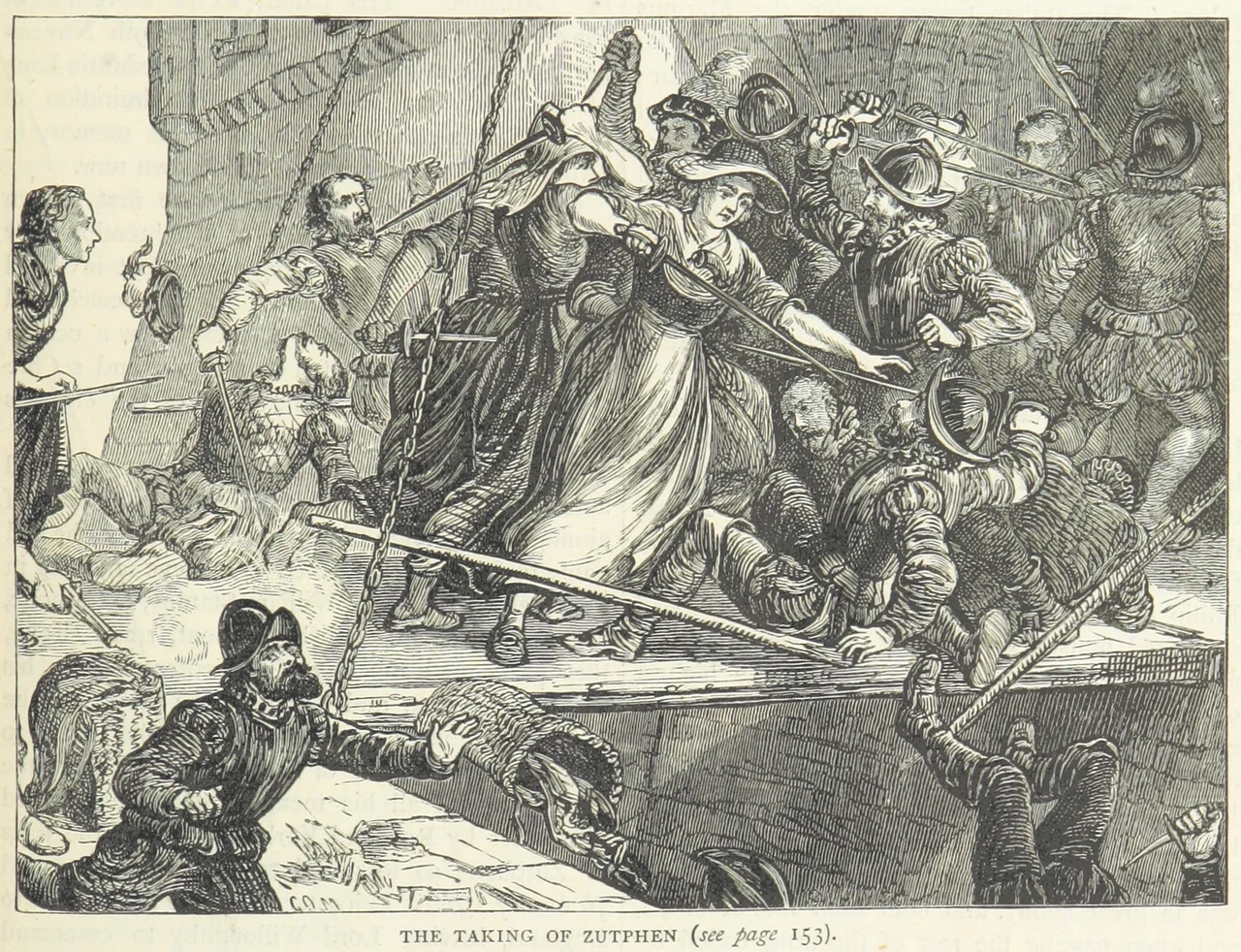

Siege of Zutphen (1591)
They walked up to the Spanish fort selling cheese. A handful of English soldiers, drilled in advance by Sir Francis Vere, dressed as Dutch farmers heading to market. A few wore women's clothes. They carried baskets of butter, cheese, and eggs and they let the Spanish guards open the gates and rummage through the goods, while a sham cavalry charge appeared on the horizon to make their flight to the walls convincing. By the time the order was given, the disguised English were inside the sconce. By the time the Spanish realised what was happening, the gates were open and Maurice of Nassau's cavalry was thundering across the field. Eleven days later, on the last day of May 1591, Zutphen was Dutch again.
A Hanseatic City With a Bloody Memory
Zutphen had been a prize for centuries before Maurice came for it. The city sat on the east bank of the IJssel, prosperous from Hanseatic trade, and it controlled river traffic in a way that made it strategically essential. It had also been the scene of one of the Dutch Revolt's worst atrocities. In 1572, after a brief State occupation, Don Frederick's Spanish army recaptured the city and slaughtered the population in punishment for its earlier surrender. Almost two decades on, the city was still firmly in Spanish hands, partly because of a sordid betrayal: in 1586 the English captured the key outlying sconce on the river's west bank, only to have it handed back to the Spaniards by Rowland York, a turncoat whose name would echo through this siege as well.
The Young Stadtholder's Method
Maurice of Nassau, son of the murdered William the Silent, was 23 years old and changing the way Europeans fought. He had taken Breda in 1590 by hiding troops in a peat barge, a stunt that gave his army a forward base and gave the Republic a template: speed, deception, and overwhelming artillery once the enemy was off balance. In the spring of 1591 he marched his army from the south to the IJssel in five days, his guns following by ship because barges hauled cannon faster than oxen could drag them through Dutch mud. To take Zutphen he first had to take the sconce on the Veluwe side of the river - the same fort Rowland York had betrayed four years earlier. He turned to Vere, who had asked for the assignment, and gave him a dozen men.
The Ruse
Vere brought his English troops to Doesburg and rehearsed the trick. On the appointed morning his disguised men walked toward the sconce, baskets in hand, while a pretend Dutch cavalry patrol appeared in the distance, sabres drawn. The disguised soldiers ran for the gate as if seeking refuge from the riders. The Spanish guards, seeing farmers with goods to sell, let them in. The English even paused to negotiate over butter and eggs, the kind of homely transaction that would not raise alarm in a garrison hungry for fresh food. Then the order came. The guards were cut down before they could shout, the gates were flung wide, and Dutch cavalry hidden behind a nearby mound rode through. The whole Anglo-Dutch column followed. The sconce, and with it the bridge over the IJssel, was Maurice's.
Eleven Days
Once the bridge was secured and Count William Louis arrived with his Frisian companies, Maurice could conduct a proper siege. The barges came up the river and disgorged their cannon, and the Dutch gunners positioned thirty pieces at three points around the city, ready to bombard or to repel any Spanish sortie. They opened fire. The Spanish garrison inside Zutphen, isolated now and watching enemy artillery wheel into place, did the calculation any professional soldier would do. They surrendered. The terms were lenient: the garrison could march out unharmed, and the citizens were given three days to leave or to swear allegiance to the Dutch Republic. Many chose to stay. Zutphen would remain in Dutch hands for the rest of the Eighty Years' War.
The Fox and the Gibbet
Vere earned a nickname that day: 'the fox.' He earned something else too. Rowland York had died in 1588, but Vere had not forgotten his betrayal of the sconce in 1587. He had York's body exhumed, hanged, and gibbeted - a brutal piece of theatre meant to remind every traitor that the long memory of an army outlives a coffin. Maurice did not linger to enjoy the moment. He sent his guns back down the IJssel in their barges and marched north. Deventer, also lost to Spanish treachery in 1587, was his next target. Within months he would take that city too, then Hulst, then Nijmegen. The campaign of 1591 had begun with a basket of cheese and ended with the entire eastern Netherlands swinging back to the Republic.
From the Air
Coordinates 52.14 N, 6.20 E, with Zutphen on the east bank of the IJssel and the historic sconce site on the Veluwe (west) side. The river curves distinctively here, and the medieval city's red-roofed core and Walburgis tower are easy to spot. Recommended viewing altitude 2,500-4,000 ft AGL. Nearest field is Teuge International (EHTE) roughly 12 nm west-northwest; Deelen (EHDL) lies south-west. The Veluwe forests press up to the west bank - the same wooded terrain that hid Vere's cavalry behind a mound on a May morning in 1591.
Nearby Stories
- Haaksbergen 5.8 km away
- Heerde 6.1 km away
- Kleve 7.3 km away
- Heesen Yachts 9.8 km away
- Aviodrome 11 km away
- Grebbe Line 12 km away
- Raesfeld Castle 15 km away
- Hans Philipp 17 km away