
Woerden
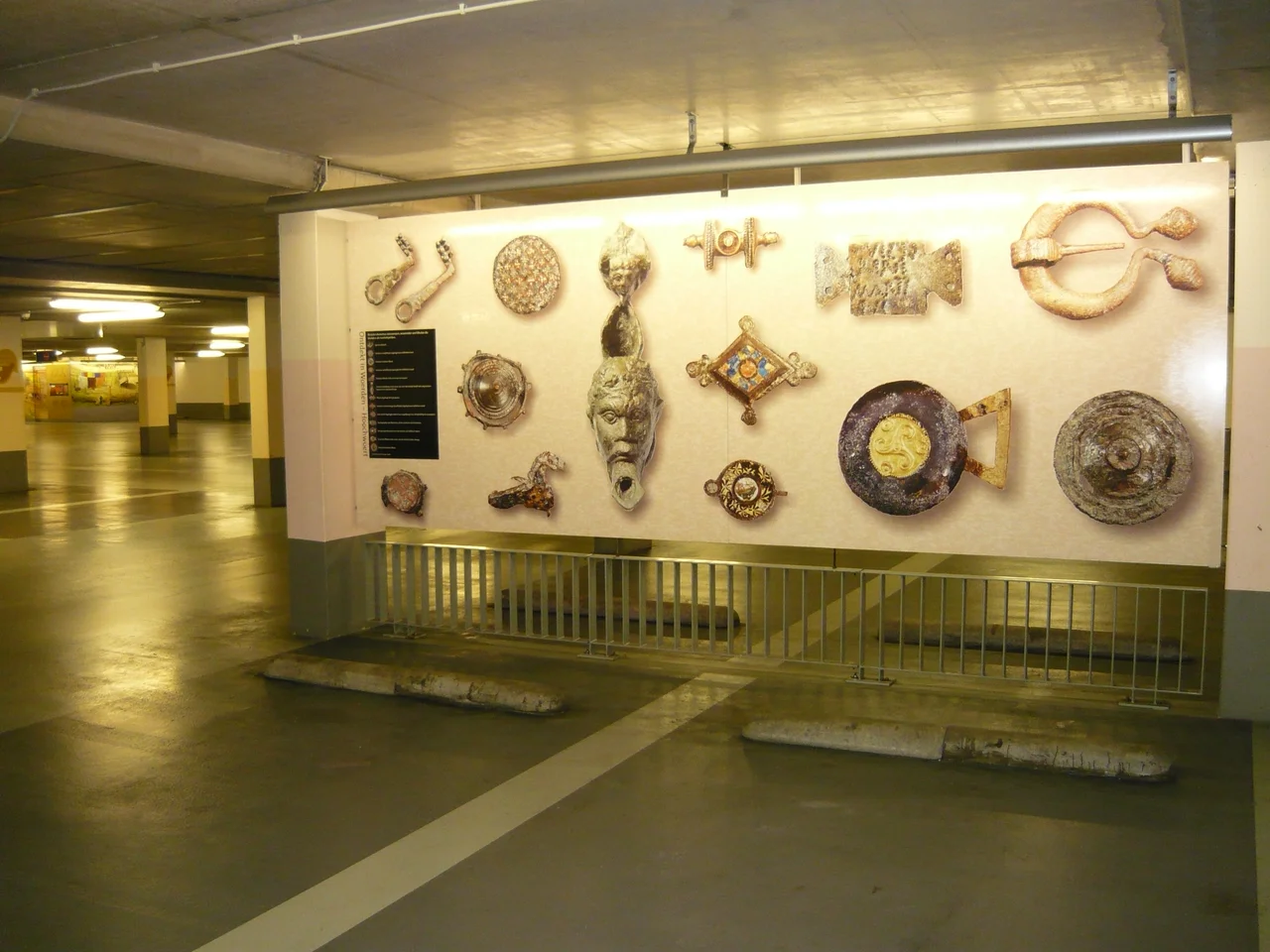
Beneath the Saturday cheese market in the center of Woerden, archaeologists found a Roman ship. They were digging a parking garage in 2003 when the contractors hit something that should not have been there: timbers from a cargo vessel that had been moored at the northern edge of the empire nearly two thousand years earlier. The site sat on a slight rise above the surrounding bog, the only solid ground for miles. The Romans built a fort here in the 40s AD and called it Castellum Laurum. The Dutch built a cheese market on the same spot eighteen centuries later. Both groups knew a good location when they saw one.
The Northern Edge of Rome
The Oude Rijn was a frontier once. Castellum Laurum stood on its bank as part of the limes, the line of forts that marked where the Roman Empire stopped and the cold forests of Germania began. The first castellum went up in the 40s AD, burned during the Batavian rebellion of 69, and was rebuilt the following year. Soldiers kept watch here until 402 AD, give or take a few decades of disruption around 275. They left behind pottery, coins, the bones of a cargo ship, and a Frankish sword that someone dropped on the old castellum grounds in the 8th century and which surfaced again in 2012. The medieval Petruschurch was built directly over the Roman fort. Layers of empire, sitting on top of each other, the same way water sits on Dutch land.
Bishop or Count
After Rome fell, the empire that mattered here was the church. The Bishop of Utrecht claimed Woerden in a tenth-century inventory with a single line of Latin: In UUrdin totum Sancti Martini. In Woerden, everything belongs to Saint Martin. But the Counts of Holland were rising along the coast, and by 1160 the bishop had built a castle in Woerden to hold his ground against them. The town spent the next four centuries as a border post between two stubborn powers. Local lords played both sides badly. In 1296 Herman van Woerden helped assassinate Count Floris V on a hunting party and was driven into exile. The castle he had defended still stands at the heart of town, much rebuilt, much less defensive than it used to be.
Jan the Baker
Erasmus probably spent four years of his boyhood in Woerden, in the household of his father the local priest. A generation later another Woerden son made a more dangerous choice. Johannes Pistorius - Jan de Bakker, named for his father's other trade - returned home from Leuven in 1522 as a Catholic priest with Lutheran sympathies. He preached the new ideas, broke his celibacy, married. The Inquisition arrested him in May 1525 and took him to The Hague. On 15 September they burned him at the stake. He was the first preacher in the Northern Netherlands to die for the Reformation. His widow saved her life by recanting and lived out her years in an abbey. Forty years later the city magistrates, still tolerant of Lutherans, would face down a duke who tried to force them back to Catholic worship.
Cheese on the Square
Since 1885, every Saturday in spring and summer, wheels of Gouda are stacked on the marktplein in the city center and traded the old way - by handshake, with the price agreed by clap of palm against palm. Woerden sits in the heart of the region that produces the cheese the rest of the world calls Gouda, and the market here predates the renovations of De Windhond, the gristmill that still turns nearby. The cheese-makers' warehouses, the kaaspakhuizen, line the streets around the square. The river that once carried Roman supplies was diverted around the city center in 1960. Where it used to flow, you can now walk between buildings that have been standing for five centuries.
Quiet Town with Loud History
Today Woerden is a commuter town, fifteen kilometers from Utrecht, thirty-two from Amsterdam. About 720 people lived inside its walls when it received city rights in 1372. The population has grown but the medieval street plan is still legible: a moat, a wall line, the steeple of the Petruschurch standing where the Roman fort once stood. The town hall built in 1510 is now a museum. Walk the streets long enough and you start to feel the layers - the legionary, the bishop, the heretic, the cheesemonger - all standing in the same square, separated only by time.
From the Air
Woerden sits at 52.09 N, 4.88 E in the central Netherlands, fifteen kilometers west of Utrecht. From altitude the town shows as a small compact urban area, the medieval core still legible as a roughly oval moat around the church steeple, set among the geometric polder fields drained in the medieval reclamation. Nearest major airport is Schiphol (EHAM) about 35 km northwest; Rotterdam-The Hague (EHRD) lies 45 km southwest. Visibility in the Netherlands is often hazy in summer; the polders below Woerden are best appreciated at lower altitudes where the grid pattern of medieval drainage ditches comes into focus.
Nearby Stories
- Halfweg Sugar Factory 0.3 km away
- Luchterduinen Offshore Wind Farm 5.2 km away
- Kamp Amersfoort 6.4 km away
- Ockenburg 6.6 km away
- Hellevoetsluis Dry Dock 6.9 km away
- Dordrecht 7.3 km away
- Oostvaardersplassen 9.8 km away
- 's-Hertogenbosch 19 km away