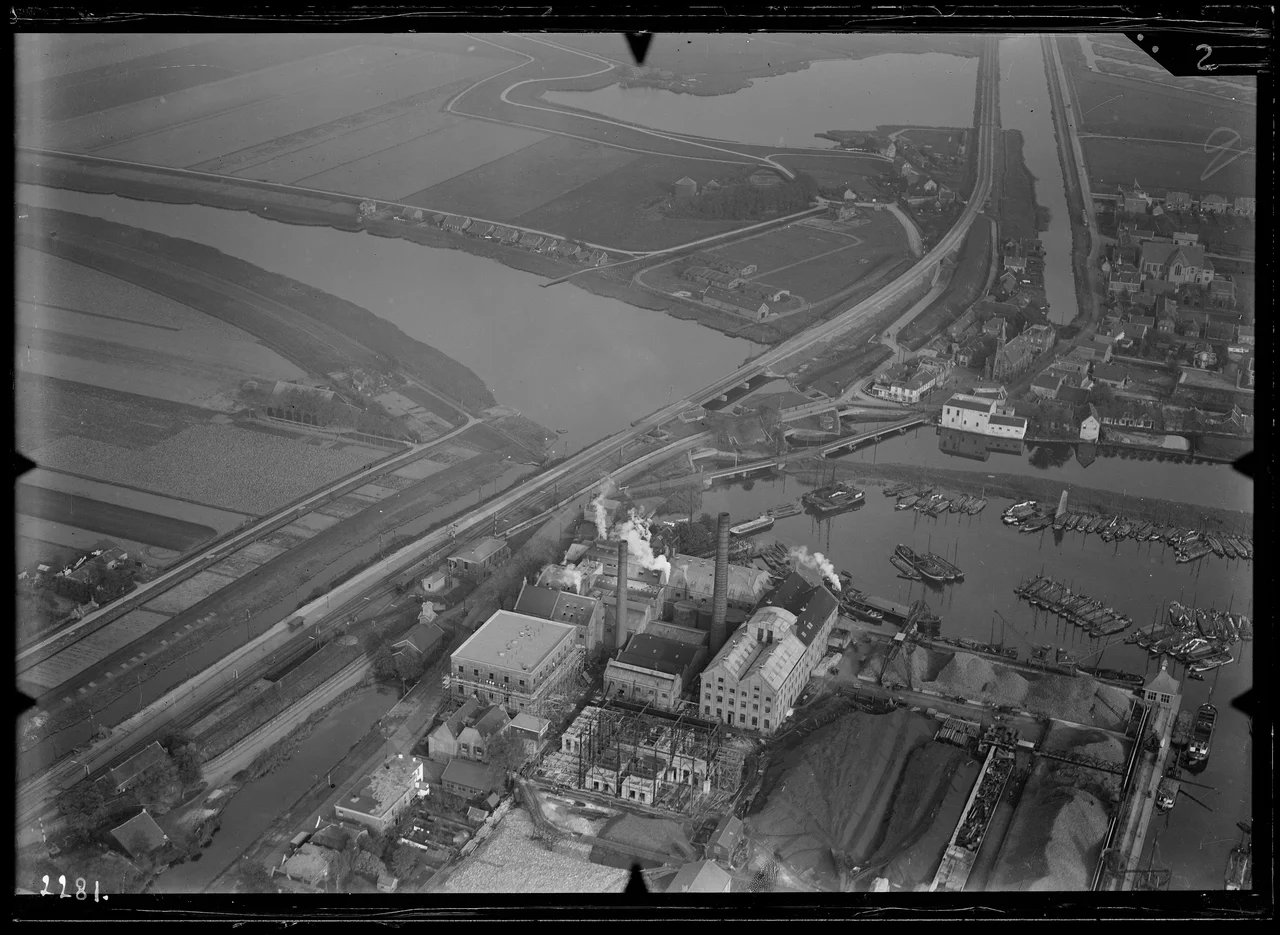

Halfweg Sugar Factory
Picture a single autumn day in November 1890. Forty to fifty barges crowd the wharves at Halfweg, riding low under tonnes of sugar beet hauled in from the polders. The factory chimney smokes around the clock. The sweet, slightly burnt smell of boiling beet juice hangs in the air for miles, drifting east on the wind toward Amsterdam and west toward Haarlem. This was the campagne, the brief, frantic processing season that defined the Dutch sugar year, and Halfweg was at the centre of it. The campaign lasted weeks; the factory itself lasted 130 years. When it finally closed in 1992, the silos still held twenty million kilos of sugar - the whole season's crop, packaged up for the supermarket shelves of a Netherlands that had forgotten where its sugar came from.
Halfway Between Two Cities
The village got its name from the trekvaart, the horse-drawn passenger canal completed in 1632 between Amsterdam and Haarlem. The canal was not continuous through the polders of Houtrijk and Polanen, so passengers had to disembark and switch boats here, halfway along the route. A settlement formed around the transfer point. In 1645 the architect Pieter Post designed a stately house here for the regional water board - the Gemeenlandshuis Zwanenburg - sited just west of the sluices that kept brackish IJ water out of the Haarlemmermeer lake. Two centuries later, after the great lake had been pumped dry in 1852, the elegant Zwanenburg building stood functionless and was scheduled for demolition. Then someone noticed it was tall, strong, and right next to navigable water - exactly what a sugar factory needed.
Beet, Cartel, and Survival
The first attempt failed. Sugar factory Zwanenburg opened in 1863 inside the old water-board mansion, but the local Haarlemmermeer beet were salty and low in sugar, the operation never quite paid, and in 1881 creditors auctioned the works for 84,600 guilders. The buyer was Adrianus van Rossum, an Amsterdam sugar merchant; in 1882 he reorganised the works as Suikerfabriek Holland. Where his predecessors had failed, van Rossum succeeded. Capacity rose from 120 tonnes of beet per day in 1882 to 1,360 tonnes by 1907; from five boilers to fourteen; from seven steam engines to thirty-six. By the start of the new century Holland was one of the most productive sugar factories in the country, surviving even the Bond van Suikerfabrikanten - the price-fixing cartel - and the coal shortages of the First World War.
Barges by the Thousand
Sugar beet is heavy and water transport was cheap, so the campagne ran on barges. In 1900 alone, 1,497 vessels moved beet to the Halfweg works. By 1961, even after the rise of trucking, the factory still received 1,300 barges and 14,000 trucks in a single season. The 1898/99 campaign processed more beet in 52 days than the previous year had managed in 108 - the engineers had learned that a short, intense campagne let them squeeze more sugar from beet before storage robbed them of it. Photographs from the 1930s show a near-solid raft of barges queued along Zijkanaal F, waiting their turn at the unloading cranes. A 1932 film records the other side of the equation: wet autumns when fields turned to mud and farmers could not get their crop to the canal at all.
From CSM to Closure
In 1920 the Centrale Suiker Maatschappij - the new sugar holding that would dominate the Dutch industry - bought a controlling share, and Halfweg became one cog in a national machine. The factory shifted from raw to white sugar in 1953 and was rebuilt almost entirely between 1958 and 1963, replacing batch processing with continuous-flow automation. Two 43-metre silos went up in the 1960s, each capable of holding twenty million kilos - a whole season's white sugar, ready to be packaged in the new consumer-friendly one- and two-pound bags that supermarkets demanded. By 1992, however, CSM concluded that its factories in Breda and Groningen could fill the entire European quota. The Halfweg sugar was being sold on the world market at a quarter of the European price. That autumn, after one last campagne, the works closed for good.
Sugar City
What survives is one of the most complete industrial heritage sites in the Netherlands. The pre-industrial Gemeenlandshuis Zwanenburg from 1645 still stands - the water-board mansion that became a sugar mill. So do the silos, now wrapped in sheet metal and pierced with hundreds of small LED lights that turn the night-time skyline into something between architecture and signal. The middle factory and the old pulp press hall host events under the name SugarFactory; the 2015 knockout rounds of The Voice of Holland were filmed here. In 2007 the complex joined the European Route of Industrial Heritage. In 2020 a designer outlet mall opened on the western tip, where the 1980 beet-pulp storage shed once stood. The smell of boiling sugar is long gone. The silhouette of an industry that once ran the Dutch autumn remains.
From the Air
Coordinates 52.385°N, 4.744°E, on the Ringvaart canal halfway between Amsterdam-Schiphol and Haarlem - and directly under Schiphol's approach paths. The site is unmistakable from the air: two cylindrical 43-metre sugar silos rising beside the wide Ringvaart, with the original 1645 Gemeenlandshuis Zwanenburg and the brick factory buildings clustered around them. Schiphol (EHAM) lies about 4 nm south-southwest, so most flyovers here are airliners on final or departure. VFR traffic operates well outside this zone.
Nearby Stories
- Battle of Camperdown 2.1 km away
- Randstad 6.4 km away
- Oostvaardersplassen 6.7 km away
- Luchterduinen Offshore Wind Farm 7 km away
- HMS Prince George (1895) 7.2 km away
- Amersfoort 9.6 km away
- Ockenburg 16 km away
- Stavoren 18 km away