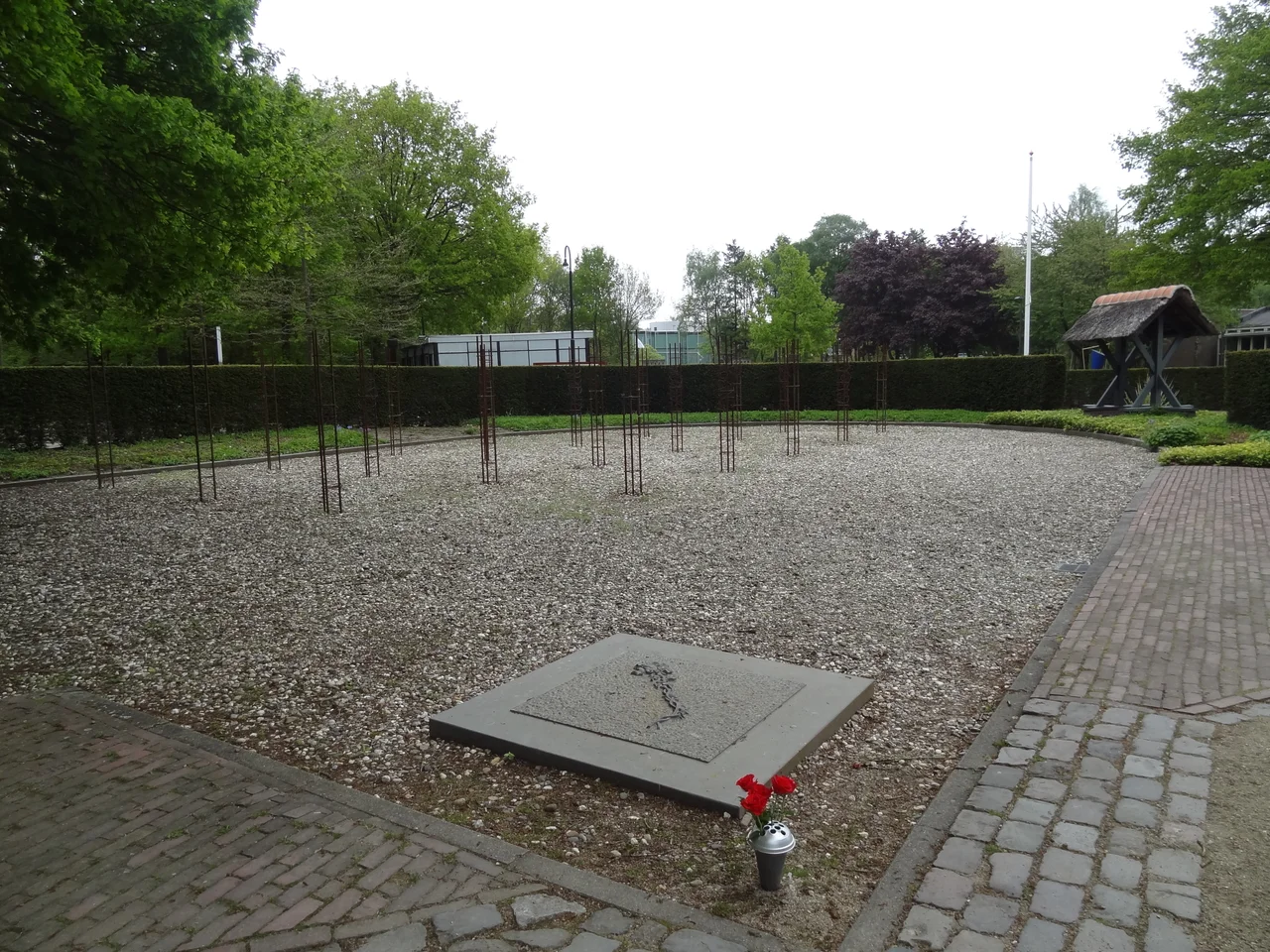

Kamp Amersfoort
They came on foot from the railway sidings, walking through ordinary residential streets in Amersfoort to reach the camp gate. Witnesses inside the houses remembered the silhouettes behind the lace curtains: their own children, mostly motionless, sometimes lifting a hand in a small uncertain wave that an adult quickly pulled back down. Forty-seven thousand prisoners would make that walk between August 1941 and April 1945. They were Jews, Soviet prisoners of war, resistance fighters, Jehovah's Witnesses, communists, clergy, hostages, alleged smugglers, ordinary Dutchmen swept up for reasons large and small. Most survived the camp. Many did not survive what came after, when the trains continued east. Kamp Amersfoort was a transit camp, but the word transit is doing too much work. The prisoners were beaten, starved, frozen, infected, and worked into illness here. Some were killed in the woods nearby. Then the survivors were put on trains.
Polizeiliches Durchgangslager
Before the war, the site was a complex of barracks attached to artillery exercises on the Leusderheide, the heath just north of the municipality of Leusden. The Germans took it over and gave it an official name in two words of bureaucratic German: Polizeiliches Durchgangslager Amersfoort, the Amersfoort Police Transit Camp, abbreviated P.D.A. The first prisoners arrived on 18 August 1941. The camp ran for nineteen months in its first incarnation, until March 1943, when nearly all the surviving prisoners were transferred to Kamp Vught and the site was expanded. From April 1943 it ran again with greater capacity and faster turnover, until 19 April 1945, when the German staff fled and Loes van Overeem of the Dutch Red Cross took control. Canadian soldiers of the First Canadian Army arrived to formally liberate the camp on 7 May, the day German forces in the Netherlands surrendered. The single watchtower that remains on the memorial site today was built in the spring of 1943.
The One Hundred and One
After Operation Barbarossa, Soviet prisoners of war began to arrive. Among them, in late 1941, were 101 Uzbek soldiers, men from Central Asia conscripted into the Red Army, captured in the western frontier campaigns and shipped to the Netherlands for a reason that survives only as a phrase in the records: to be displayed to the Dutch for propaganda purposes. They were paraded as evidence of the supposed Asiatic savagery the Reich was fighting. All of them died. Some died in the winter of 1941, of cold and hunger and untreated illness. The rest were taken to the woods near the camp in April 1942 and executed. They had names. The records of those names are incomplete; their families in Uzbekistan went on waiting for letters that would never come. They lie now, with 864 other Soviet prisoners who died in or near the camp, in the Rusthof cemetery a short distance away.
Names of the Cruelty
The camp leaders are named in the surviving documents and were tried in Dutch courts after the war. SS-Schutzhaftlagerfuhrer Karl Peter Berg, in command from January 1943, was described by witnesses as a predator who took pleasure in others' suffering, sneaking behind the rows of prisoners on roll call to catch them in small infractions and torment them with a wide grin. He was sentenced to death and executed in 1949. SS-Unter-Schutzhaftlagerfuhrer Josef Johann Kotalla, a former sales representative and repeat psychiatric patient, was the most notorious sadist on the staff. The resistance fighter B.W. Stomps remembered Kotalla's Christmas 1944: on 23 December Kotalla banned all parcels for three weeks, on 25 December he cancelled all three meals on the pretext of a smuggled letter, and on Christmas morning he kept the men standing on the snow-covered parade ground from seven in the morning until half past noon. The geese for the guards' Christmas dinner hung from the barbed wire where the prisoners could see them. Kotalla was sentenced to death; his sentence was commuted to life; he died in a Dutch prison in 1979.
Life in the Camp
Between 1941 and 1943, around 8,800 people were imprisoned at Amersfoort; 2,200 were deported to Germany. Between 1943 and 1945, 26,500 more passed through; 18,000 were sent east to Buchenwald, Natzweiler, and other camps. After the July 1942 deportations of Dutch Jews began, Amersfoort became one of three Dutch sites, with Vught and Westerbork, from which Jewish prisoners were sent to Auschwitz, Sobibor, and Theresienstadt. Edith and Rosa Stein, two ethnic Jewish Catholics arrested by the SS, arrived at three in the morning on 3 August 1942 and were driven from the vans with truncheons into huts where 300 men, women, and children lay on iron frames without mattresses; the guards switched the lights on and off through the night. The Stein sisters were sent to Auschwitz and killed within days. Edith Stein, a philosopher and Carmelite nun, was canonized by Pope John Paul II in 1998. The prisoners of Amersfoort were also afflicted by lice, dysentery, diphtheria, tuberculosis, hunger that emptied bodies and minds, and a kind of cold that the young boy Yehudit Harris would remember as the pain of his mother washing him with snow to keep him alive. Elie Cohen, who survived, said that being transferred from Amersfoort to Westerbork felt like going from hell to heaven.
What Remains, and What Does Not
The site today is the Nationaal Monument Kamp Amersfoort, a memorial and museum on the boundary between the municipalities of Amersfoort and Leusden. The single watchtower from 1943 still stands. So do the ruins of the mortuary, the rebuilt rose garden where bodies were once stacked, the execution ground in the woods, and a wall of names that does not pretend to be complete. The men who ran the camp were tried, and most were punished. The Breda Four, including Kotalla, became a long Dutch political controversy in the postwar decades about whether mercy was possible for what these men had done; Kotalla was the only one who was not eventually released. The town that watched the silhouettes pass behind its lace curtains has spent eighty years thinking about what those silhouettes saw looking back. The walk from the railway sidings to the camp gate is still there, paved now, residential, quiet. The visitors who follow that route in 2026 are mostly the great-grandchildren of the witnesses, and the children of the children whose hands were pulled back from the windows.
From the Air
The memorial site is at 52.131 N, 5.365 E, on the boundary between the municipalities of Amersfoort and Leusden, just south of central Amersfoort. From cruising altitude, the location is visible as a small cleared site in the wooded edge of the Leusderheide, with the city of Amersfoort to the north and the Veluwe ridge starting to the east. Schiphol Airport (EHAM) lies 45 km west; Soesterberg (closed) is 5 km west-northwest; Lelystad (EHLE) is 30 km north. The Onze Lieve Vrouwentoren in Amersfoort, 4 km north, is the most prominent visual landmark in the immediate area. Approaches should respect this as a place of mourning.
Nearby Stories
- Willem I Lock 0.9 km away
- Battle of Woerden 3.3 km away
- Ter Horst Castle 3.6 km away
- Heerde 6.4 km away
- Flevopolder 8.2 km away
- Heesen Yachts 11 km away
- Kleve 13 km away
- De Biesbosch National Park 16 km away