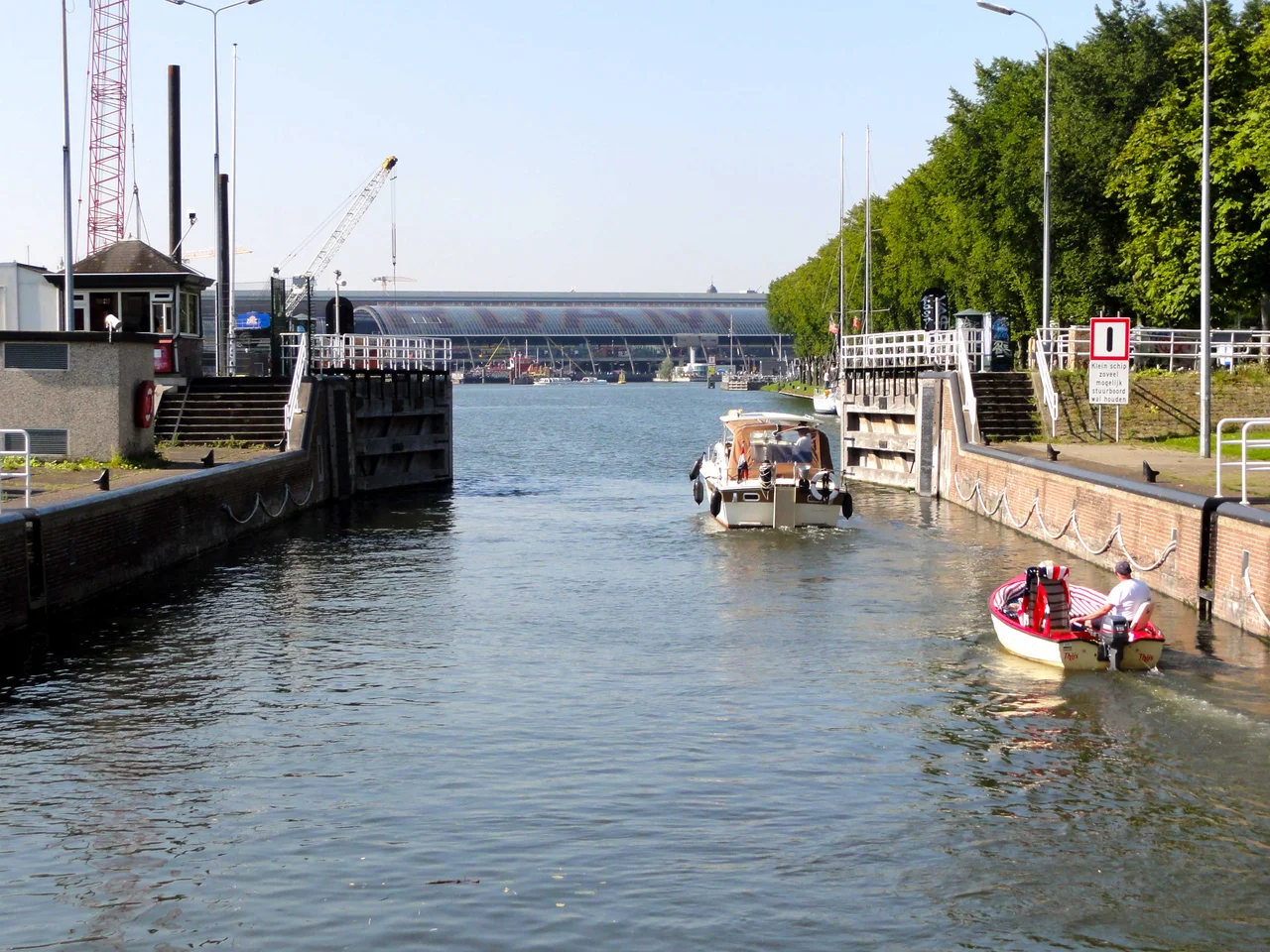

Willem I Lock
In late April 1857 the brand-new Dutch steam frigate HNLMS Wassenaar arrived at the IJ-side of Willem I Lock, on the north bank opposite what is now Amsterdam Centraal Station. The lock had been open for thirty-three years. The Wassenaar would not fit. To get her through, the engineers closed the Buiksloot Flood Gate further up the canal, opened the lock to the IJ, and let salt water flood into the polders until the Noordhollandsch Kanaal sat level with the harbor. On 2 May the frigate was hauled through. A day later, the Wassenaar reached the identical lock at Purmerend - same dimensions, same builder - and passed it without difficulty. Why one worked and the other didn't became a debate that helped trigger the construction of the entire North Sea Canal.
The King's Canal
Willem I Lock sits at the headland called Volewijck, a stub of land that pokes south into the IJ. In 1818 the new Kingdom of the Netherlands needed a way to get ocean ships to Amsterdam without the awful navigation of the Zuiderzee, and King William I commissioned Inspector General Jan Blanken to figure out how. Blanken proposed a 75-kilometer canal running north from Amsterdam to Den Helder, where the Wadden Sea meets the North Sea. The works were tendered in July 1819 and the canal opened gradually through the early 1820s. The first water entered the great lock chamber on 19 July 1821; the king himself came to see it, and a tent of models stood beside the lockworks. On 13 December 1824, the frigate HNLMS Bellona passed through Willem I Lock and made the first complete run on the new Noordhollandsch Kanaal.
Big Lock, Small Lock, Three Sets of Gates
Willem I was not one lock but two, side by side. The large chamber - originally 72.34 meters long, 15.70 meters wide, and 6.83 meters deep below the Amsterdam Ordnance Datum - handled the ocean-going ships. The small one, 25 meters long and 5.65 meters wide, served the canal barges and skippers who had used the local waterways long before they were absorbed into the king's project. A doubled lock like this was unusual in the Netherlands but common on British canals, and the point of the pairing was speed: at any given moment one chamber's gates were likely to be open and ready. What was unusual at Willem I was the third set of gates on the inland side, opening toward Waterland. Those were used only in exceptionally low tides on the IJ, when the harbor sat below the canal level and the gates had to keep the water in rather than out.
The Wassenaar's Problem
The puzzle of the Wassenaar's 1857 passage was that two identical locks behaved differently. At Willem I, the water level dropped as the ship descended toward the IJ, and the frigate's bow and stern - lifting and falling against the gate-tops as the water moved - struck the upper edges of the high IJ-side gates. At Purmerend the water rose, and the same hull shape was less of a problem. The Willem I gates also had to be taller; they were holding back the sea, while Purmerend was bridging a freshwater drop of only 52 centimeters in summer. The whole episode was less a quirk and more a warning: the canal that was supposed to keep Amsterdam connected to the open sea could not handle the new generation of warship. In 1856 the government appointed a commission to study what to do. Among its recommendations was Willem III Lock - bigger, deeper, finished in 1864 - and, eventually, an entirely new North Sea Canal cut straight west from Amsterdam to IJmuiden, the canal that has carried Dutch shipping ever since.
Shipworm and Brick
On 16 December 1864, one day after Willem III Lock opened next door, Willem I Lock was decommissioned and cut off by a dam so it could finally be repaired. The reason for the damage turned out to be entirely biological: the wooden floor of the lock had been chewed apart by shipworm, the same boring mollusk that had threatened Dutch sea dikes for centuries. The brickwork above had cracked along with it, which was why salt water had been leaking into the polders for years. The Dutch rebuilt the floor in brick this time. The small chamber was lengthened from 25 to 50 meters. On 25 June 1868 the small lock reopened; on 12 December 1868 the large lock followed. The official names Schutsluis Willem I and Schutsluis Willem III had been fixed by decree on 6 October 1864.
Still Working
Willem III Lock is now closed off and silent. The Noordhollandsch Kanaal has lost most of its commercial traffic to the bigger North Sea Canal that runs west from Amsterdam to IJmuiden. But Willem I Lock still operates. The large chamber handles commercial and recreational vessels moving between the IJ and the polders of North Holland. The small chamber, decommissioned in 1992, was restored in 2009 for recreational use and water management, and the province has been working toward remote operation. From the Amsterdam Centraal ferry across the IJ, the lock is visible on the far bank near the Tolhuis - two centuries of brick, water, and gates still doing exactly what King William asked them to do.
From the Air
Coordinates 52.384N, 4.908E, in Amsterdam-Noord on the north bank of the IJ directly across from Amsterdam Centraal Station. Schiphol (EHAM) is 17 km southwest. Best viewed at 2,000-3,000 ft; the lock complex marks the IJ-end of the Noordhollandsch Kanaal, which runs north 75 km to Den Helder. From the air the lock is identifiable as the southernmost set of gates on the canal where it meets the IJ at the Volewijck headland, with Amsterdam Centraal and the historic city center clearly visible on the opposite bank. The much larger North Sea Canal, which superseded the Noordhollandsch Kanaal for ocean shipping, runs west from Amsterdam to IJmuiden and is the dominant waterway on any overflight of the region.
Nearby Stories
- Battle of Camperdown 2.1 km away
- Randstad 6.4 km away
- Oostvaardersplassen 6.7 km away
- Luchterduinen Offshore Wind Farm 7 km away
- HMS Prince George (1895) 7.2 km away
- Amersfoort 9.6 km away
- Ockenburg 16 km away
- Stavoren 18 km away