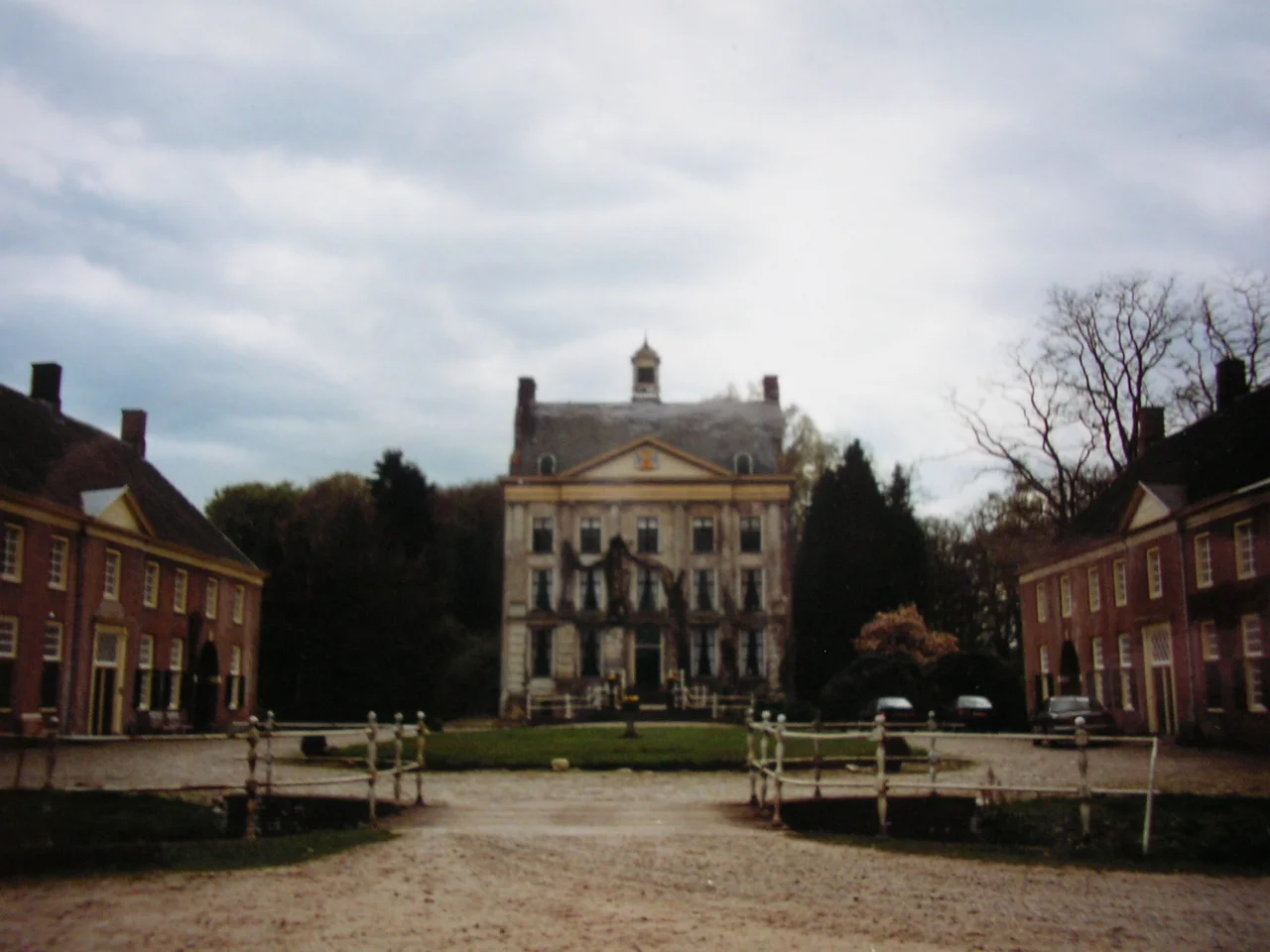

Ter Horst Castle
On 9 October 1423, the Bishop of Utrecht died at a quiet house in the woods near Loenen. Frederik van Blankenheim had ruled his diocese for thirty years and shaped the medieval map of the northern Low Countries, but his last day was spent at a manor whose foundations were already old when he arrived. The cellars beneath Ter Horst Castle still hold stones laid around 1300, when the Duke of Gelre kept his rents here - cheese and grain hauled out of the Veluwe and stacked against a tax season older than the castle itself. Bishops, dukes, families with seven generations of one surname above the door: the place has outlasted most of what tried to define it.
Older Than Itself
There has been something here much longer than the castle that bears the name. In the 14th century a fortified house belonging to the Duke of Gelre stood on the site, used as a storage point where peasants delivered the rent of the Veluwe in kind - sheaves, salted meat, casks - and where ducal officials kept their ledgers. That earlier structure was destroyed in the regional wars of about 1354. For two centuries afterwards the site was just a farm. The stones from 1300 survive only as the floors of the present castle's cellars, an underfoot reminder that what looks like a country house began as a tax barn for a vanished duchy.
A Mayor Builds a Castle
In 1557 Wynant Hacfort, the mayor of Arnhem, decided he wanted a country seat befitting his standing. He built a castle on the old foundations: stepped gables on the side facades and on the entrance front, the typical silhouette of a mid-16th-century Gelderland manor. The Hacfort family would hold Ter Horst for seven generations - long enough that the name became attached to the place as firmly as the moat. Tucked into the annexes was a small shelter that doubled as a Roman Catholic chapel for the village of Loenen during centuries when Catholic worship in the Republic was tolerated but kept out of sight. The chapel's altar carries marble paintings dated 1792, a small fragment of an underground religious life now made publicly visible.
Front Becomes Back
In 1791, architect Roelof Roelofs Viervant gave Ter Horst its current face. Stately neoclassicism in natural stone replaced the stepped gables, the entrance was rotated 180 degrees so that what had been the back of the house became the front, and a new forecourt, outbuildings, and a bridge linking the castle to its forecourt were laid out. The orangery, which serves visitors today as the elegant face of garden Ter Horst presents to its admirers, predates everything around it - the building was originally a granary, and church records from 1557 suggest it may earlier have functioned as the parish church of Ter Horst's estate, in the medieval diocese of Deventer.
Seven Families, One House
After the Hacforts came the Van Wijnbergens, through marriage in 1862. Then the Van Lyndens, then the Van Leeuwens. In 1933 the Russelman family bought the castle and the estate, and the Russelman name still appears on the deed nearly a century later. Ter Horst is a private home, lived in by the Russelman and Schoonderwoerd families, and the rhythm of an inhabited house is part of what visitors sense when they walk the grounds: smoke from a chimney in winter, washing on a line beyond the trees, the low hum of a working estate. A specially decorated room hosts weddings, and the orangery and gardens open to the public on occasion. Until 1927 the lord of Ter Horst also owned the nearby paper mill De Middelste Molen, still a working water-powered mill today - one of those old Veluwe industries the castle's owners managed as a matter of course for hundreds of years.
From the Air
Coordinates 52.12 N, 6.03 E, northeast of Loenen village on the road to Klarenbeek, set in mature woodland on the Veluwe's eastern flank. Look for the moat reflecting around a compact neoclassical block with a separate orangery and outbuildings. Recommended altitude 1,500-2,500 ft AGL; the wooded estate breaks up the surrounding farmland clearly. Teuge International (EHTE) is roughly 5 nm north-east, an easy starting point for a visual tour of Apeldoorn-area castles. Deelen (EHDL) lies south-west. The VSM heritage steam railway runs nearby, often visible as a plume of white smoke above the trees.
Nearby Stories
- Haaksbergen 5.8 km away
- Heerde 6.1 km away
- Kleve 7.3 km away
- Heesen Yachts 9.8 km away
- Aviodrome 11 km away
- Grebbe Line 12 km away
- Raesfeld Castle 15 km away
- Hans Philipp 17 km away