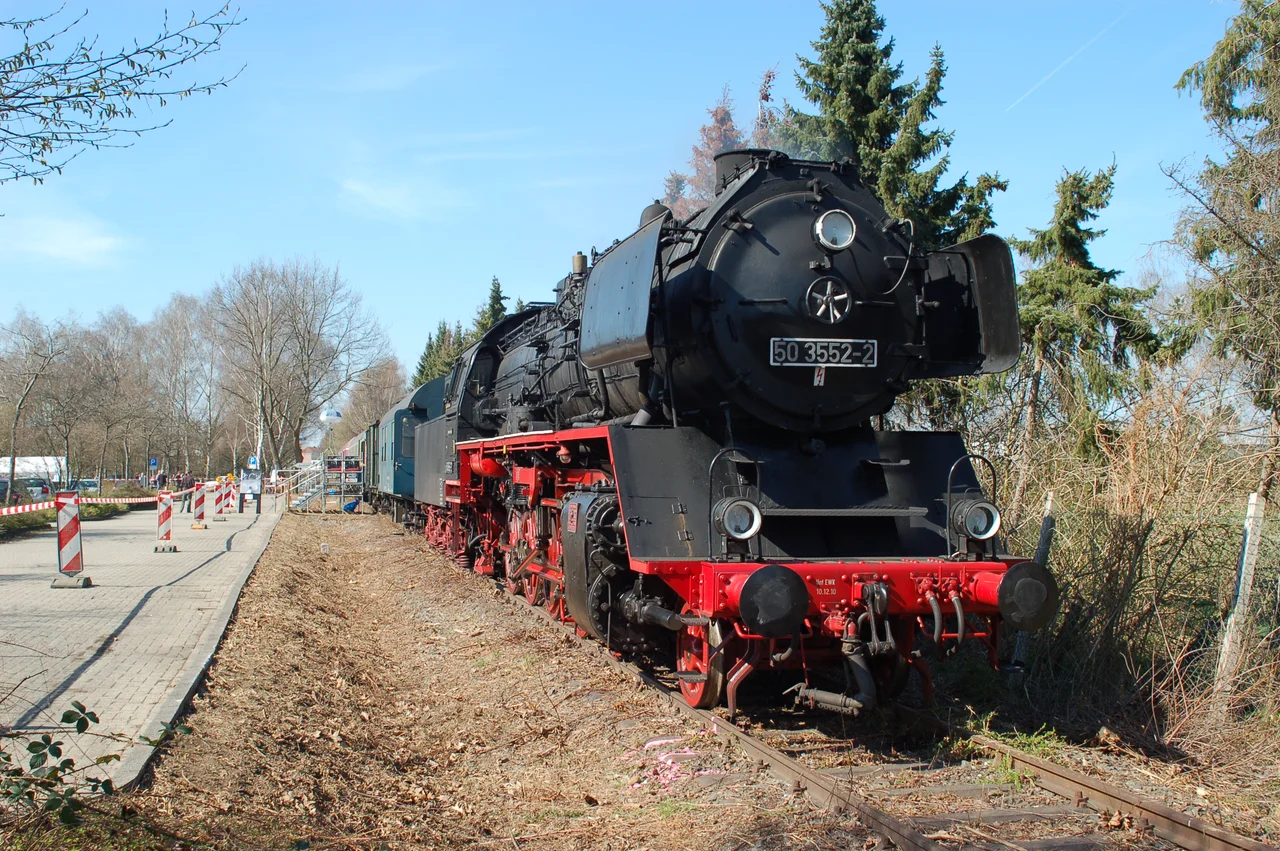

Heinsberg-Lindern Railway
When the railway surveyors arrived in Porselen in the late 1880s, the smallholders did not greet them with paperwork or pitchforks. They pelted them with marbles. The locals had been offered money for their fields and answered with the only ammunition handy. The marble-throwers lost. On 16 May 1890, the first train rolled twelve kilometers from Lindern, on the Aachen-Mönchengladbach main line, to the little terminus at Heinsberg, and the structurally weak farmland north of Aachen suddenly had a thread of iron tying it to the wider world.
Marbles and Manchester
The line was conceived more modestly than what came. Early plans imagined a narrow-gauge route or even a tramway for horse-cars, the kind of low-stakes infrastructure rural Rhineland councils could afford to argue about. Standard gauge won out, and standard gauge changed everything. Once the rails reached Oberbruch, a textile firm called Vereinigte Glanzstoff-Fabriken bloomed from a village workshop into one of the region's largest employers, hauling its own freight on its own works railway right through the streets. The Wurm Valley line had done its trick: it turned a side-pocket of the Rhineland into a working industrial district, with sugar beets, fertilizer, and chemical drums riding the same single track.
How a Branch Line Dies
By the 1970s, that working district was being talked down. A 1972 ZDF broadcast compared sleepy Heinsberg station with bustling Erkelenz and dismissed Heinsberg as a peasant village unfit to be a district seat. Passenger counts kept dropping, and the local CDU member of the Bundestag, Adolf Freiherr Spies von Büllesheim, accused Deutsche Bahn of cooking the books with surveys timed for school holidays and long weekends. He called the numbers unrealistic phantom figures. It did not matter. The last scheduled passenger train ran on 26 September 1980. Tractors had taken the sugar beet, trucks had taken the parcels, and the Heinsberg station building was demolished in the mid-1980s to make way for a shopping center.
A District Without Trains
Then came the strange middle period, when the Wurm Valley railway was technically a railway but practically a freight siding. Diesel locomotives shuttled wagons to and from the Chemiepark at Oberbruch, sometimes hauled by a fireless steam shunter of the Meiningen class - a relic that survived into the new millennium because it could move tank wagons without striking sparks near volatile chemicals. Meanwhile Heinsberg had earned a peculiar distinction: it was the only district in all of North Rhine-Westphalia, and one of very few in Germany, with no passenger trains at all. Bus route 493 rolled where the trains used to.
Bringing It Back
The reactivation took longer than the original construction. Pro Bahn activists campaigned through the 1990s. The state ministry was skeptical. Federal funding shrank, deadlines slipped, and an electronic interlocking refused to come online when promised. Then, on 13 December 2013, a public celebration filled the platforms, and two days later the first regular RB 33 service rolled into Heinsberg-Kreishaus and on to the new terminus near the bus station. The whole project cost around eighteen million euros, the line was electrified end to end, and a district of nearly a quarter million people stopped being the railless oddity of NRW. The marble-throwers of Porselen had lost again, but this time they had not even thrown anything.
Riding It Today
The route is still only twelve kilometers, still single-track for most of its length, still beginning on platform three at Lindern and climbing through the loess hills of the Jülich Börde before dropping into the Wurm valley. The old station buildings at Randerath and Porselen are gone, replaced by simple open platforms. The Oberbruch station building is now a physiotherapy practice. The Dremmen station, the only original entrance building left standing, is a picturesque ruin watching its replacement platform from across the tracks. RB 33 trains run twice an hour, in service of commuters who, a generation ago, had no choice but to drive.
From the Air
The Wurm Valley railway runs roughly northwest from Lindern (51.05N, 6.15E) to Heinsberg, a span of about 12 km parallel to the Dutch border. Recommended viewing altitude is 3,000-5,000 ft AGL to trace the line through agricultural country. The nearest airports are Mönchengladbach (EDLN) about 15 nm northeast and Maastricht Aachen Airport (EHBK) about 25 nm southwest. Clear weather is common; expect haze in summer over the open Börde landscape.
Nearby Stories
- Tegelen 1.9 km away
- Eilendorf (Aachen) 2.4 km away
- Duisburg-Hochfeld Railway Bridge 9.9 km away
- Tongeren 12 km away
- Geldrop Castle 12 km away
- Zons 13 km away
- Genk 14 km away
- F.L.Y. 14 km away