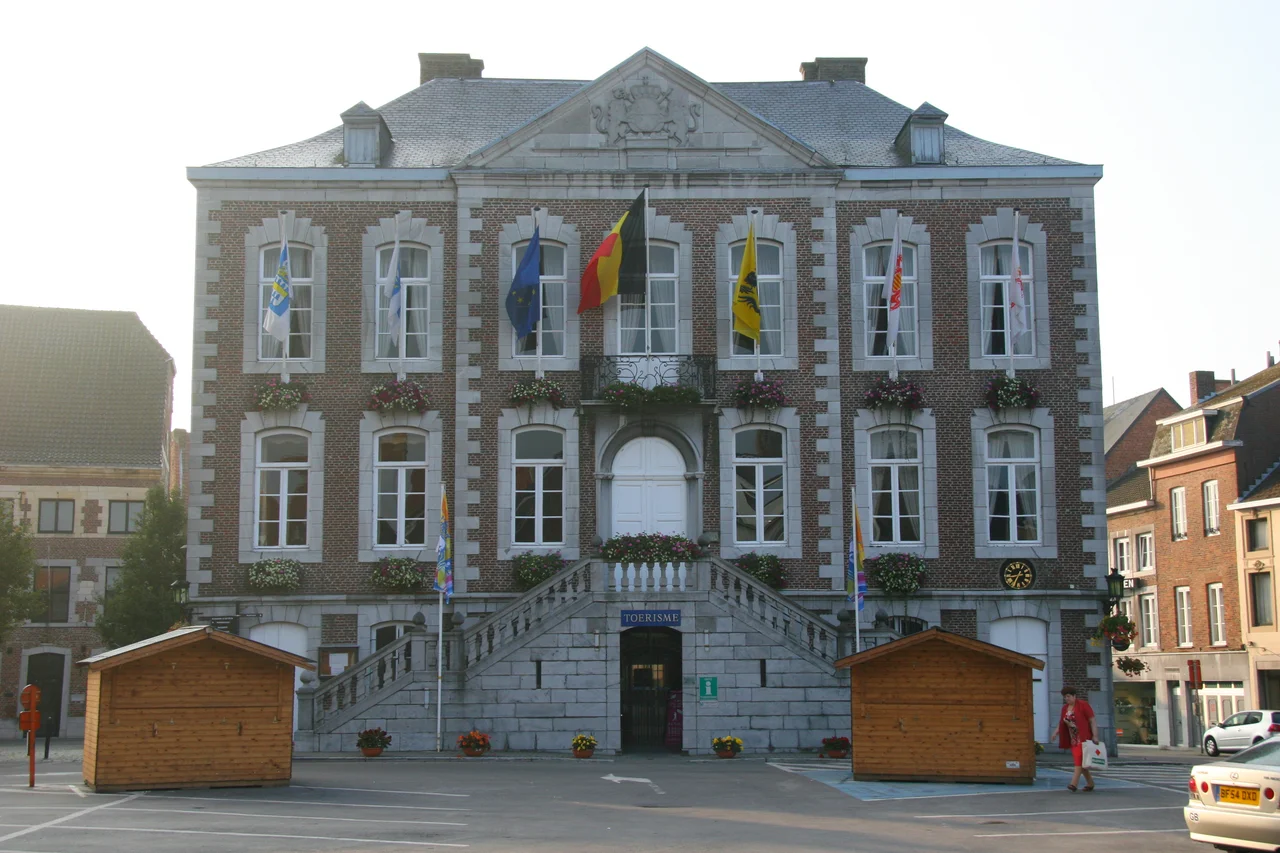

Tongeren
Ambiorix stands in the middle of the Grote Markt with one arm raised and his cloak frozen mid-swirl, a Gaulish chieftain cast in 1866 bronze to remind anyone passing through that in 54 BC, his Eburones tribe wiped out a Roman legion that had presumed to spend the winter in their territory. Caesar was so embarrassed that he reported in his Commentaries that he had "annihilated the name of the Eburones" - which was a lie, because Ambiorix slipped away and was never caught. Around the statue, the oldest town in Belgium goes about its weekly business: on Sundays, the largest antiques fair in the Benelux spreads across the squares, and tourists walk a Roman wall built in the second century that still runs for more than fifteen hundred meters through the city.
Capital of the Tungri
The Romans called this place Atuatuca Tungrorum and made it the administrative seat of a vast territory that covered modern Belgian Limburg and reached well beyond it. Tongeren sat on the great road from Cologne to Bavay, surrounded by the fertile farmland of the Hesbaye, and by the first century it had become one of the largest Gallo-Roman towns in the region - villas, temples, the road grid of any provincial capital, with tumulus graves dotting the countryside outside the walls. The Batavian revolt of 70 AD burned much of it down, but the rebuild produced the defensive wall whose remnants still stand. In 358 the future emperor Julian met a delegation of Salian Franks here who had recently moved into the marshes to the north and wanted to be left alone; he listened, gave ambiguous replies, and then ambushed them along the Meuse. The Franks won the long argument anyway.
The shepherds' city
Christianity arrived early. Saint Servatius was bishop here in the fourth century and is the reason a diocese formed around the town, though the seat eventually drifted to Maastricht and then to Liège. Throughout the Middle Ages Tongeren was one of the "bonnes villes" of the Prince-Bishopric of Liège, with a thirteenth-century defensive wall, a beguinage founded in 1257, and a Gothic basilica whose choir was begun in 1240 and whose tower took a full century to climb to its present 64 meters. Both the beguinage and the bell tower are now UNESCO World Heritage sites - the beguinage as part of the Flemish ensemble inscribed in 1998, the tower as part of the Belfries of Belgium and France listing of 1999. Inside the basilica, the statue of Our Lady of Tongeren, set up in 1475, is still carried through the streets every seven years for the Kroningsfeesten procession that the locals organize in commemoration of the 1890 papal coronation.
Burned and rebuilt
In 1677, the troops of Louis XIV came through during the Franco-Dutch War and burned almost the entire town. Tongeren never quite recovered her medieval scale. The beguinage somehow survived intact, but the surrounding city had to be rebuilt slowly, and the real rebirth waited until after Belgian independence in 1830. The two world wars left lighter marks here than they did elsewhere in Belgium - twelve civilian deaths and a dozen damaged houses in the first occupation in 1914, a station bombing on the first day of the German invasion in 1940, V-bombs falling in the surrounding fields in late 1944 - but Tongeren held on. Today the Gallo-Roman Museum holds Celtic gold, Merovingian filigree, and a Roman dodecahedron unearthed during local excavations: a twelve-sided bronze object whose purpose archaeologists still cannot agree on.
Beneath the basilica
What people now visit underground is the Teseum: three meters below the basilica floor, modern walkways thread through the archaeological layers that prove a religious building has stood on this hilltop continuously since the fourth century. A Carolingian prayer house sat here in the ninth century before the Romanesque tower went up, then before the Gothic basilica replaced everything around it. The Pliniuspark on the edge of town has its own quiet claim: the natural spring there is the one described by Pliny the Elder around 77 AD, when he was compiling his Natural History and noting the medicinal waters of the Tungrian country. In the Keverstraat, a modern partial reconstruction marks the footprint of a Roman temple - because no drawings survive beyond the floor plan, the rebuilt walls only rise a single meter, an honest acknowledgment of how much remains unknown.
The web inventor and the rebel
Tongeren's most internationally recognizable native son is Robert Cailliau, born here in 1947, who co-developed the World Wide Web with Tim Berners-Lee at CERN in the early 1990s. He grew up in a city whose central square already memorialized a different sort of pioneer - Ambiorix, the only individual Gaulish leader from this region that Caesar mentioned by name. Both men, in radically different ways, refused to be absorbed by larger systems. Today Tongeren is part of the merged municipality of Tongeren-Borgloon, formed on the first day of 2025, but its identity has not budged: oldest town in Belgium, capital of a vanished Roman province, and the place where Caesar's legion learned that the Eburones meant what they said.
From the Air
Located at 50.78°N, 5.46°E in southeastern Belgian Limburg, about 20 km northwest of Maastricht. The basilica's 64-meter Gothic tower and the still-visible Roman wall remnants make Tongeren identifiable from low altitude. Nearest airports: Maastricht Aachen (EHBK), 22 km east; Liège (EBLG), 25 km south. Visibility usually good; watch for cloud cover off the North Sea.
Nearby Stories
- Limburg (Belgium) 4.7 km away
- Herbesthal railway station 5.9 km away
- Castle of Westerlo 12 km away
- Heinsberg-Lindern Railway 14 km away
- Ad's Path 20 km away
- Marcinelle Mining Disaster 35 km away
- Fort Jeanne d'Arc 148 km away
- Basilica of Saint-Pierre-aux-Nonnains 157 km away