.jpg)
Herbesthal railway station
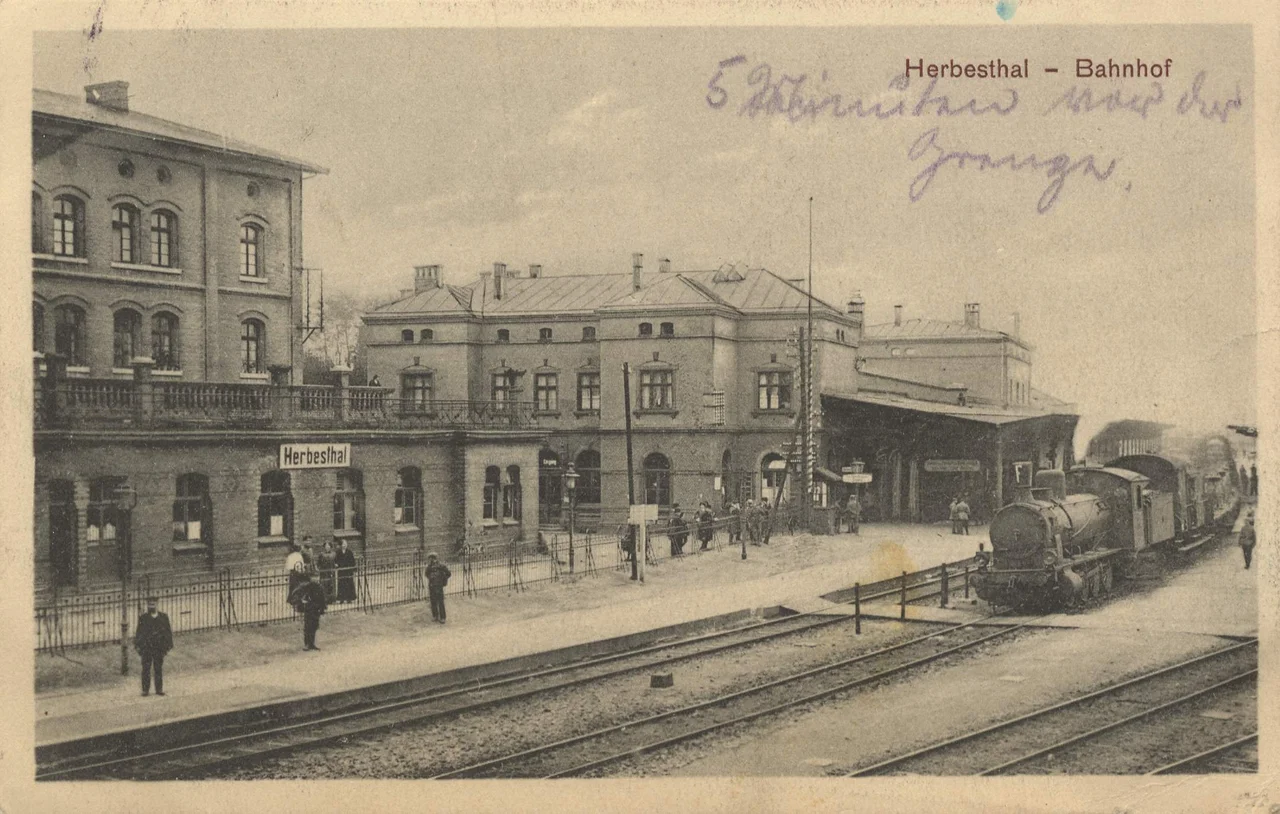
On 15 October 1843, a train pulled in to a brand-new station on the Belgian-Prussian border, and Herbesthal became something no railway station had ever been before: the world's first international rail frontier crossing. For the next 123 years, it sat at the exact point where one country's track ended and another country's track began, where customs officers boarded trains, passports were stamped, locomotives were swapped, and royal honeymooners passed through. In early 1858 the British monarch's eldest daughter, Victoria Princess Royal, came through here with her new husband Frederick, the pair traveling to their new home in Germany where three decades later he would briefly become German emperor. The station handled the Nord Express. Trans Europ Express crews changed shifts here. Today none of it is operating. The buildings are mostly gone, the platforms erased, and a youth club occupies one of the few buildings still standing.
The First Border the Trains Knew
Belgium was the second country in the world to build a railway network, just behind Britain, and its plans from the 1830s already envisioned a connection to Cologne, an industrial lifeline to the Ruhr that would let Belgian industry skip the high Dutch tolls on the Meuse. The route ran from Liege east through the hills toward Aachen, and somewhere on that line the trains crossed into Prussia. The Belgian and Prussian engineers settled on a flat stretch of land between Welkenraedt and the Busch Tunnel and built a station there. It opened on 15 October 1843. From the start it was both a passenger station and the place where locomotives switched between Belgian and Prussian operators. A massive mail sorting depot went up next door in the years that followed, proudly identified on a 1907 postcard as Europe's first international mail sorting center. The station reached its maximum extent after a major redevelopment in 1889, with five mainline platforms and two branch line platforms for the local service to Eupen.
When 70,000 Forced Laborers Came Through
The First World War turned Herbesthal into a different kind of crossing. The German army took over the railways of occupied Belgium and ran them as military infrastructure. Herbesthal became a critical transit and replenishment point for the western front. Wounded soldiers stranded on the way back from the fighting received medical care here. More than 70,000 forced laborers from Belgium were channeled into Germany through this station, men deported to factories they had not chosen and could not leave. The congestion grew so severe that the Germans built an alternative route, the Montzen line, between 1915 and 1917, bypassing Herbesthal and Liege entirely. When the war ended in November 1918, plunderers returning from the front looted what remained. The Treaty of Versailles redrew the map: Eupen, Malmedy, and Moresnet were transferred to Belgium, and the border moved east, leaving Herbesthal more than 10 kilometers inside Belgian territory. The station kept its frontier function until 1940, only now the customs officers were Belgian, working for the country the station had until recently been positioned against.
Pacifics and Politics
After 1945 Herbesthal had a brief, dignified second act. The SNCB, Belgium's national railway, used it as the home depot for its Pacific class Type 1 locomotives, the most powerful high-speed steam engines in the country. They had been built in the late 1930s for prestigious international expresses, and from Herbesthal they hauled the Nord Express, the Tauern Express, and after 1957 the Trans Europ Express on the Belgian sections of their routes. Then language politics arrived. In 1962, Belgium formally divided itself into four language zones. Herbesthal sat in the small German-speaking enclave in the east, the territory taken from Germany in 1920. Just 200 meters west, Welkenraedt was in the French-language area. As customs administration centralized, the offices moved 200 meters west to francophone Welkenraedt. The station that had been built specifically for the border found itself stranded just inside the wrong language zone.
The Voltage That Ended It
The killing blow was electrification. Belgian railways had committed to a 3 kilovolt DC system. German railways used 15 kilovolt AC. Dual-voltage locomotives were rare and expensive, so a decision had to be made about where to switch the power and the engines. Both could happen at the same place, and they could happen at Aachen, where many trains were already being reconfigured anyway, with carriages split or joined for different routes across Germany. The switching point moved to Aachen. The Eupen branch line had already closed to passengers on 28 March 1959. International trains were being rerouted onto the Montzen line that had been built half a century earlier to bypass Herbesthal. The electrification project was commissioned on 22 May 1966. Herbesthal station was formally closed on 7 August 1966. By 2012 the local municipality of Lontzen began renovating some of the abandoned buildings. In 2014 they held an exhibition on the site about the station's history. Today, trilingual information boards mark where platforms 1 through 5 stood, the footprint of the western end of the old passenger building is outlined on the ground, and the eastern end is buried in undergrowth, slowly returning to forest.
From the Air
Coordinates 50.6605 N, 5.9863 E in the municipality of Lontzen, eastern Belgium, near the German border. Recommended viewing altitude 2,000 to 4,000 ft AGL. The site is a clearing along the active Liege-Aachen rail line; the platforms are gone but the right-of-way and a few remaining brick buildings are visible. The neighboring town of Welkenraedt has the active station. Nearest airports are Liege (EBLG / LGG) to the west and Maastricht Aachen (EHBK / MST) to the northwest.
Nearby Stories
- Heinsberg-Lindern Railway 7.8 km away
- Baptismal font at St Bartholomew's Church, Liège 7.8 km away
- Federal Office for the Protection of the Constitution 16 km away
- Limburg (Belgium) 17 km away
- F.L.Y. 17 km away
- Marcinelle Mining Disaster 84 km away
- Fort Jeanne d'Arc 148 km away
- Marmoutier Abbey 202 km away