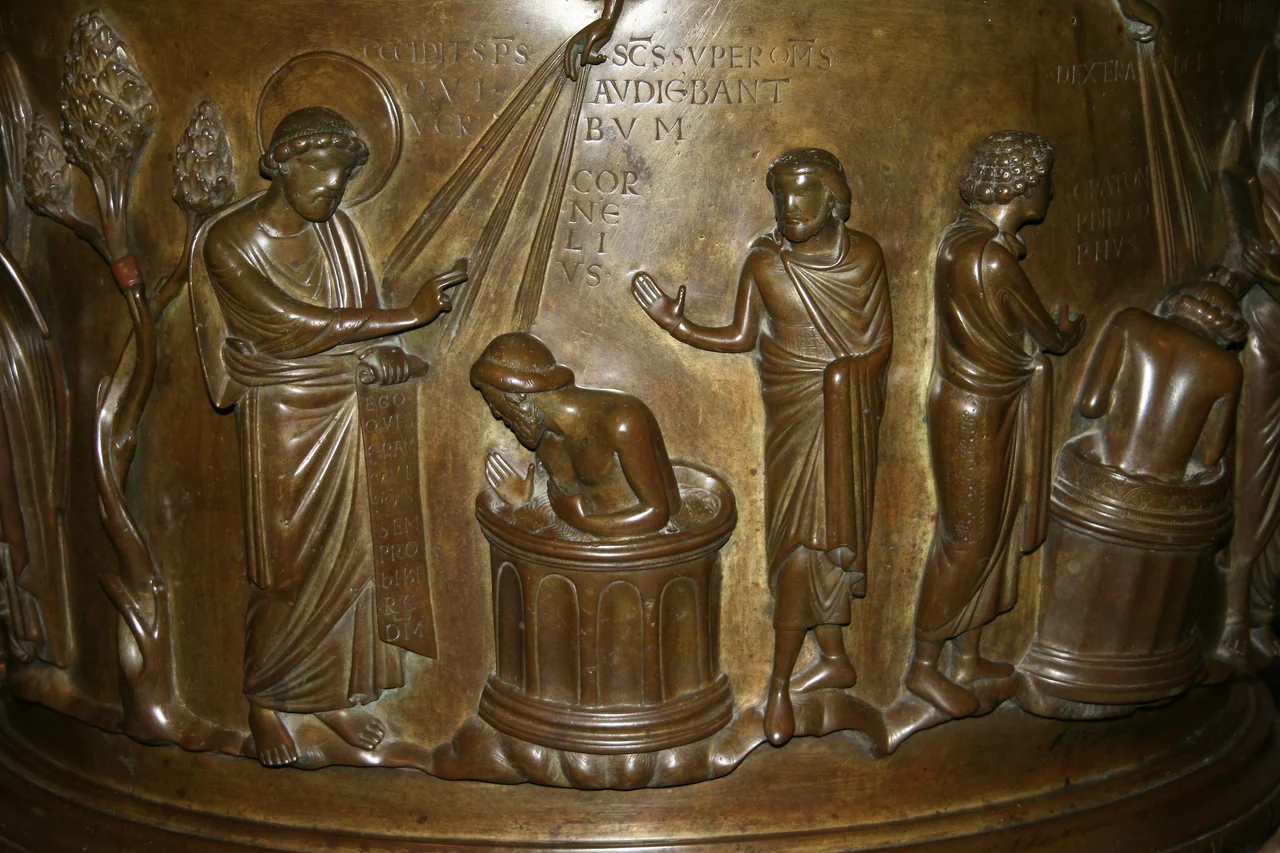

Baptismal font at St Bartholomew's Church, Liège
Around a brass basin 91 centimeters across, twenty-eight figures in high relief act out five Bible scenes. One of them is naked, standing in a three-quarters view from behind, the kind of pose that belongs to ancient Greece, not to twelfth-century Belgium. That figure has caused arguments. Half a dozen serious scholars have stood in the Collegiate Church of St Bartholomew in Liège, looked at the back of that small bronze man, and concluded that the artist who made him must have seen sculpture from Constantinople, or from imperial Rome, because nothing in the world around the Meuse in 1110 should have produced him. The font is still there. So is the argument.
A Font for a City
It was cast between 1107 and 1118 for the Church of Our Lady with the Font, the city baptistry that stood next to old Liège Cathedral. The dating comes from the obituary of Abbé Hellin, the parish priest who commissioned it. The Meuse river valley was then the leading center of Romanesque metalwork in Europe, and metalwork was still the most prestigious of the arts - more highly regarded than painting, more permanent than wood, the material that princes and bishops competed to give to their churches. The Liège font ranks among the few unambiguous masterpieces of that tradition. Both the cathedral and the Church of Our Lady were destroyed during the French Revolution; the font was hidden away for safekeeping, then moved to St Bartholomew's in 1804, where it has stood ever since. A small fee, normally a euro or two, lets you walk up to it. It is still used for baptisms.
Twelve Oxen, Five Scenes
The basin sits on twelve cast brass oxen - or did originally; two are now missing. The number is no accident. The oxen reference the molten sea of Solomon's Temple, described in the Old Testament as resting on twelve bronze oxen, a Hebrew prefiguration of Christian baptism. Around the basin run five scenes, identified by Latin inscriptions and to be read in order. John the Baptist preaches to a small crowd; a fig tree closes the scene. John baptises two neophytes in the Jordan, the river piling up behind them like a mound in the Early Medieval convention. Christ is baptised by John, beardless and young as twelfth-century artists usually showed him, with an angel holding a cloth in veiled hands. Then Saint Peter baptises Cornelius the Centurion - the first gentile to be received into the church - and Saint John the Evangelist baptises a philosopher named Craton from an apocryphal text. Between most of the scenes a different tree stands, each with its own leaf-shape carefully cast: fig, palm, olive, vine. An unbroken undulating groundline runs all around the basin, tying everything together.
Renier de Huy
Tradition assigns the font to Renier de Huy, a metalworker from the small Meuse city of Huy a few kilometers south of Liège. Almost nothing is known of him. A document from 1125 calls him a goldsmith. A chronicle written two centuries later names him as the artist of the font. He may have died around 1150. Two other works are usually attributed to the same hand or a close follower: a small bronze crucifix now in the Schnütgen Museum in Cologne, and a censer in similar style. A second generation of Mosan metalworkers - Godefroid de Huy, called de Claire - would continue the regional tradition. The Liège font is the high-water mark from which everything else descends.
The Classical Problem
What troubles art historians is the style. The figures are modelled in rounded, idealized bodies. Several are nude. One stands with his weight on one leg and shows a three-quarters view from behind - a contrapposto pose that, as Honour and Fleming put it, recalls 'classical models far beyond Byzantine, Carolingian, or even Early Christian art.' Where did a Mosan craftsman in 1110 see such a thing? Some scholars argue Renier or his master travelled to Constantinople with the First Crusade and studied surviving ancient Greek sculpture there. Others trace the classicism through older Carolingian and Mosan currents, refreshed by recent Byzantine influence. A more dramatic theory, developed by Pierre Colman and Berthe Lhoist-Colman in recent decades, suggests the font was not Mosan at all: that Holy Roman Emperor Otto III commissioned it from Greek craftsmen working in Rome around the year 1000 as a gift for the Basilica of Saint John Lateran, and that Henry IV or Henry V later carried it off northward to the Meuse. In 1993 lead-isotope analysis of the metal showed it came from mines in Spain or Sardinia, where other Mosan works used local sources - a piece of evidence the Roman theorists invoke. Most art historians still accept the Liège attribution. The argument continues, mostly in French, sometimes acrimoniously.
A Local Theology
Whatever its origin, the iconography is unmistakably Mosan. The five scenes do not follow Byzantine patterns. Instead they reflect the typological theology of Rupert of Deutz, a Liège-born theologian who was actively writing in the same decades the font was cast - a thinker fascinated by how Old Testament events foreshadowed New Testament ones. The Solomon's-temple oxen, the baptisms ranging from John in the Jordan to Saint John and the philosopher Craton, all reach back across centuries to bind scripture together. A small baptismal font in the village of Furnaux, far from Liège but in the same medieval diocese, shows the same theological vision. The head of God the Father appears above the Baptism of Christ, identified as PATER - an unusually early appearance of God the Father in Western art, which usually represented only the Hand. The font is, among other things, a treatise in bronze. It is also one of seven works officially named in 2008 to UNESCO's tentative list as proposed 'Masterpieces of Mosan Art.' If you stand in front of it now, you can put your hand on a basin that has baptised the children of Liège for nine hundred years.
From the Air
Located at 50.65°N, 5.58°E in the center of Liège, on the Place Saint-Barthélemy near the Meuse. The Collegiate Church's twin sandstone towers (Romanesque, late 11th century) are a distinctive landmark above the riverside. Liège-Bierset Airport (EBLG) lies about 10 km west; Maastricht-Aachen (EHBK) is 30 km north; Brussels (EBBR) 90 km west. The font sits inside the church; a small viewing fee usually applies.
Nearby Stories
- Limburg (Belgium) 4.7 km away
- Herbesthal railway station 5.9 km away
- Castle of Westerlo 12 km away
- Heinsberg-Lindern Railway 14 km away
- Ad's Path 20 km away
- Marcinelle Mining Disaster 35 km away
- Fort Jeanne d'Arc 148 km away
- Basilica of Saint-Pierre-aux-Nonnains 157 km away