
Castle of Westerlo
A devout countess kept her most precious possession on a small altar in the private chapel of her brand-new castle. The painting was three panels of oil on oak, made around 1428 by a Tournai master named Robert Campin, showing the Annunciation in a Flemish merchant's tidy parlor. After Jeanne de Mérode died in 1944, her heirs sold the Mérode Altarpiece to the Metropolitan Museum in New York. It now lives at the Cloisters, six thousand kilometers from the Westerlo chapel where she prayed before it every morning. The castle she built is now the town hall. The painting is gone. The walls remember.
The Old Castle
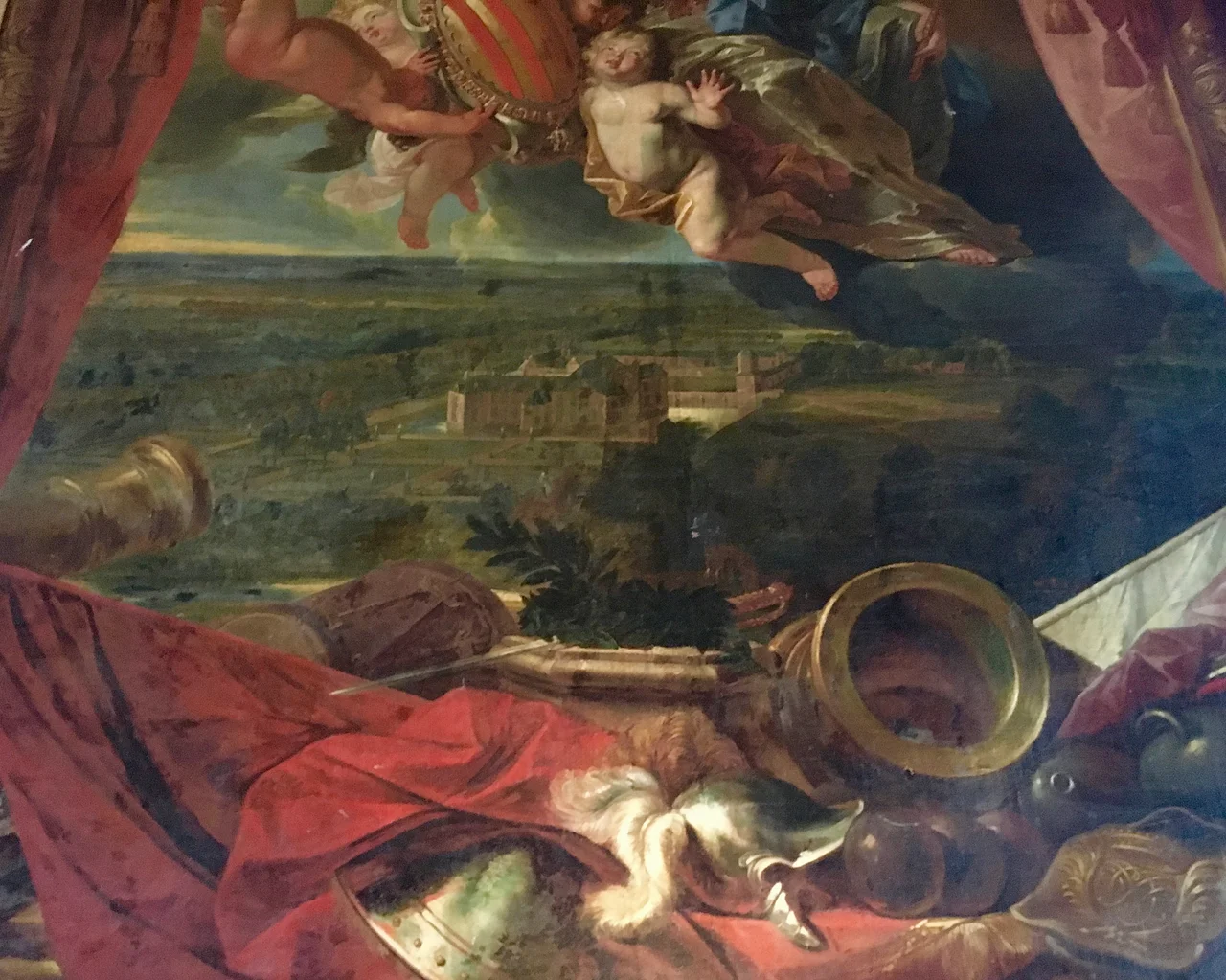
Locals call it Oud Kasteel - the Old Castle - to tell it apart from its younger sibling a kilometer away. The donjon at its heart is the original, raised in local brown sandstone by the Lords of Wesemael in the late fourteenth century, walls more than two meters thick where the medieval mason thought a siege might come. It almost certainly replaced an earlier fortress that nobody bothered to write down. The House of Merode has lived here for more than five hundred years, layering each century onto the last. The sixteenth century softened the fortifications and added comfort. Romantic restorations in the 1800s put medieval flourishes back on. The interiors hold Córdoba leather wall hangings, family portraits, the heavy furniture of an aristocracy that survived everything Europe could throw at it. The Knights' Hall, the dining room, the drawing room - they open to visitors one weekend a year, the first weekend of July, for the Kasteelfeesten.
A Garden Inspired by Versailles
Across the Nete river from the castle stretches sixty hectares of formal French landscape, a rectangular pond drawing the eye toward a distant point of perspective. Fieldmarshall Jean-Philippe-Eugène de Mérode-Westerloo commissioned it at the start of the eighteenth century after returning from court. He had seen Louis XIV's gardens at Versailles and wanted the same geometry of power expressed in his own grounds. Closer to the castle, twelve hectares of English landscape park curl around the moats, the ponds connected to the castle's water like a single circulatory system. Two centuries, two philosophies of beauty, both still here. From the air the contrast is startling - the French side rigid as graph paper, the English side wandering like a thought.
The Countess Who Stayed
Jeanne de Mérode was born in Paris in 1853, daughter of the Marquess of Westerlo and Princess Marie-Nicolette d'Arenberg. She never married. She devoted her inheritance to religion and to the people of Westerlo, financing a church, a school, a monastery in Heultje, a home for the elderly, and a carpet factory that gave the town's young women work. When her brother died in 1908 she planned to leave for her father's castle at Grimbergen. The town begged her to stay. She agreed - and commissioned an entire new castle to live in, just a kilometer from the old one. Pierre Langerock designed it in neo-Gothic to echo the abbey of Tongerlo, with four small towers, a large one, and a bell tower shaped like a crown. Inside, beneath the historical surfaces, it was startlingly modern for a Belgian country house in 1912: steel roof beams, electric elevator, central heating, running water, indoor bathrooms.
What the Castle Became
When German troops crossed the border in May 1940 they took the New Castle for a local Nazi headquarters. Jeanne moved back to the Old Castle and died there on 1 July 1944, two months before liberation, ninety-one years old and never again to see her own bed. She left her castle to a monastic order of sisters. The church used it as a home for retired priests until the 1970s, when the municipality of Westerlo bought it. It has been the town hall ever since. Couples marry there. Tax forms are processed in rooms that once held a countess's library. The chapel still stands. The altarpiece on which she prayed every day is in Manhattan.
What to Look For
Two more castles complete the count. The Castle de Meeûs d'Argenteuil, in nearby Tongerlo, was built during and after the First World War by the Baron de Trannoy. Another, built in the 1920s by the Naets family of notaries, sits quietly among them - the youngest of Westerlo's accumulation of stone manor houses. Approaching the town from the air, look for the moats first. They appear as dark, almost perfect rectangles in the green countryside, water older than any building it now reflects, fed by the Nete and the ponds and the small drainage channels that have outlasted every owner whose family name once appeared on the deeds.
From the Air
Coordinates 51.08°N, 4.92°E. The Castle of Westerlo sits in flat Campine countryside southeast of Antwerp, the broad Nete river curving past it. View from 2,500 ft on a clear day shows both castles clearly - the Old Castle's compact moat-and-tower silhouette, the New Castle's neo-Gothic mass crowned by the bell tower. The formal French gardens are unmistakable as a rectangular green pattern across the Nete. Antwerp International (EBAW) is 35 km west. Brussels (EBBR) is 45 km southwest. Best light is mid-morning, when the moats throw the castle into clean profile.
Nearby Stories
- Hertogin Hedwigepolder 1.5 km away
- Eersel 4.3 km away
- County of Loon 5.4 km away
- Bosteels Brewery 5.8 km away
- Hoogstraten 8.2 km away
- Zonhoven 11 km away
- SWIFT 20 km away
- Battle of Steenkerque 22 km away