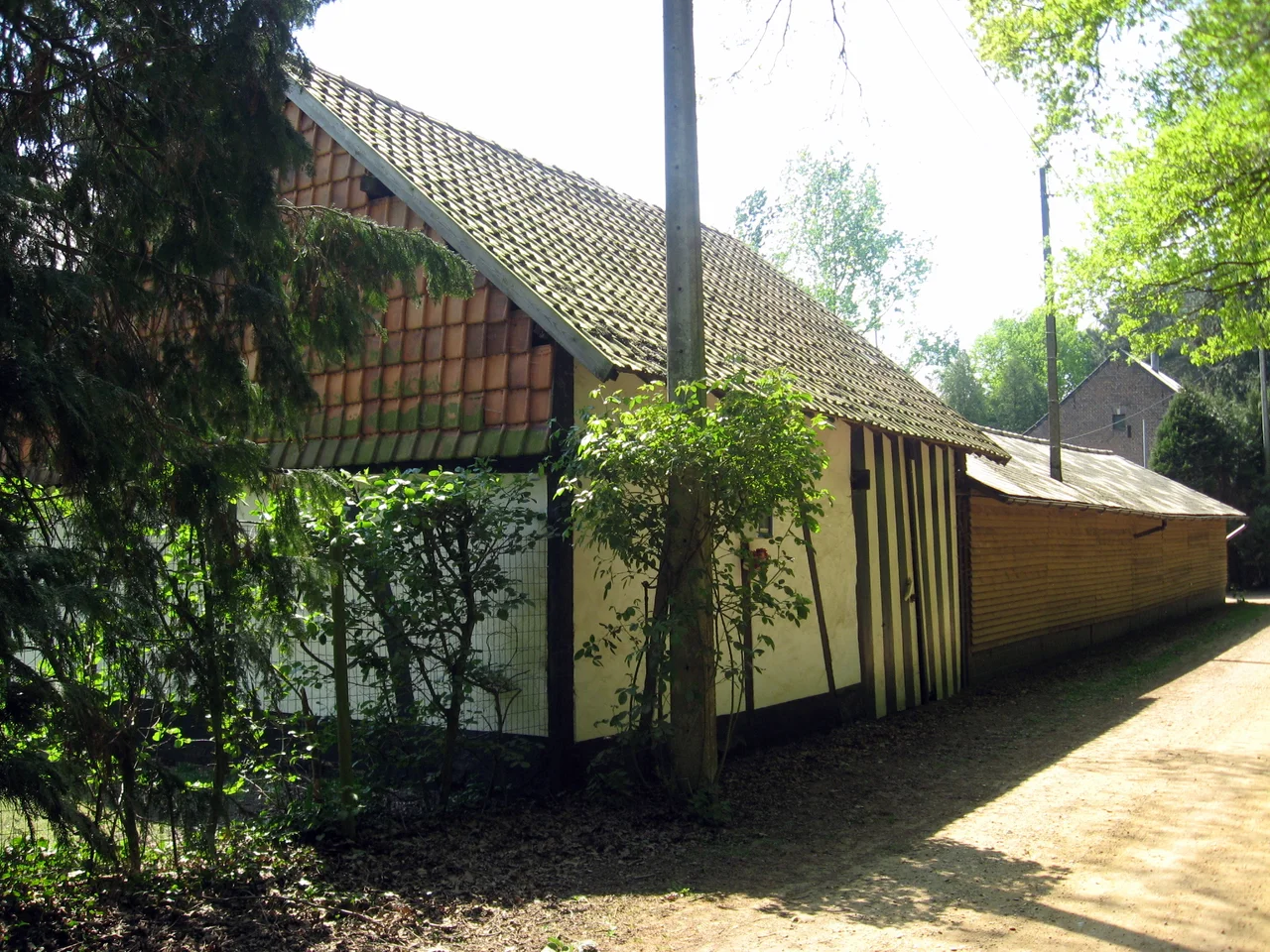

Zonhoven
The town puts the sun on its coat of arms. Its main primary school is called De Zonnewijzer, the Sundial. The local beer is Zonderik. The cafe on the square is 't Zonnehof, the Sun Court. The baseball club calls itself the Sunville Tigers. The name Zonhoven, the residents have decided, must have something to do with zon, the Dutch word for the sun. Almost none of this is true. The first syllable of Zonhoven comes from the Son, an old name for the Zonderikbeek stream that runs through the municipality, and the second is a corruption of -ouwe, meaning alluvial land. The whole place is named for marsh by the river. But somewhere along the centuries the residents heard the syllable zon, decided they liked it, and built a town's identity around the wrong word.
Eleven Thousand Years on the Same Ground
Long before anyone argued about the etymology, people were here. Archaeologists working in the Zonhoven area have found tools and traces dating back to roughly 11,000 to 5,000 BCE - including the only fixed prehistoric polishing stone known in all of Flanders, a piece of bedrock that early people used to grind and shape their stone implements over generations, leaving smooth bowls in its surface. The Romans came through later; the Tungri, a Germanic tribe, lived in the broader area under Roman rule. By the Middle Ages, Zonhoven and the surrounding villages belonged to a tiny feudal fragment called the Land of Vogelsanck, ruled from a fortified manor that gave the area its name. For most of the centuries that followed, it was a small agricultural place doing what small agricultural places do: not much that anyone outside cared to write down.
A Treaty Nobody Remembers
Then, on November 18, 1833, two delegations met in a Zonhoven house called De Franse Kroon - the French Crown - and signed something that did matter. The Treaty of Zonhoven was a small but consequential agreement between the new Kingdom of Belgium and the Netherlands, three years after the Belgian Revolution had split the two countries. The treaty established rules for how the two states would share the use of the Meuse, the great river that drains both countries to the sea. It was not the grand Treaty of London that finally settled the Belgian-Dutch divorce - that came six years later, in 1839 - but it was a working arrangement that kept barges moving while diplomats argued. That two nations chose a Zonhoven sitting room for this work tells you something about the town: practical, on a useful road, willing to host.
Iron, Then Industry, Then Suburb
Through the 19th century, iron ore mining became prominent in the local economy, and after the railway reached Limburg in the late 1800s, Zonhoven began to grow. Between 1930 and 1980 its population tripled - the kind of growth that follows when a sleepy agricultural town finds itself in commuting distance of bigger industrial neighbors. By the 21st century the iron was long gone but the people stayed, with 21,237 residents as of January 2019 living in the four hamlets - Halveweg, Termolen, Terdonk, and the center. Today Zonhoven is essentially a comfortable edge-suburb of Hasselt to the south, with the third-highest density of people-per-square-kilometer in middle Limburg and a population that has more or less stopped growing.
The Sports Town That Could
Drive past the open-air sports center called Basvelden and you start to understand what a small Belgian town does with its civic budget when it gets serious. Seven football fields. Eight tennis courts and an indoor tennis hall. Two baseball fields. A skate and BMX park. A stable with a covered riding arena. Beach volleyball courts. A 2,700-meter Finnish track for runners - the springy kind made of wood chips. Zonhoven has carved out an unlikely national reputation for women's football: DV Zonhoven played at national level for years before merging with DV Lanaken in 2012 to form DVL Zonhoven. The men's volleyball club VC Helios spent a long stretch in Belgium's Liga B. The Sunville Tigers - the wrongly-named baseball club - compete at the highest level the country offers. A town of twenty-one thousand should not have this much sporting depth. Zonhoven does.
De Teut and the Land of Vogelsanck
Outside the built-up center, on the northern edge of the municipality, lies De Teut - a 700-hectare nature reserve of heath and pine that is one of the best-preserved pieces of original Campine landscape anywhere in Belgian Limburg. The old wooden boswachterswoning, the forester's house from the Land of Vogelsanck era, still stands among the trees as a reminder that this corner of Zonhoven was once managed game forest for noble hunting. Walk De Teut in late August and the heather turns the whole sandy plateau a saturated purple, broken by stands of Scots pine. It is the landscape the town used to live in before the railway, before the iron, before the suburb. The Zonderikbeek runs through it, the stream whose name the town never really understood but built itself around anyway.
From the Air
Zonhoven sits at 50.99 N, 5.36 E, just north of Hasselt in central Belgian Limburg. Cruise at 2,500 to 4,000 feet to pick out De Teut nature reserve on the northern edge - purple heath in late summer, dark pine the rest of the year - and the urban tile of the town center to the south. The Albert Canal is to the south. Nearby airports: Maastricht-Aachen (EHBK) about 25 km east, Liege (EBLG) 30 km south, Kleine Brogel military base (EBBL) 20 km north-east - check restricted airspace. Brussels (EBBR) is 80 km south-west.
Nearby Stories
- Castle of Westerlo 2.2 km away
- Tongeren 2.6 km away
- Vaals 4.5 km away
- Heers, Netherlands 8.2 km away
- Steyl 10 km away
- Heinsberg-Lindern Railway 12 km away
- Hoogstraten Castle 13 km away
- Ligny to Wavre to Waterloo: The Forty-Eight Hours That Lost an Empire 31 km away