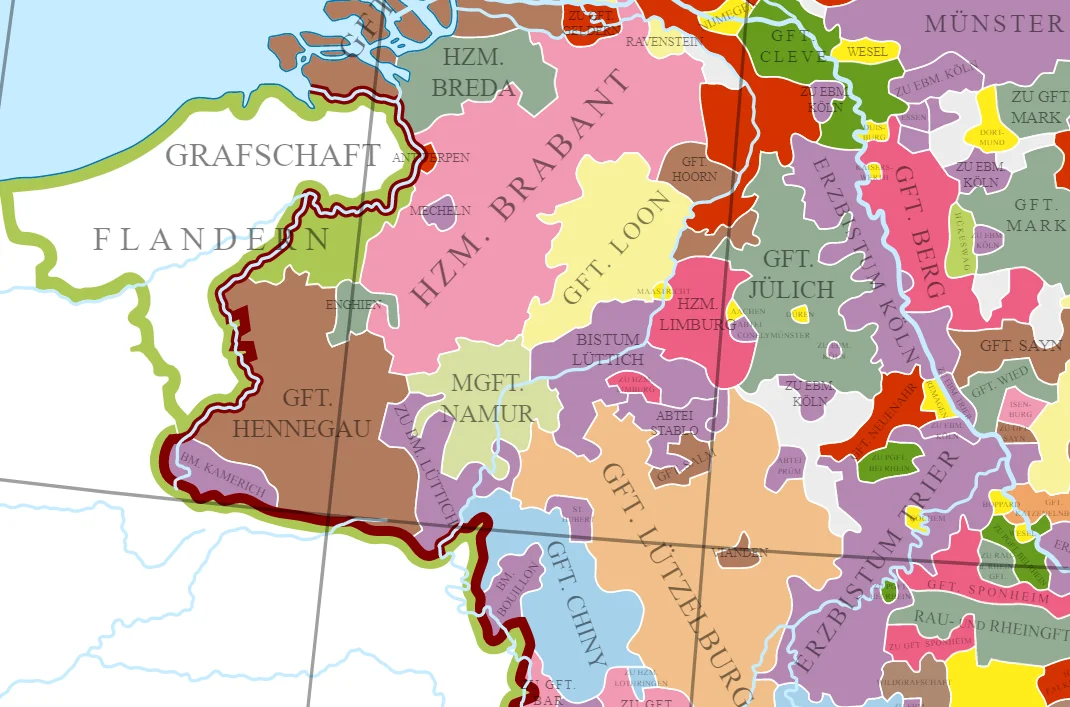

County of Loon
The province is called Limburg. The dynasty that ruled it never was. For three and a half centuries a Dutch-speaking county in what is now eastern Belgium answered to the Counts of Loon, whose seat sat on a low hill called Borgloon and whose lands stretched from the sandy Kempen north through the orchards of Haspengouw to the Meuse near Maastricht. Then the male line died out in 1336, the Prince-Bishop of Liège absorbed the territory, and Napoleon's surveyors carved up the map. In 1839 international arbitration handed the western half of what had been called Loon back to a new Belgium, and the diplomats picked a name from across the river - Limburg - because it sounded like a remembered duchy. The land kept its borders. It just lost its name.
Three Landscapes Under One Count
From its earliest mentions the County of Loon was not one place but three. In the northeast, fields along the Maas - the Frankish Maasau - included the towns of Maaseik and Bree. In the northwest, the dry, sandy Kempen plain - which Roman administrators had called Texandria and the church still did - held Tessenderlo, Beringen, and Overpelt. In the south, the rolling chalk-and-loam hills of Haspengouw produced the wheat and orchards that paid for the count's castles; Borgloon itself sat there, in the gentle country between Sint-Truiden and Tongeren. The earliest counts held a scattered bundle of rights and revenues rather than a clean territory, and other lords had their own pockets inside the same area. What unified Loon over time was language. All of it spoke Dutch - or what would become Dutch - in a region where the Walloon-Flemish linguistic frontier ran just to the south through Tongeren.
Origins in the Eleventh Century
The records begin abruptly with Count Giselbert, present in documents from at least 1015 to 1036. He had two brothers: Arnulf, the last secular count of a neighbouring district called Haspinga, and Balderic II, who became Bishop of Liège in 1008. The trio's parentage is unclear; a much later chronicle from the Abbey of St Truiden names their father as a Count Otto, but the source is unreliable and modern historians like Baerten doubt Otto ever existed. The county passed through Count Emmo, the first man clearly called 'count of Loon' in his own lifetime, who died in 1078. Around the same time a Countess Ermengarde granted allodial land in key Loon locations to the Bishop of Liège - a transaction whose details still puzzle medievalists, because Ermengarde's known husband cannot account for her holdings. The early county is a place where the documents only tell you what you do not know.
Marriage, Castles, and Abbeys
By the twelfth century the counts were operating like classic medieval lords. Arnold I, son of Emmo, married Agnes, heiress of the Burgrave of Mainz, and in 1106 acquired the German counties of Rieneck - planting one foot of the family in the Holy Roman Empire's heartland. He probably built the motte-and-bailey castle that crowned Borgloon. His son Arnold II founded Averbode Abbey. Louis I added Kolmont and Bilzen and gave Brustem its town freedoms. Count Gerard, ruling from 1171 to 1191, moved the comital court north from Borgloon to Kuringen - today part of Hasselt, the modern provincial capital - and founded the Cistercian women's house of Herkenrode Abbey. He also fell into the long quarrel with Liège that defined the county's politics: in 1179 Prince-Bishop Rudolf of Zähringen sent troops who devastated the old Loon capital at Borgloon. By 1190 the count had to acknowledge the bishop as his overlord. The Prince-Bishopric never let go after that.
The Good Cities
All of the Dutch-speaking towns in the Prince-Bishopric of Liège - the so-called Good Cities, with chartered rights to send representatives to the bishopric's assemblies - lay inside Loon. Beringen, Bilzen, Borgloon, Bree, Hamont, Hasselt, Herk-de-Stad, Maaseik, Peer, Stokkem: every one of them is in modern Belgian Limburg today, often still ringed with the cobbled streets and Gothic town halls that came with their medieval freedoms. Loon was the Dutch-speaking quarter of a French-speaking princedom, and its towns were the carriers of that linguistic identity. When Liège took the county over directly after 1366 - the male line having died with Louis IV in 1336 and the Lords of Heinsberg having sold their claim - the prince-bishops added 'Count of Loon' to their own titles, but they ran Loon as a distinct quartier with its own court and its own language.
A Borrowed Name
Loon never joined the Burgundian or Habsburg consolidation of the Low Countries. While the Counts of Flanders, the Dukes of Brabant, and the rest were absorbed into what would become first Burgundy, then the Spanish Netherlands, then the Austrian Netherlands, the Prince-Bishopric of Liège kept its independence, and Loon kept its place inside it. The whole arrangement only ended when Revolutionary France annexed the bishopric in 1795 and folded Loon into the new département of Meuse-Inférieure. After Napoleon, the territory passed to the United Kingdom of the Netherlands in 1815, which gave it a new name: Limburg, borrowed from a medieval duchy that had stood nearby. When Belgium broke away in 1830 the Limburg question became a diplomatic crisis. International arbitration in 1839 split the territory in two: the western half - corresponding roughly to old Loon - became a Belgian province, while the eastern half stayed Dutch. Both kept the name Limburg. The old name, Loon, survives only in the small town of Borgloon - 'Castle-Loon' - which still sits on its low hill in the Haspengouw orchards. Drive there in May, when the cherry and apple trees bloom across miles of low country, and the medieval county is suddenly visible again under its modern name.
From the Air
Centered roughly at 50.80°N, 5.35°E in eastern Belgium. The historic county sprawled across modern Belgian Limburg, with three distinct landscape zones: the Maas valley along the eastern edge, the sandy Kempen plain in the north, and the rolling Haspengouw orchards in the south. Hasselt is today's provincial capital and roughly the old comital center at Kuringen. Liège-Bierset (EBLG) lies about 35 km south; Maastricht-Aachen (EHBK) about 25 km southeast; Brussels (EBBR) 70 km west. Best seen in late April or early May when the Haspengouw fruit orchards bloom in great white-and-pink sweeps.
Nearby Stories
- Limburg (Belgium) 4.7 km away
- Herbesthal railway station 5.9 km away
- Castle of Westerlo 12 km away
- Heinsberg-Lindern Railway 14 km away
- Ad's Path 20 km away
- Marcinelle Mining Disaster 35 km away
- Fort Jeanne d'Arc 148 km away
- Basilica of Saint-Pierre-aux-Nonnains 157 km away