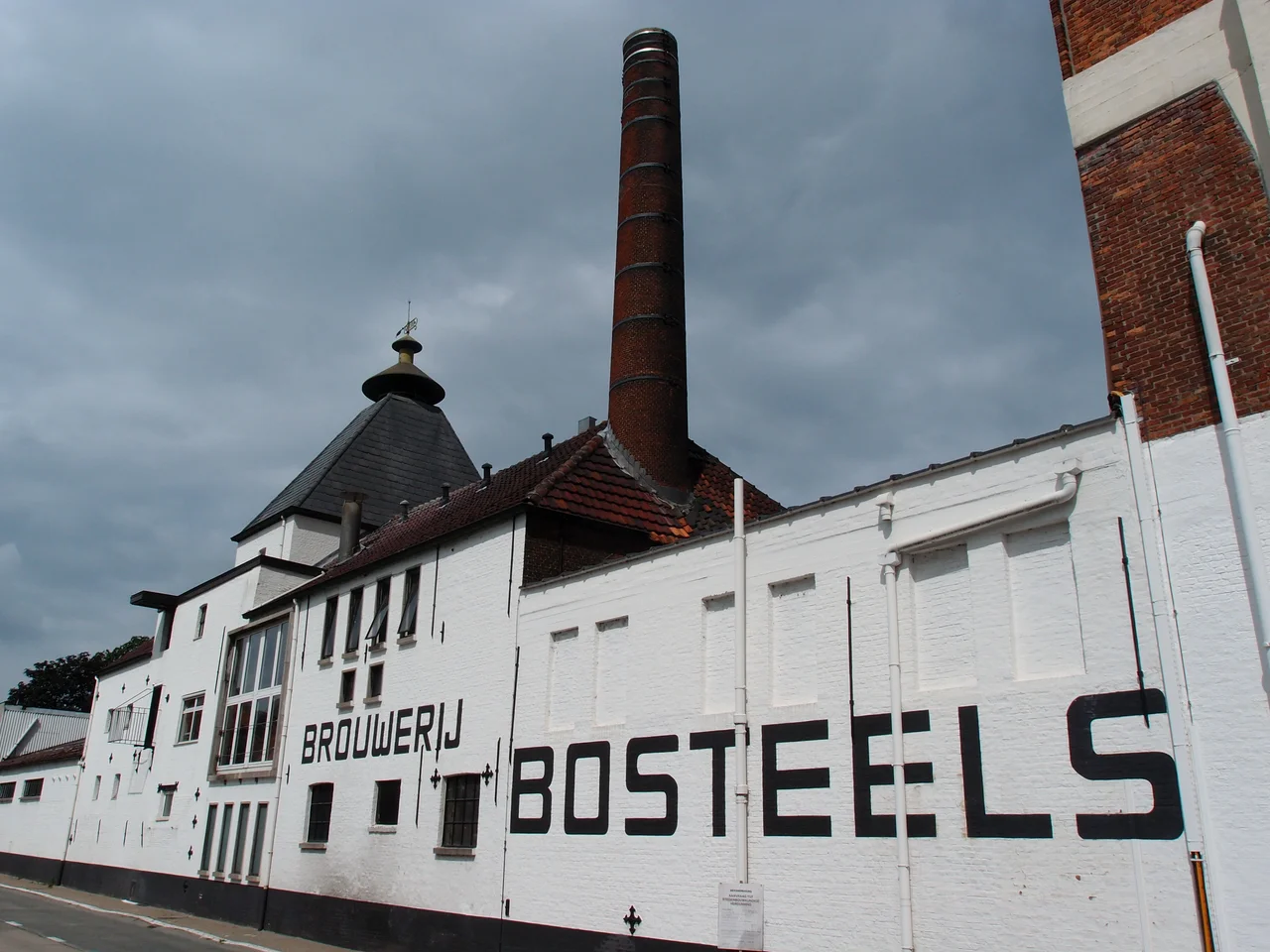

Bosteels Brewery
Order a Kwak in any bar in Belgium and you will be asked for one of your shoes. The bartender hangs it behind the counter as collateral, because the glass that is about to arrive cannot stand on its own. It is a strange, ballooned vessel set into a wooden yoke, and it walks home with patrons who leave the pub forgetting they have surrendered footwear in exchange. The glass, the brewery claims, dates to an 18th-century innkeeper named Pauwel Kwak, who is said to have shaped it for coachmen who could not climb down from their boxes for a drink. The Bosteels family - who have run a brewery in the village of Buggenhout since 1791 - put their version of his strong amber beer on the market in the 1980s, and the iconic glass has been hanging behind bars worldwide ever since.
Seven Generations in Buggenhout
Buggenhout sits on the edge of the Flemish Diestian hills, about thirty kilometres west of Antwerp. It is a quiet East Flanders village whose biggest landmark, for centuries, has been the chimney of Brouwerij Bosteels. The brewery was founded in 1791, the year French revolutionary armies began to threaten the Austrian Netherlands, and it stayed under continuous Bosteels family ownership for seven generations - an extraordinarily long run even by Belgian standards. The family stuck to traditional Belgian top-fermenting styles when most of Europe had pivoted to pilsner. They survived two world wars, the loss of access to copper and grain, and the consolidation that swallowed dozens of village breweries around them. In 2016, the family sold to AB InBev, ending more than two centuries of independent operation, though the beers are still produced in Buggenhout.
Tripel Karmeliet
The brewery's most celebrated beer was created remarkably recently. Tripel Karmeliet was first brewed in 1996, based on a 1679 recipe that the Bosteels family traced to an old Carmelite convent in Dendermonde, twelve kilometres away. The recipe calls for three cereals - wheat, oats, and barley - which is unusual; most tripels rely on barley malt alone. The resulting beer pours a complex gold-blond with a fruity nose of banana and vanilla from the yeast, a creamy mid-palate from the oats, and a dry, almost quinine-like finish from Styrian hops and the brewer's herb mixture. At 8.4% alcohol by volume it is dangerously easy to drink. Tripel Karmeliet took gold in the Best Belgian-Style Tripel category at the 1998 World Beer Cup, silver in 2002, and Best Pale Ale at the World Beer Awards in 2008 - a result that nearly broke the brewery's supply chain. Sales jumped so fast in 2009 that Belgian pubs ran out, and Bosteels had to install a new brew vessel and add 6,000 hectolitres of annual capacity to keep up.
A Beer Finished in Champagne
DeuS - the brewery calls it 'Brut des Flandres' - is the family's strangest creation, and arguably the most ambitious project any small Belgian brewery has ever attempted. It begins in Buggenhout as a strong, spiced golden ale fermented for a month with two yeasts. Then it travels south to Épernay, in the heart of the French Champagne region, where it is re-fermented using the méthode champenoise. It rests on its lees for nine months, is riddled by hand a week at a time, and is finally disgorged like vintage champagne. The result is a beer that drinks like sparkling wine - effervescent, bone-dry, faintly bready, and absurdly expensive. London restaurants were once selling it for thirty-two pounds a bottle. It is hard to think of another beverage that has so completely shrugged off the old fence between beer country and wine country.
The Coachman's Glass
The Pauwel Kwak glass is a piece of pub theatre. A bulbous spherical bottom, a long flared neck, a heavy wooden stand to keep it upright - the design is supposedly meant to hook over a coachman's box, though no surviving 18th-century example has ever been found. Whether the inn 'De Hoorn' really had a glass like this in the 1700s is uncertain. What is not uncertain is that since the 1980s, when Bosteels launched the modern Kwak beer in the modern Kwak glass, the design has become inseparable from Belgian beer culture. The beer itself is a strong amber ale, malty and caramelly, around 8.4% alcohol. The glass is also the reason Belgian bartenders ask for your shoe: customers were leaving with the souvenir glassware. Hence the deposit. It remains, two centuries after the original Pauwel Kwak supposedly served coachmen on the road from Antwerp, one of the most photographed objects in any Belgian pub.
Visiting Buggenhout
Buggenhout is small enough to cross on foot in fifteen minutes. The brewery itself does not run regular public tours, but the village pubs all carry Kwak, Tripel Karmeliet, DeuS, and Monte Cristo - the brewery's first new beer in seventeen years when it launched in 2019. Antwerp is half an hour east by car, Brussels an hour southeast, and the medieval beer town of Dendermonde - whose Carmelite convent supplied Tripel Karmeliet's recipe - is fifteen minutes south. For travellers chasing Belgian brewing history, this corner of East Flanders is dense ground.
From the Air
Coordinates 51.0136 N, 4.2007 E - East Flanders, Belgium, roughly halfway between Antwerp (25 km northeast) and Brussels (30 km southwest). Recommended viewing altitude FL050-FL080. Visual landmarks: the Scheldt river loop south of Antwerp, the Brussels-Antwerp E19 motorway to the east, and the flat Flemish polderlands. Nearest major airport is Antwerp (EBAW) 20 km northeast, with Brussels (EBBR) 25 km southeast. The area is in the EBBR TMA - VFR transit requires coordination.
Nearby Stories
- Sluis 2.7 km away
- Poeke Castle 5.3 km away
- 1997-98 UEFA Champions League 8.9 km away
- Hertogin Hedwigepolder 12 km away
- 1989 Belgium MiG-23 Crash 15 km away
- Halle 15 km away
- Hoogstraten 16 km away
- Battle of Landen 33 km away