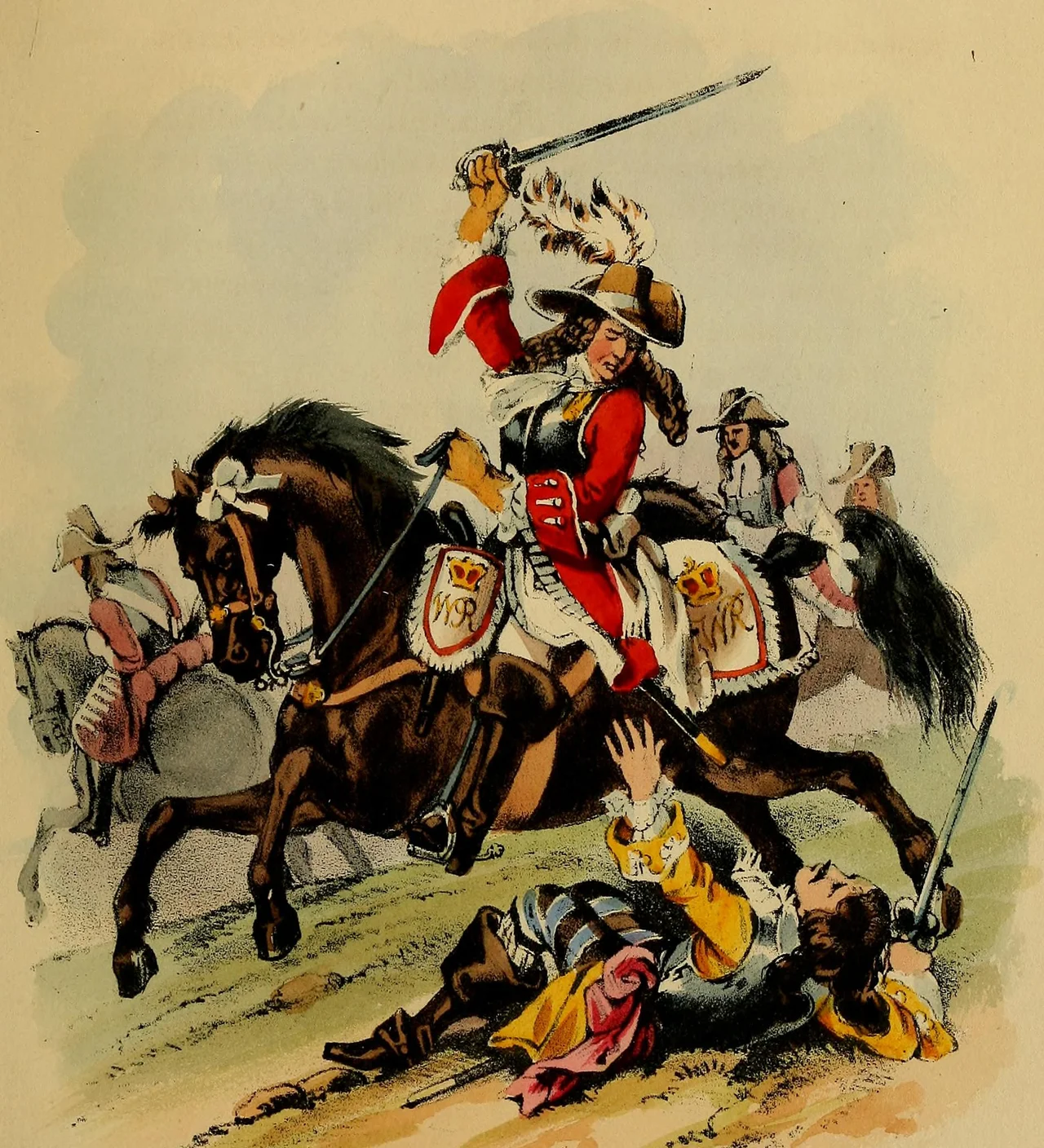

Battle of Landen
Fourteen years after the battle, a visitor walking the wheat fields between the villages of Laar and Neerwinden noticed the soil still gave up the bones of the dead. The villages had changed hands three times in a single July day in 1693, and somewhere between eight thousand and twenty thousand men on each side had fallen in a strip of farmland three kilometers wide. Tradition holds that William III of England, watching French infantry march into massed artillery fire and keep coming, exclaimed in disbelief, "Oh! That insolent nation!" He lost the field that afternoon, but he saved Liège, and a silver medal was struck to commemorate the saving rather than the losing.
An impossible position
Marshal Luxembourg arrived in front of William's lines on the evening of 28 July with about 80,000 men, after a forced march of thirty kilometers. William had 50,000, with the Little Geete River uncomfortably close behind him. His officers urged him to slip across the river under cover of darkness. He refused. He lacked the cavalry for an orderly retreat, and the battlefield was narrow enough that French numerical superiority would not tell. So through the night his troops dug earthworks between Laar and Neerwinden, jamming 80 of their 91 heavy guns into the line. The artillery would be the equalizer. When dawn broke, the Allied gunners were waiting, better equipped than the French and supplied with vast amounts of canister shot.
Three assaults on one village
The first French attack came between eight and nine in the morning. Twenty-eight battalions stormed the villages of Laar and Neerwinden, and the fighting collapsed into the kind of street combat that armies of that era barely understood how to manage. The defenders fought from behind hedges and out of windows, taking each house one at a time. By midday the French had been thrown out twice. Streets in Rumsdorp clogged with corpses as Dutch artillerymen poured canister into French dragoons trying to force the entrenchments. Luxembourg's subordinates told him to break off the attack. He refused. He still had twenty fresh battalions in reserve, including the elite Maison du Roi, and his cavalry of 30,000 was untouched. He ordered a third assault around three in the afternoon, and this one finally broke through. The Allied defenders had run out of ammunition.
A retreat without a pursuit
What followed was a hand-to-hand cavalry brawl. There were 125 French squadrons behind the Allied line, and the battle dissolved into something like 35,000 horsemen fighting at sword's length in three square kilometers. William personally led several cavalry charges to slow the French enough that his infantry could scramble across the Geete. He was nearly captured. The Dano-Dutch left fought its way through seven kilometers of enemy to reach the bridges. Most of the Allied army crossed the river by five in the evening, abandoning almost every gun. The French were too exhausted to pursue. Their infantry had been bled white in the village fighting. Even the captured Allied artillery proved a mixed blessing, because the French scarcely had horses enough to move their own.
Whose victory
Luxembourg, who normally bragged of his triumphs in elaborate dispatches, sent his king only a curt summary. Both sides claimed casualty figures the other disputed. A French officer named de la Colonie reckoned his own army had lost twenty thousand. A mutiny broke out in the French ranks afterward, regiments threatening their officers over back pay, and Louis XIV had to send money and pull the army back to the border. Meanwhile William, whose army was supposedly destroyed, replaced his losses within days and saved both Liège and Maastricht from the campaign Luxembourg had been ordered to wage against them. The Irish Brigade had fought for France that day and lost their hero Patrick Sarsfield, the Jacobite who once defended Limerick, mortally wounded attacking Neerwinden. Luxembourg himself would be dead within eighteen months, and Louis lost his finest general.
Tristram Shandy remembers
The battle haunted the eighteenth century. Laurence Sterne's 1759 novel Tristram Shandy gave the action to Corporal Trim, the loyal servant of Uncle Toby, who remembered with concern "the total rout and confusion of our camp and army at the affair of Landen, every one was left to shift for himself." Three regiments held the bridge at Neerspeeken long enough for William to escape, and Trim never forgot it. The fields the corporal walked have returned to wheat and sugar beet, divided by roads that follow the same lines they did three centuries ago. The villages of Neerwinden and Laar still stand. The Little Geete still runs three kilometers behind where the Allied line ran, and the bones the visitor saw in 1707 have long since worked themselves back into the soil that grew them.
From the Air
The battlefield lies at 50.77 N, 5.04 E, on the rolling Hesbaye plain in Flemish Brabant, about 50 km east of Brussels and 30 km northwest of Liège. Best viewed from 3,000 to 5,000 feet, where the strip between the villages of Neerwinden, Laar, and Rumsdorp is still distinguishable as flat farmland threaded by the Little Geete. Nearest airports are Brussels Airport (EBBR) 50 km west, Liège (EBLG) 30 km east, and Maastricht Aachen (EHBK) 35 km northeast. The same ground saw a second great battle exactly one century later.
Nearby Stories
- Diest 3.4 km away
- Hoge Kempen National Park 3.9 km away
- Waterloo Campaign: Waterloo to Paris (18-24 June) 5.4 km away
- Royal Carillon School "Jef Denyn" 8.3 km away
- Fort Eben-Emael: The Largest Fort in the World 10 km away
- Marcinelle Mining Disaster 12 km away
- Fort Jeanne d'Arc 152 km away
- Courrieres Mine Disaster 156 km away