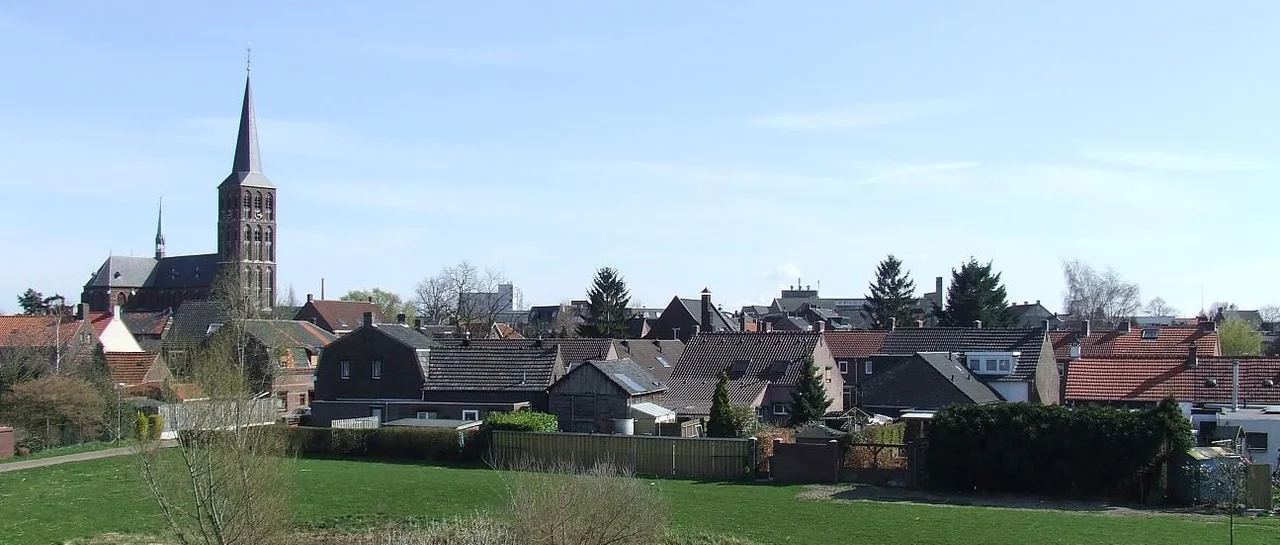

Tegelen
If you've ever read a paper on Pleistocene mammal evolution in northwestern Europe, you've encountered Tegelen without knowing it. The Tiglian, a glacial stage near the start of the Pleistocene, takes its name from this small Limburg town because workers digging clay for the local brickworks kept turning up fossils. The town that gave a geological epoch its name now sits inside the municipality of Venlo, has roughly 20,000 residents, and is still arguing, half-jokingly, with its neighbor across the road about whose dialect is correct. The argument is older than the Netherlands.
When Venlo Was a Foreign Country
For centuries, Tegelen and Venlo lived a kilometer apart and answered to different rulers. Tegelen belonged to the Duchy of Jülich; Venlo to the Duchy of Guelders. In practical terms this meant that, by the lights of a Tegelen mayor, the people of Venlo were foreigners, and the people of Venlo returned the compliment. The black uncrowned lion on Tegelen's flag still nods to the Jülich coat of arms. The dialect difference between the two towns is sharper than you would expect from neighbors. The rivalry softened over time but never quite died. In 2001, when Tegelen was finally merged into the municipality of Venlo, the news produced a slightly wounded shrug from older residents who remembered when crossing Roermondseweg meant crossing a border.
Clay, Tiles, and Captive Workers
Tegelen has been making things out of dirt since the Romans, whose pottery and tile ovens have been excavated under the town. The industry hit its stride between roughly 1750 and the Second World War, when pottery, brickworks, and stoneware put Tegelen on the map and made a handful of families very rich. The Globe smelter cast drainage covers known across the Netherlands. Pottery dynasties built villas you can still walk past today. But the wealth came at a cost the workforce paid. During World War I, factory owners claimed the embargo on Germany would bankrupt them and cut wages drastically. The workers struck. The strike fund ran out. The clergy negotiated a return to subsistence pay, and only later did the books reveal that the bankruptcy threat had been a fiction and the wage cuts had funded record profits. The villas survived the scandal.
A Passion Play Every Five Years
Tegelen is internationally known for one tradition above all others: the Passion Play, staged every five years (in years divisible by five) at the open-air Openluchttheater De Doolhof. The performances have run since the 1930s and draw audiences from across the Netherlands and Germany who fill the wooded amphitheater for a community-acted retelling of the last days of Christ. The cast is local, the production is enormous, and tickets sell out a year in advance. In off years, the same theater hosts a bluesrock festival that operates on a rather different register but is also packed. A town that once made tiles now stages spectacles.
The Baron and the Beer-Sugaring Wife
Tegelen has produced its share of characters, and two of them are still remembered in stone. The Baron, an 18th-century Prussian aristocrat who inherited the castle of Holtmuhle, loved military life so much that he privately financed his own army corps and sent it off to fight in the Seven Years' War. More locally beloved are Joes and Petatte Nelke, the pub-owning couple Gustaaf Schreurs and Petronella Muller. A folk song about them survives in the Limburgs dialect, mocking and affectionate, accusing Nelke of sweetening the beer with sugar. A statue of the pair stands in the market square. The song is still sung. In a town that put colorful characters on equal footing with kings, it makes a certain sense that the publican gets the same monument the baron does.
Sons and Daughters
For a former pottery town of modest size, Tegelen has produced an outsized roster of national figures. The long-distance runner Carla Beurskens grew up here, as did the actor Huub Stapel and the comedian Ronald Goedemondt. The musical star Chantal Janzen, a fixture of Dutch television, was born in Tegelen in 1979. So was the conceptual jeweler Ted Noten, whose subversive pieces have ended up in major museum collections. Even Max Warmerdam, one of the Netherlands' leading chess players, was born here in 2000. None of them appears on the souvenir mugs sold in nearby Venlo, but if you mention any of their names in a Tegelen cafe, someone at the bar will tell you who their cousin was.
From the Air
Tegelen lies at 51.34 degrees north, 6.14 degrees east, on the right bank of the Meuse just south of central Venlo. From altitude it appears as a continuation of the Venlo urban area, distinguished by a denser belt of older red-roofed housing closer to the river. The chimney of the former Canoy Herfkens stone works still stands as a navigation landmark. Nearest airports are Weeze (EDLV) 30 km north, Maastricht Aachen (EHBK) to the south, and Dusseldorf (EDDL) southeast. The Meuse is a navigable inland waterway directly to the west.
Nearby Stories
- Duisburg-Hochfeld Railway Bridge 4.6 km away
- Geldrop Castle 4.7 km away
- Moyland Castle 10 km away
- Heinsberg-Lindern Railway 12 km away
- Zons 12 km away
- Heesen Yachts 12 km away
- Raesfeld Castle 14 km away