.jpg)
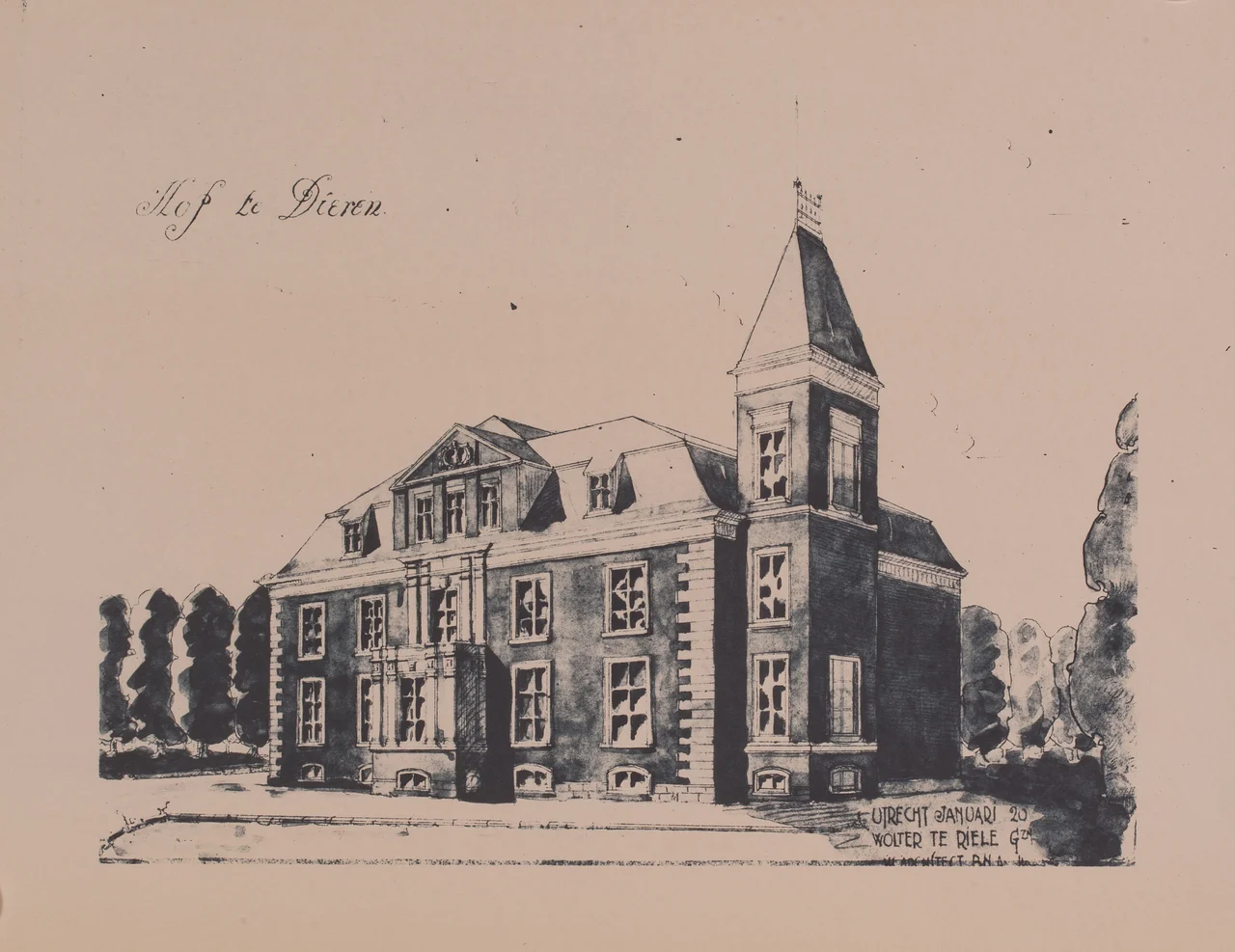
Hof te Dieren
There is a shallow pit in a park near Dieren where, for almost seven centuries, a great house stood. Knights of the Teutonic Order lived there first, in a stone commandery donated by a count of Berg in 1218. Four hundred years later it became the favourite hunting lodge of the man who would one day rule England as William III. On the night of 28 December 1944, German soldiers billeted in its upper rooms lit a fire on a wooden floor because the stoves were locked. The local fire brigade refused to help. By morning the Hof te Dieren was gone, and only the depression in the grass now marks where its rooms once opened onto the gardens.
The Knights' Bequest
Adolf VI, count of Berg, did something curious in 1218: he gave away his country house. The estate at Dieren, on the south-eastern fringe of the Veluwe, passed to the Teutonic Order, the crusading knights who would later carve out a state along the Baltic. They turned the donated house into a commandery, a regional headquarters where brothers prayed, administered farms, and sent revenue back to the order. The arrangement lasted four centuries. By the time the Republic of the United Provinces was buying out the order's Dutch holdings, the Veluwe around the lodge had become known for one thing above all others: red deer, wild boar, and forest paths perfect for the hunt.
A Prince Who Loved the Chase
In 1647, William II of Orange paid 147,000 florins for the old commandery. He turned it into a hunting lodge and threw himself into the woods. In the early years of his stadtholdership he sometimes spent ten weeks of the year on the Veluwe, riding out from Dieren with kennels and falconers. When his son William III married Mary Stuart in 1677, the modest house felt suddenly insufficient for a princely couple with English ambitions. Mary, who would later rule England jointly with her husband, took to horticulture while William chased deer. They expanded the lodge, laid out formal gardens with grottoes, a labyrinth, and a Venus cave, and Peter Schenk the Elder engraved the result in a folio called *Praetorium Dieranum*. Those engravings are now most of what survives of the original house.
The Romantic Replacement
A later century had different taste. The 17th-century lodge gave way to a manor in Gothic Revival style, and that house was itself modernised barely 25 years later into something more eclectic. The grounds were reimagined as an English landscape garden by Jan David Zocher and the Prussian master Eduard Petzold, all gentle curves and considered views where the formal parterres of William and Mary had once been. By 1877 the estate had passed through marriage to the van Heeckeren van Wassenaer family, whose principal seat was Twickel Castle far to the north. Hof te Dieren became a second home: well kept, occasionally inhabited, drowsing pleasantly in the shadow of older glory.
December 1944
The German occupation force confiscated the house during the Second World War. On the night of 28 December 1944, with the Netherlands still half-occupied and Allied armies pressed against the Rhine, soldiers in the upper rooms lit a fire on the floor because the stoves had been locked. The flames spread. The local fire brigade, weighing what they owed the occupiers against what they owed the house, declined to help. By dawn the manor was a shell. The ruins stood for two more decades before being cleared in 1965. What remains today is the slight depression where the house once was, the network of garden paths, and the engraved memory of a vanished world.
A Working Estate, Open to All
When the last baroness van Heeckeren van Wassenaer died in 1975, she left her estates to the Twickel Foundation, which had been established in 1953 to preserve the family's lands as nature reserve and cultural monument. The foundation still owns Hof te Dieren. Today the grounds operate as a plant nursery and a vineyard, an oddly Mediterranean note this far north, and the public is welcome to walk the paths. The Foundation has floated the idea of an apartment building somewhere in the park's centre, which would change the place again. For now, the gravel crunches underfoot, the old pond reflects the sky, and the lodge that hosted kings exists only as a shape in the grass.
From the Air
Coordinates 52.04 N, 6.09 E, on the south-eastern edge of the Veluwe just north of the IJssel. The estate lies between Dieren and Spankeren, a short hop from Middachten Castle (visible as a moated complex to the south-west) and Rozendaal. Recommended viewing altitude 2,000-3,500 ft AGL to pick out the park's geometry against surrounding farmland. Nearest controlled airspace is Teuge International (EHTE) about 18 nm north-west; Deelen (EHDL) lies west. Best light in autumn when the landscape garden's deciduous canopy turns.
Nearby Stories
- Haaksbergen 5.8 km away
- Heerde 6.1 km away
- Kleve 7.3 km away
- Heesen Yachts 9.8 km away
- Aviodrome 11 km away
- Grebbe Line 12 km away
- Raesfeld Castle 15 km away
- Hans Philipp 17 km away