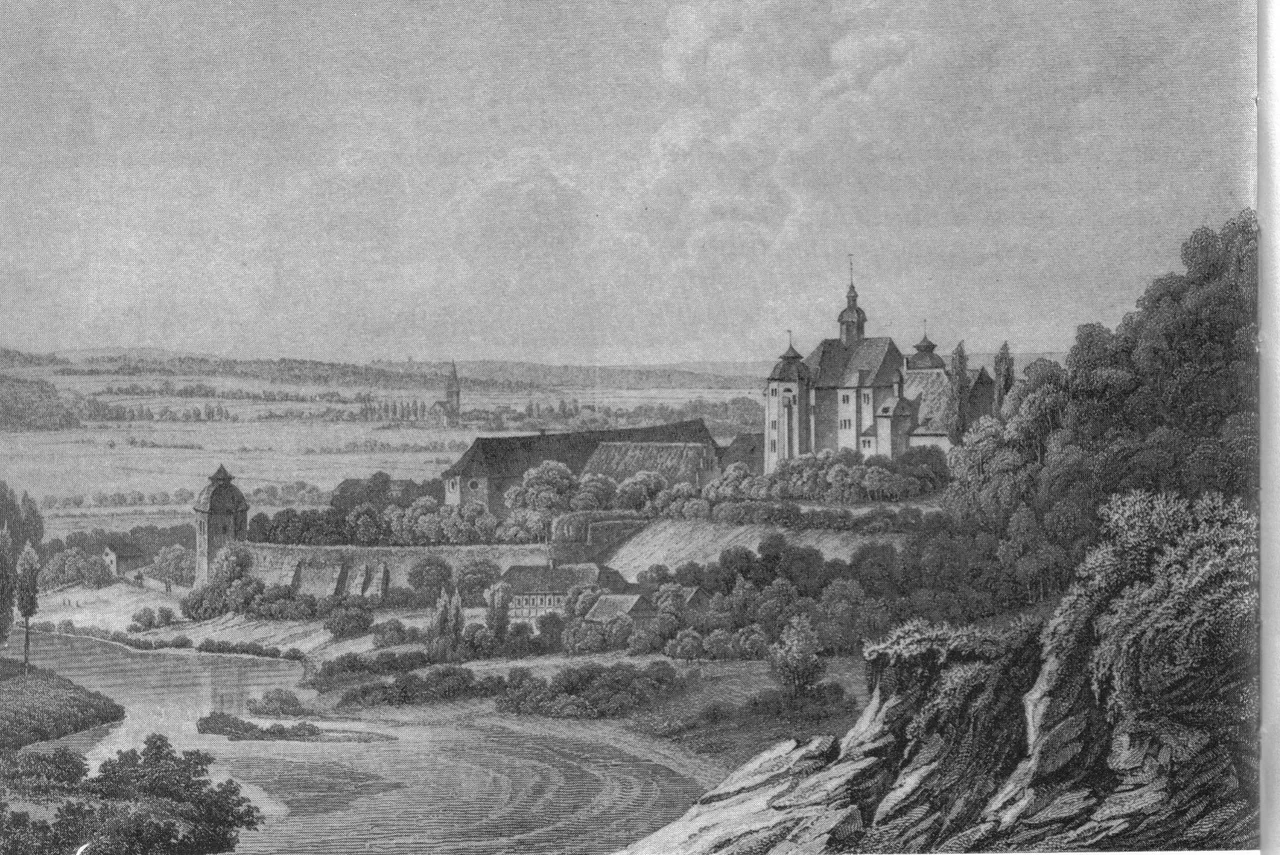

Schloss Allner
On 7 April 1945, the US 97th Infantry Division tried to cross the Sieg River south of Hennef and stepped into a perfect kill zone. Two German officers and a handful of soldiers from the 353rd Infantry Division had set up machine guns in the towers of Schloss Allner, a 15th-century moated castle on the north bank, with clean fields of fire down both sides of the river. American gun crews from the 922nd Field Artillery Battalion fired over three thousand 105 mm rounds at the castle in two days. According to the after-action report, the building crumbled and the machine gun fire continued. The Americans eventually had to send G Company across the river on 8 April and clear the castle out room by room. Ten American soldiers died in the assault. Nobody recorded how many Germans. The castle came out of the war with one tower destroyed by a direct artillery hit and the rest holed and burnt. Its strangest chapter was still ahead.
A Castle on the Sieg
The original cross-shaped manor at Allner was built around 1419 on the south slope of the Nutscheid Ridge, just where the small River Sieg loops past on its way to join the Rhine at Bonn. Arnold von Merkelsbach, vassal of the Stifts Vilich and bailiff of the Blankenberg Office in the Duchy of Berg, is the first owner recorded in 1421. Schloss Allner stayed in family hands for the next six centuries, passing by marriage from the Merkelsbachs to the Scheiffart von Merode line in 1557, then by another marriage to the von Loe family. The 1643 great hall was added by Bertram Scheiffart von Merode, who put his and his wife Lucie von Hatzfeldt's coat of arms over the main gate. A second marriage escutcheon, from 1668, marks the wedding of Johann Wallraff Scheiffart von Merode and Maria Anna von Harff. The dates are still visible in the keystones. The Prussian general Walter von Loe was born inside the castle on 9 September 1828.
The Ophthalmologist's Gothic Revival
In 1850 the von Loe heirs left Schloss Allner and it sat empty for twenty years. In 1870 the Dusseldorf eye surgeon Albert Mooren bought it as a country retreat, and in 1875-76 he hired the Franciscan brother Paschalis Gratzke - a working architect as well as a religious - to remodel the castle in the Gothic Revival style fashionable in late 19th-century Germany. Gratzke added steep concave mansard roofs to the front towers, joined the rear towers with a third mansard roof, removed an old balcony over the front door, and built a new terrace on the garden side. The result was unusual: a 15th-century cruciform plan dressed up in 19th-century neogothic clothes, but unlike the show-castle at Drachenburg built a few years later, this one had a working family in it. Mooren's daughter Irma was born there in 1884. She lived in the castle until 1923, then with her ophthalmologist husband Adolf Pagenstecher, who became the next owner, and their daughter Lucy who was born in the castle in 1928 and baptized in the chapel on the second floor.
Two Days of Artillery
By April 1945, the Pagenstechers had been pushed out and the Wehrmacht held the building. Two officers from the 353rd Infantry Division of the LVIII Panzerkorps had set up machine guns in the towers when the US 97th Infantry Division reached the south bank of the Sieg on 7 April. The Americans needed to cross the river to push into the Ruhr pocket, the last major German concentration of forces in western Germany. The castle's height and clear field of fire made a river crossing impossible until it was reduced. The after-action report describes what happened next in plain military language. Tank destroyers, heavy machine guns, mortars, and field artillery all brought to bear on the castle. The building crumbled. The machine gun fire kept coming. Over the next two days the 922nd Field Artillery Battalion put more than three thousand 105 mm shells into the area around the castle. Eventually the 387th Infantry Regiment crossed the river, the 2nd Battalion took stiff resistance on the loop, the tank destroyers blasted what was left from the south bank, and G Company moved in and cleared the castle room by room on 8 April. Ten American soldiers died in the assault. The south front tower was demolished by a direct hit. The rest of the building survived in damaged form, holed and burnt but still standing in outline.
An Orphanage, and What Happened Inside It
After the war, Lucy Pagenstecher married Rainer C. Horstmann, who served as mayor of the municipality of Lauthausen from 1956 to 1969. In 1950 Horstmann sold Schloss Allner for the symbolic price of one Deutschmark to the Bonn Caritas Association, a Catholic charity, which converted the damaged castle into a children's home. Renovations finished in 1962. The mansard roofs Brother Paschalis had built in the 1870s were replaced with simpler tented roofs. Up to 120 children, most of them born outside marriage and many placed there by court order, lived in the castle through the 1960s. The conditions inside were terrible. An inspection on 12 April 1965 found severe overcrowding, malnutrition, beatings, jaundice from poor sanitation, and what the inspectors described as severe mistreatment. Children were tied to their beds. Some are believed to have died of abuse and neglect. The inspection report led to no immediate follow-up. A 2010 study, based on interviews with thirty-five former residents and former staff, recorded panic attacks, depression, and lifelong psychological injury in the survivors. The orphanage operated for another eight years after the 1965 inspection before a series of court cases forced its closure in 1973. The records were destroyed when the home shut down.
Condominiums Above the Watermill
Schloss Allner is now a privately owned residential complex. The castle was subdivided into condominiums in the 1980s, and the most recent restoration in 2010 added a bridge across the moat-fed channel to the property's well-preserved watermill. The marriage escutcheons of 1643 and 1668 still mark the gates. The octagonal river tower of 1550 still stands on its 10-meter ashlar curtain wall. The neogothic mansard roofs Gratzke designed in the 1870s are gone, replaced with the post-1962 tented roofs. The chapel on the second floor where Lucy Pagenstecher was baptized in 1928 is now part of a private apartment. The castle's address is Schlossstrasse in Hennef, in the Rhein-Sieg-Kreis. A private home for residents. A scene of war damage that took two days and three thousand shells to reduce. A site of institutional cruelty toward children whose own state called them illegitimate. Three lives in one building, none of them quite finished. The descendants of the children who lived there in the 1960s are still campaigning, on the seventh decade, for the official acknowledgment that the German records destroyed in 1973 made deliberately hard.
From the Air
Coordinates: 50.7808, 7.3017. Schloss Allner sits on the north bank of the River Sieg, about 25 km east of Bonn and 5 km northeast of Hennef town center. From the air the castle is identifiable as a cross-shaped four-story manor with corner towers, set just north of the Allner See, a small impoundment lake. Recommended viewing altitude 2,500-3,500 feet. Nearest major airport: Cologne Bonn (EDDK), 17 nm west-northwest. Watch for the EDDK Class C/D shelf and for the Sieg valley's prevailing west wind.
Nearby Stories
- Marienstatt Abbey 5.7 km away
- Baumwollspinnerei Ermen & Engels 14 km away
- Düren-Neuss railway 15 km away
- Operation Chastise 15 km away
- Battle of Hurtgen Forest 22 km away
- Zwingenberg Castle 147 km away
- Basilica of Saint-Pierre-aux-Nonnains 153 km away
- Fort Jeanne d'Arc 169 km away