
Ruhr University Bochum
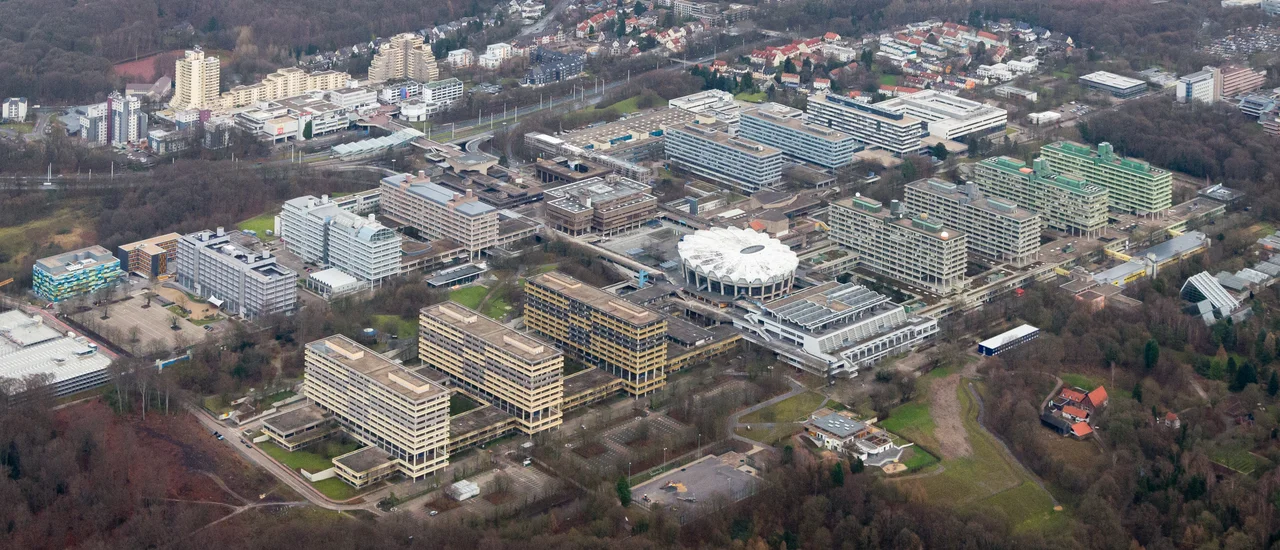
The architect Helmut Hentrich called it a 'harbor of knowledge.' Fourteen high-rise buildings, almost identical, placed across the ridge south of Bochum so that all their roofs hit the same height even though the hillside underneath ripples up and down. From the right angle, the buildings really do look like ships at anchor in a concrete dock, their funnels lined up against the Ruhr sky. The metaphor is romantic, the execution is brutalist, and the meaning is unmissable: in 1965, on a former coal field, West Germany opened its first new public university since the war, and built it as the largest single thing the postwar republic had attempted on a green field.
First After the War
The Ruhr-Universitaet Bochum - everybody says RUB - was founded in 1962, and instruction began in 1965. It was the first new public university Germany had founded since the Second World War. The Federal Republic had spent its first two decades rebuilding the institutions that already existed; RUB represented a deliberate act of expansion. The Ruhrgebiet, with its coal and steel economy beginning to soften, needed an academic anchor; the new state of North Rhine-Westphalia needed to absorb a generation of postwar children who were starting to think about university. Bochum got the bid. The site chosen was a green ridge in Querenburg, on the southern edge of the city, where the ground falls away toward the Ruhr River. The university would educate the children of the miners. That was, more or less, the promise.
Concrete Fleet
Hentrich's design - 14 nearly identical high-rise faculty buildings arranged across the campus - is the largest pure expression of German brutalism. The buildings are gray concrete, ribbed and ribbed again, with horizontal window bands and vertical service cores. Walk between them on a winter morning and the campus feels like a city of warships, each tower a hull. Walk through them in spring and the courtyards bloom unexpectedly, the harshness softens, and the geometry starts to feel reassuring rather than oppressive. The buildings are connected by elevated walkways and concrete bridges - a deliberate plan to keep students above the rain and the steep hillside underneath. The campus has been undergoing decades of modernization; some of the original 1960s buildings have to be rebuilt entirely, rather than refurbished, because PCB contamination in their concrete makes salvage impractical.
Forty-Two Thousand
Today RUB enrolls around 37,700 students and employs more than 6,400 staff, of whom over 400 are professors. That makes it one of the ten largest universities in Germany. It offers 184 different study programs across 21 faculties - the full sweep from Protestant Theology and Catholic Theology to Computer Science and East Asian Studies, with Engineering, Medicine, Philosophy, and Sport Science in between. RUB was one of the first German universities to adopt international bachelor's and master's degrees, replacing the older German Diplom and Magister system. The Faculty of Medicine spreads across multiple teaching hospitals in Bochum and the surrounding Ruhr area. The first rector of the university, from 1967 to 1969, was Kurt Biedenkopf, who later became Minister-President of Saxony - a Bochum starting point for one of postwar Germany's more memorable political careers.
Gardens, Organs, Floer
Two unexpected things on the campus. The first is the Botanical Garden, on the slope below the towers, which contains the only southern-Chinese-style garden in Germany - bridges, ponds, calligraphy stones, designed in collaboration with horticulturists from Tongji University in Shanghai. The second is the Klais-Orgel in the Audimax lecture hall: 82 registers, one of the most modern concert organs in the country, played at academic ceremonies and public concerts. RUB's notable alumni include Andreas Floer, the mathematician who invented Floer homology and changed symplectic topology; Cardinal Reinhard Marx, Archbishop of Munich and Freising; Norbert Lammert, the 12th President of the Bundestag; Hartmut Neven, who leads Google's Quantum AI lab; and Olympic medalists in rowing and discus. The campus also houses the Hegel-Archiv, the official archive of the philosopher Georg Wilhelm Friedrich Hegel.
A Harbor That Stayed
The Excellence Initiative of 2007 - Germany's federal competition to identify a handful of elite research universities - put RUB through several rounds. It made it deep into the contest but lost in the final cut. The result has shaped the campus's self-image: RUB sees itself as one of the most ambitious mid-tier German research universities, with serious depth in materials science, IT security, neuroscience, and theology. It is also one of the most ethnically diverse student bodies in Germany, drawing heavily from the Ruhrgebiet's immigrant and working-class communities, who were exactly the population the founders wanted to reach. The concrete fleet has stayed where Hentrich docked it. Sixty years in, it is no longer brutalism as architectural moment - it is the campus that several generations of Ruhr children went to in order to become something other than miners. The harbor metaphor turned out to be more accurate than the architect probably knew.
From the Air
Located at 51.44 N, 7.26 E, on the green ridge of Querenburg in southern Bochum at roughly 130 meters elevation. From altitude, the 14 nearly identical high-rise faculty towers are the unmistakable signature - their flat roofs line up at the same height, forming a clear man-made horizon against the ridge. The Botanical Garden lies on the slope just south of the buildings. The Ruhr Valley is visible further south. Nearest major airport: Dortmund (EDLW), 22 km east. Best aerial appreciation is from low altitude on approach to Dortmund or Duesseldorf - the parallel towers look exactly like a fleet at anchor.
Nearby Stories
- Burg Castle (Solingen) 4.1 km away
- Düren-Neuss railway 9.6 km away
- Operation Chastise 9.7 km away
- Krefeld Zoo 10 km away
- Festspiele Balver Höhle 13 km away
- Lembeck Castle 16 km away
- Haldern Pop 18 km away
- Warendorf 35 km away