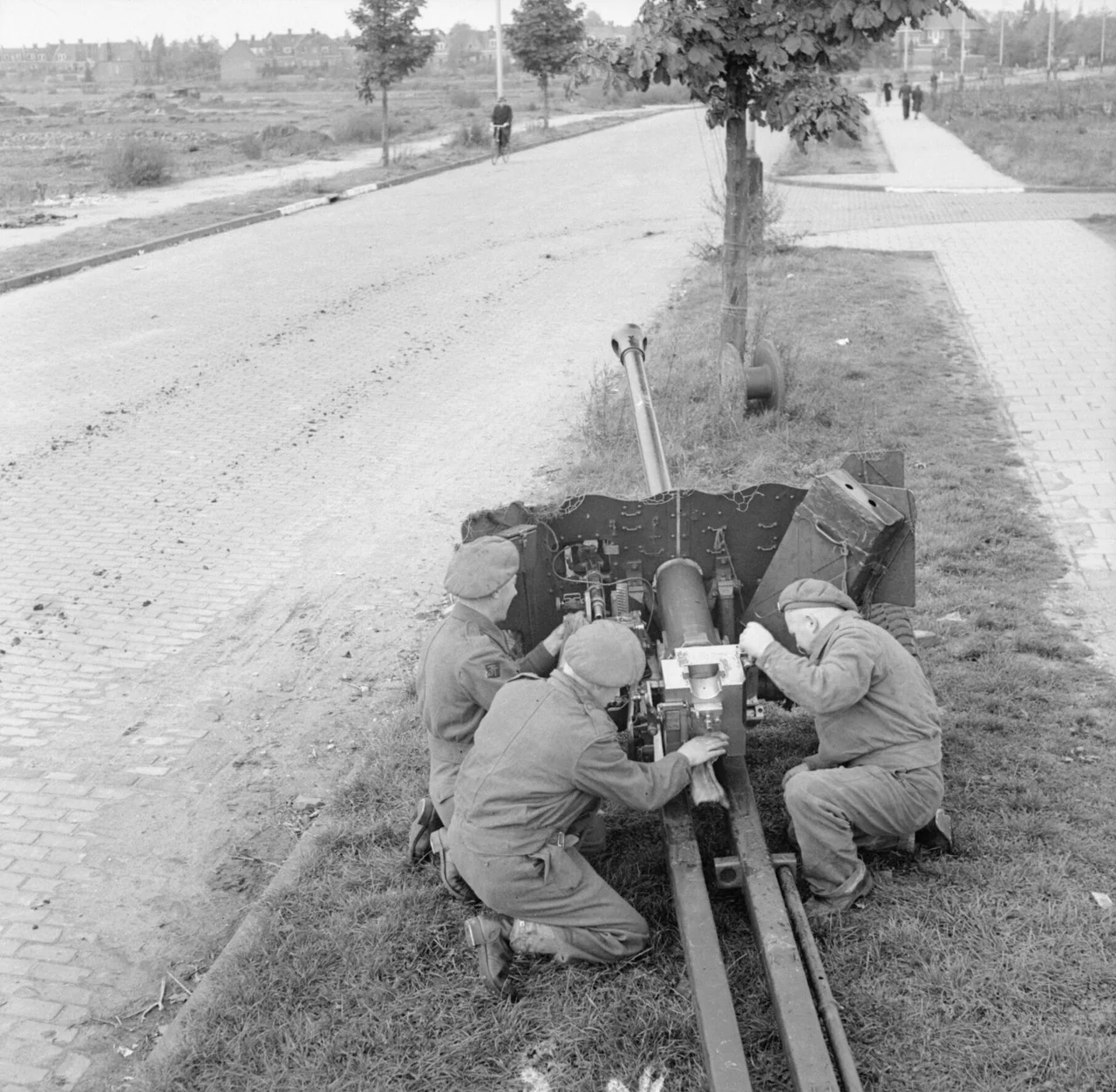

Battle of the Nijmegen salient
Operation Market Garden ended on 26 September 1944, when the last survivors of the British 1st Airborne were ferried back across the Rhine in the dark. The next morning the Germans began trying to push the Allies back off the long thin corridor they had just paid so much to seize. The fighting that followed lasted into October, killed more men than most histories of the campaign bother to mention, and ended with the front line exactly where Market Garden had left it. The soldiers who fought there called the wedge of farmland between the Waal and the Nederrijn the Island.
The Geography of the Island
The Allies had taken the Nijmegen bridge intact on 20 September in a now-famous daylight river crossing by the US 82nd Airborne, but they had not taken Arnhem. What they held instead was a salient running north from the Belgian border across south-eastern Holland to the south bank of the Nederrijn: the Betuwe, a low polder hemmed in by dykes between the Waal and the Lower Rhine. Walter Model, commanding Army Group B, was ordered by Hitler in a special directive on 25 September to destroy the Allies in the Nijmegen-Arnhem area. The job was given to Wilhelm Bittrich's II SS Panzer Corps, with the 9th Panzer Division and 116th Panzer Division brought up from the Aachen sector where the US First Army had just punched into the Siegfried Line. The British 43rd Wessex Infantry Division, which had relieved the Guards Armoured at the end of Market Garden, held the salient under General Ivor Thomas. The 5th Guards and 8th Armoured Brigades, the 69th Infantry Brigade, and reserves from the 50th Northumbrian Division were placed under his command.
The Counterattack at Randwijk
On 26 September, the day after Operation Berlin pulled the airborne survivors out of the Oosterbeek pocket, the Germans crossed the Nederrijn in battalion strength at Randwijk and seized a small bridgehead. The 43rd Reconnaissance Regiment holding that stretch of dyke was thin on the ground, but the Hampshires and Somersets came up with tanks of the 8th Armoured Brigade and fought through the village. The last action was inside the village church. The Hampshires took 150 German prisoners. The German bridgehead south of the Nederrijn was effectively destroyed within two days of forming. The same day, the 5th East Yorkshires of 69th Brigade took Bemmel east of the Waal. The Green Howards took Heuvel on the 27th but failed to clear Baal and Haalderen, where the brickworks gave the German defenders cover and observation enough to call down accurate artillery and screaming Nebelwerfer rocket fire on anything that moved.
Bittrich's Two-Pronged Push
Bittrich's counterattack came in from the north and east. The 10th SS Panzer Division Frundsberg, already deployed on the Island, opened the assault. The 9th Panzer Division, freshly arrived, picked up command of the ad hoc Kampfgruppen Knaust and Bruhn that had fought the British paratroopers at Arnhem only days earlier. The 116th Panzer Division joined the attack as well. The fighting through the first week of October ground across small farms and dyke roads, often inside a few hundred meters of named villages whose names the British troops were still learning. Despite losing some ground, Thomas's force repelled every major attack. On 4 October the British launched their own counterattack and recovered the ground they had lost, picking up additional villages in the process. The US 101st Airborne Division, still in the line after their part of Market Garden, came up to reinforce the salient. Further German assaults broke against the combined position. On 7 October, US medium bombers destroyed the Arnhem road bridge that John Frost's paratroopers had held two weeks earlier. The fighting tailed off over the following three days. The Germans called off any major attempt to retake the salient. The frontline on the Island would not move again until the spring.
What the Salient Cost
The Germans suffered heavy losses in infantry and armor during the nine days of attacks. British casualty figures from the salient are folded into the larger campaign totals and are harder to extract; the divisional histories of the 43rd Wessex, the 50th Northumbrian, and the 8th Armoured Brigade record the fighting in the kind of detail that Market Garden's more famous chapters tend to overshadow. The 21st Army Group, already pinned to the defense of the salient it had just bled to take, redirected significant resources to opening the Scheldt estuary so that the port of Antwerp could begin receiving Allied supplies. The Scheldt campaign would itself become one of the most costly of the autumn. The salient itself stayed where it was through the winter, an uncomfortable bulge of Dutch farmland between two rivers, with German artillery on the high ground at Arnhem looking down on every move. The civilian population of the Betuwe, evacuated by the British in early October to clear the battlefield, would not return to their flooded and shelled villages until after the German surrender in May 1945.
The Forgotten Coda
Market Garden has had its books and its film. The salient has not. The men who fought through the Island in those wet October days were doing the unglamorous work that follows every bold failure: holding what the bold plan actually achieved, paying again for ground that had already been paid for once. The Dutch villages around Elst, Bemmel, Randwijk and Driel kept their commemorations small and local. The British divisions involved moved on to the Scheldt and then to the Reichswald, and the autumn fighting on the Betuwe became the section of the campaign history that gets summarized in a paragraph. The frontline the salient defended was the line from which, five months later, Operation Veritable would finally push east into Germany. The Island had to be held first. It was.
From the Air
The salient lies roughly between 51.85 degrees north (Nijmegen) and 51.96 degrees north (the south bank of the Nederrijn), bounded east-west by Arnhem and the Waal-Maas confluence near Tiel. Approximate center 51.90 N, 5.85 E. Key towns include Elst, Bemmel, Huissen, Driel, Randwijk and Opheusden on the Island itself, with Nijmegen forming its southern hinge and Arnhem just north of the front line. Nearest airports: Teuge (EHTE) 35 km north of Arnhem, Eindhoven (EHEH) 60 km south, Schiphol (EHAM) 95 km west, Düsseldorf (EDDL) 95 km southeast. Recommended viewing altitude 3,000-5,000 feet AGL to follow the dyke network and the two-river geography that defined every tactical decision. The Nijmegen Waal bridge and the rebuilt John Frost Bridge at Arnhem remain the most useful visual references for orienting the salient.
Nearby Stories
- Herzogenbusch Concentration Camp 1.8 km away
- Gooi 4.8 km away
- Volkel Air Base 6.9 km away
- Achterhoek 8.3 km away
- Sportpark Berg & Bos 8.8 km away
- Vetera 9 km away
- Beverweerd Castle 10 km away
- Sallandse Heuvelrug National Park 15 km away