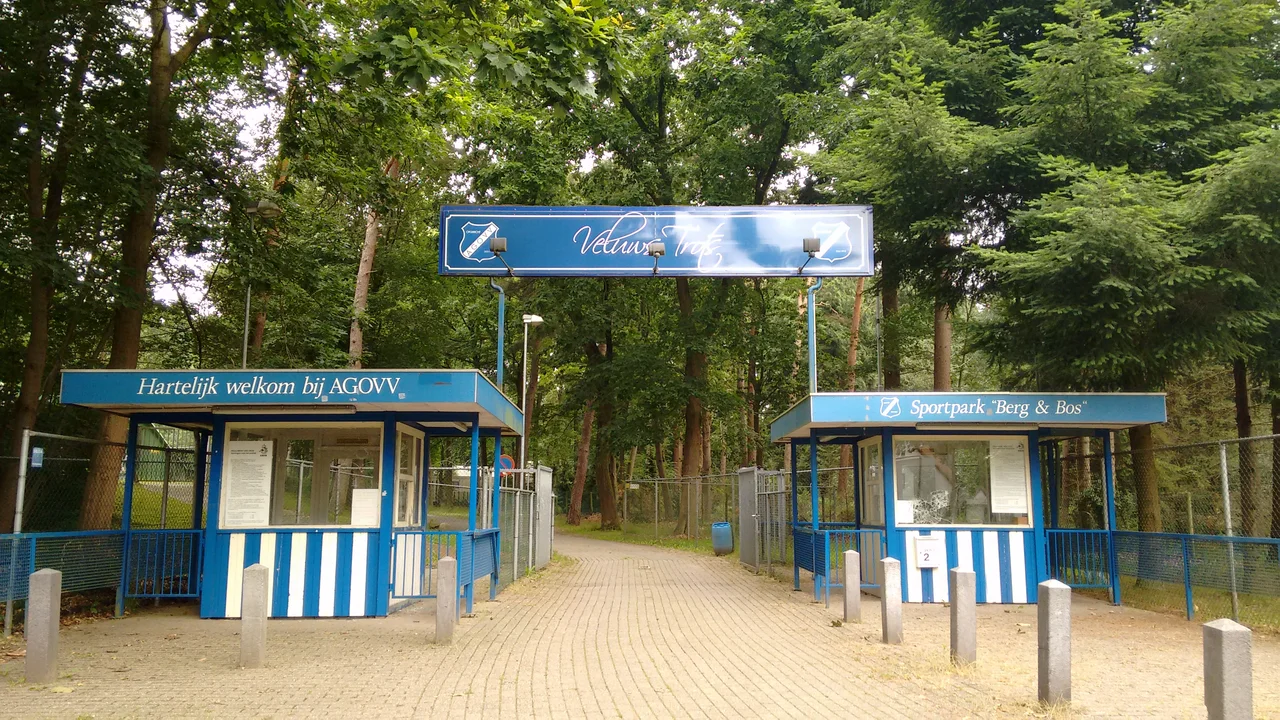

Sportpark Berg & Bos
In July 2012, a single Asian longhorn beetle threatened to bring down a piece of Dutch architectural heritage. The insect had bored deep into a load-bearing pole of the 1924 grandstand at Sportpark Berg & Bos in Apeldoorn, and the inspectors who climbed up to look did not like what they found. The Municipality of Apeldoorn ordered the stand closed before anything could collapse. A metal emergency brace went in. The club that played beneath it - AGOVV, founded long before anyone in Apeldoorn had heard of an Asian longhorn beetle - was already running out of money. By the end of that year, the most beautiful grandstand in Gelderland had been locked up, possibly for good.
A Park That Was Never Just a Field
AGOVV has played here since 1921, in a wooded pocket on Apeldoorn's western flank, right next to the Apenheul primate park. The complex spreads across four football pitches and a stadium, and in the early years it doubled as a venue for the annual hippique concours - the local horse show that drew its own crowds. The fields sit on sandy Veluwe soil under tall conifers; in 2021 the football magazine Voetbal International named Sportpark Berg & Bos the most beautiful football complex in the Netherlands. The trees, the historic stand, the small-club intimacy: it earned the title by being exactly what most modern grounds are not.
The Crowd That Came Anyway
The current Stadion Berg & Bos opened in 2003 with a tidy 3,250 seats, expanded slightly to fit 3,500 for cup nights. Those numbers tell only part of the story. In the past, when Berg & Bos hosted exhibition matches against the giants, the woods filled up well beyond what any seat count could explain. The Dutch national team under Louis van Gaal drew 12,000 people here. A match against SC Heerenveen featuring Abe Lenstra brought in 25,000 - more than seven times the modern capacity, packed onto banks and standing room and the edge of the trees. The official record under professional rules is more modest: a sold-out 3,500 on 24 September 2009, when AGOVV took on Ajax in the cup and lost 1-2. Even that night, in a stadium built for a smaller world, felt like overflow.
Gerrit de Zeeuw's Stand
The grandstand the beetle attacked is not a footnote. City architect Gerrit de Zeeuw designed it in 1924, when Apeldoorn was trying to find work for the unemployed and football clubs were trying to find buildings that would last. Built as part of a job-creation scheme, the stand went up alongside the club building De Blauwe Drukte - The Blue Bustle - which dates from the same decade. The whole ensemble eventually landed on the municipal monuments list, which is part of why the 2012 beetle damage became such a problem. You cannot just tear down a protected monument. You also cannot leave one to collapse on its fans.
Bankruptcy, Then Crowdfunding
AGOVV's professional branch did not survive 2013. On 8 January the club was declared bankrupt and the pros disappeared, but the amateurs kept playing on the same patch of grass they had used since 1921. The stand stayed closed. Then something quieter than rescue capital arrived: a campaign. Former AGOVV player Klaas-Jan Huntelaar, by then a Schalke and Netherlands striker of some renown, publicly called on supporters to save the grandstand. Fans symbolically sponsored individual seats for 100 euros each. The municipality added a subsidy. In 2016 the renovation finished, and the stand reopened to spectators who had been waiting four years to sit in it again. In 2021 the platform Nederlandse Velden voted it the most beautiful main stand in Gelderland - a title earned, by then, the hard way.
What Remains
Plans to move AGOVV to a 6,000-seat ground at Kuipersdijk or on the Europaweg drifted away with the professional licence. Negotiations to sell the site back to the municipality collapsed in March 2012 over price. The stadium keeps the artificial turf installed in 2006 by Royal Ten Cate NV and once approved by UEFA, and for three seasons between 2010 and 2013 it carried the sponsored name Fly Brazil & Desko Stadium - a corporate label now mostly forgotten. The wooden stand and the brick clubhouse are what people remember. From the air, the trees are the giveaway: a small, green football island wedged between the zoo, the suburb that gives the park its name, and the long pine forests rolling away to the west.
From the Air
Coordinates 52.21°N, 5.93°E, on the western edge of Apeldoorn in Gelderland. Look for the small football complex tucked into the forest immediately adjacent to Apenheul primate park, with the residential Berg en Bos neighbourhood to the north. Nearest airfield is Teuge International (EHTE), about 12 km east; Lelystad (EHLE) lies roughly 35 km northwest. Recommended viewing altitude 2,000-3,000 ft AGL to pick out the wooded ground against the surrounding pines.
Nearby Stories
- IJssel 3.8 km away
- Bilderberg Meeting 4.8 km away
- George Floyd protests in the Netherlands 5.2 km away
- Achterhoek 5.6 km away
- Sallandse Heuvelrug National Park 7.4 km away
- Bovenkarspel 16 km away
- Heinz Struning 17 km away
- Hardenberg 20 km away