.jpg)
Siege of Julich (1621-1622)
By January 1622 the soldiers in the fortress had already eaten the horses. The officers had, anyway. The rank and file were down to dog meat, cat meat, and rat meat, and there was no firewood left worth speaking of. Outside the walls the Spanish guns continued to drop shells day and night, while inside, the Dutch governor Frederik Pithan - seventy-two years old, a veteran of Nieuwpoort - tried to keep his garrison from melting away in the cold. He had been holding Julich since September. On 17 January 1622 he opened negotiations.
How the Truce Ended
The Twelve Years' Truce between the Spanish Monarchy and the Dutch Republic expired on 9 April 1621. Both sides had spent the previous months arguing internally about whether to renew it. In Madrid the new sixteen-year-old king Philip IV sided with the war faction led by Baltasar de Zuniga and his nephew Olivares. In The Hague, the stadtholder Maurice of Nassau played a double game - opening talks with the archdukes in Brussels while using the threat of a Spanish offensive to bring the reluctant inland provinces around to continuing the war. When the Spanish chancellor Petrus Peckius the Younger arrived to demand Dutch submission, recognition of Catholic worship, and an end to the Scheldt blockade, his proposal was rejected utterly, and the war was on again. Open hostilities resumed on 3 August with a Dutch cavalry raid on the outskirts of Antwerp.
Spinola's Feint
The Spanish Army of Flanders was commanded by Ambrogio Spinola, the Genoese nobleman who had taken Ostend in 1604 and reshaped the war ever since. The Brussels Council of State had decided Julich must be taken. The town, far from the Dutch frontier and held by a Dutch garrison since the 1610 succession crisis, sat between the Rhine and Meuse rivers - too far from the Republic to threaten an invasion, but ideal for choking the river trade that fed the Dutch economy. Spinola assembled 15,000 infantry and 4,000 cavalry at Maastricht and marched, not directly to Julich, but across the Roer River and north to Buderich on the Rhine, opposite Wesel, to confuse Maurice about the real objective. Maurice took the bait and entrenched between Emmerich and Rees. By the time the Dutch understood what was happening, Spinola had detached Count Hendrik van den Bergh - a Catholic cousin of Maurice himself - with 6,000 infantry, 1,000 cavalry, and eight cannons to invest the real target.
Pasqualini's Star
Julich was small but exceptionally fortified. Its defenses, completed in 1580, had been designed by the Bolognese architect Alessandro Pasqualini in the mid-1500s. A large citadel with four bastions covered the north side of town, housing the ducal residence as a palazzo in fortezza. The town walls formed an elongated pentagon with four more bastions; ramparts and bastions were earth filled, brick-faced, considered when finished one of the strongest fortresses in Europe. After capturing it in 1610 the Dutch added hornworks and ravelins in front of every bastion. The garrison originally numbered 4,000 - one of the largest in the Republic, kept large for prestige - but Maurice had drawn down 1,000 men to his field army when the truce expired, leaving about 22 companies, roughly 2,500-3,000 soldiers, under Pithan. The town had everything except money to pay them, and discipline was fraying.
A Long Wet Autumn
Spinola decided to take Julich by hunger rather than assault. Van den Bergh built a line of circumvallation, reinforced with forts and redoubts, around the entire town. The Spanish diverted the Roer to drain the moats. Pithan launched sorties - one in mid-September with 700 infantry and all his cavalry struck Van den Bergh's camp, killed 54 Spaniards at a cost of 24 of his own. On 26 September another sortie of 200 musketeers and 100 cavalry was thrown back from a redoubt with 50 of its own men lost. Then came the rain. Heavy autumn rain flooded the States' Army camp ankle-deep, requiring Maurice to lay down more than 30,000 wooden plates. Forage for horses ran out. The cavalry had to be sent back to Arnhem, Zutphen, and Doesburg. Maurice planned in November to sneak a relief force by boat up the Meuse to Maaseik and then push overland to Julich, but a letter from Cologne tipped off Spinola, who positioned his army at Dulken between Maaseik and the target. The Dutch turned back without firing a shot. On 3 December Maurice gave up. The States' Army went to winter quarters.
Surrender Day
Inside Julich the cold was killing as many men as the bombardment. On 17 January 1622 Pithan opened negotiations through a commission of three captains, one each German, French, and English. Terms were agreed on 20 January and signed by Pithan and Van den Bergh two days later. A truce until 3 February. If no relief came in that window, the garrison would surrender with weapons, flags, baggage, and an escort to Nijmegen. Spinola would respect Protestant worship in Julich and allow Brandenburg's officials to remain. No relief came. On 3 February the surviving 2,000 men marched out across the citadel's bridge with their flags folded, muskets unloaded, matches extinguished. Pithan rode at the rear with the seventy remaining cavalry. At the gate he handed the keys of the city to the burgomasters, who handed them on to Van den Bergh. The Spanish took 36 cannons and 200 tons of powder. Pithan was court-martialed back in The Hague but honourably acquitted on the strength of his earlier service. The unfortunate captain Reinhard Tytfort, who had surrendered nearby Rheydt castle without much of a fight in August, had not been so lucky - sentenced to death and executed on 14 September.
The Picture Spinola Wanted
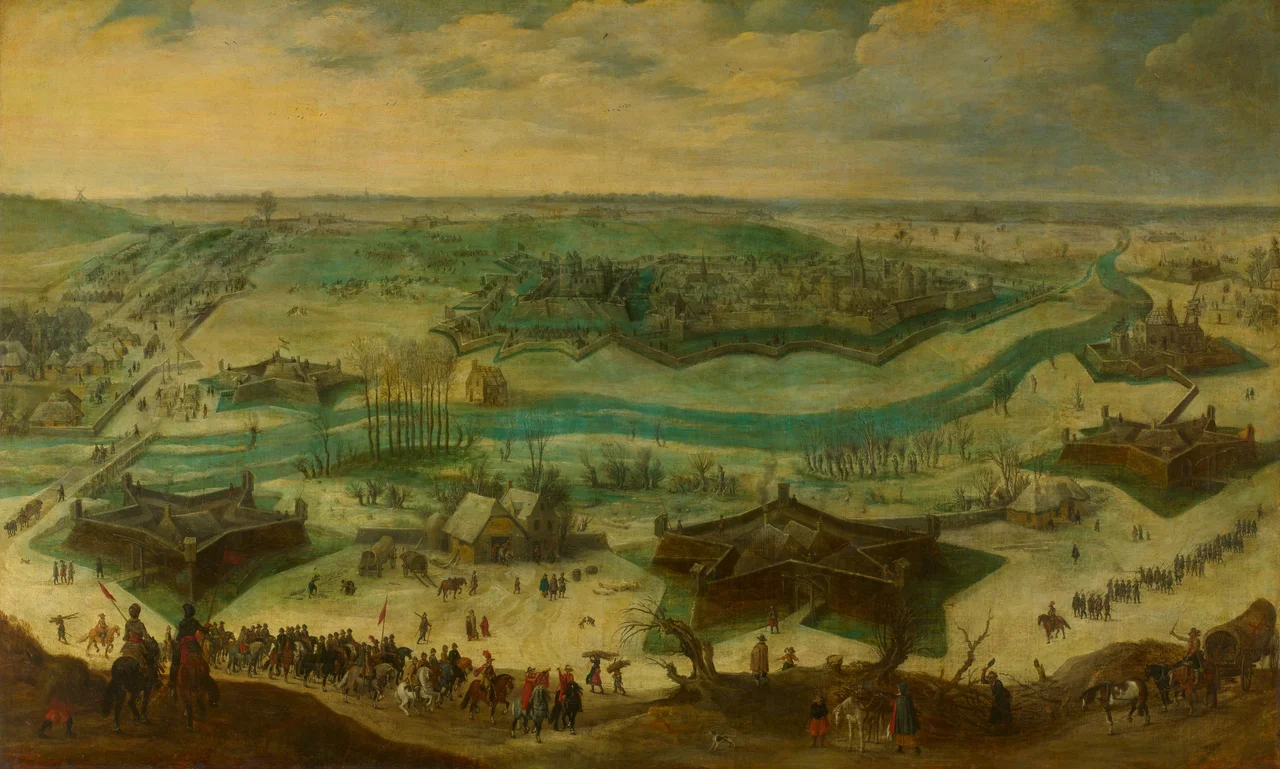
The triumph at Julich was the first major Spanish victory in the Netherlands after the Truce, and Madrid put it to work. In 1634 Philip IV commissioned Jusepe Leonardo to paint the surrender as part of the cycle for the Salon de Reinos in the Buen Retiro Palace. Spinola stands in the foreground receiving the keys, with the Marquis of Leganes beside him. Hendrik van den Bergh, who had actually conducted the siege, is missing - he had defected to the Dutch side in 1632 and become a traitor. Leganes was painted in his place from a Van Dyck engraving. The painting is often compared to Velazquez's Surrender of Breda. Other depictions followed: a snowbound canvas by Sebastian Vrancx; a similar elevated view by Pieter Snayers; a series of victory frescos in the Villa Spinola di San Pietro in Genoa; five silver reliefs cast by Mattheus Melijn for a wooden cabinet that has since been lost. Across the Dutch border, the journalist Nicolas van Geelkercken produced illustrated broadsheets celebrating Maurice. Both sides understood that a siege was also a story, and that the stories outlast the dead.
From the Air
The town of Julich (Juliers) is at 50.92N, 6.36E, on the Rur River about 30 km east-northeast of Aachen. The remarkable Pasqualini-designed citadel still survives and is the most visible landmark from the air. Recommended viewing altitude is 3,000-5,000 ft AGL to take in the elongated pentagonal town layout and the bastioned citadel on its north side. Nearest airports are Maastricht Aachen (EHBK) about 17 nm west, Cologne Bonn (EDDK) about 28 nm east-southeast, and Mönchengladbach (EDLN) about 18 nm north. The Rheinisches Braunkohlerevier and the Hambach pit lie just to the east, a startling contrast in scales.
Nearby Stories
- Trolleybuses in Solingen 4 km away
- Wessem-Nederweert Canal 5.9 km away
- Monchengladbach 7.2 km away
- South Limburg 7.6 km away
- European Transonic Wind Tunnel 7.6 km away
- Belgium 105 km away
- Marcinelle Mining Disaster 148 km away
- Zwingenberg Castle 196 km away