
Sand Engine
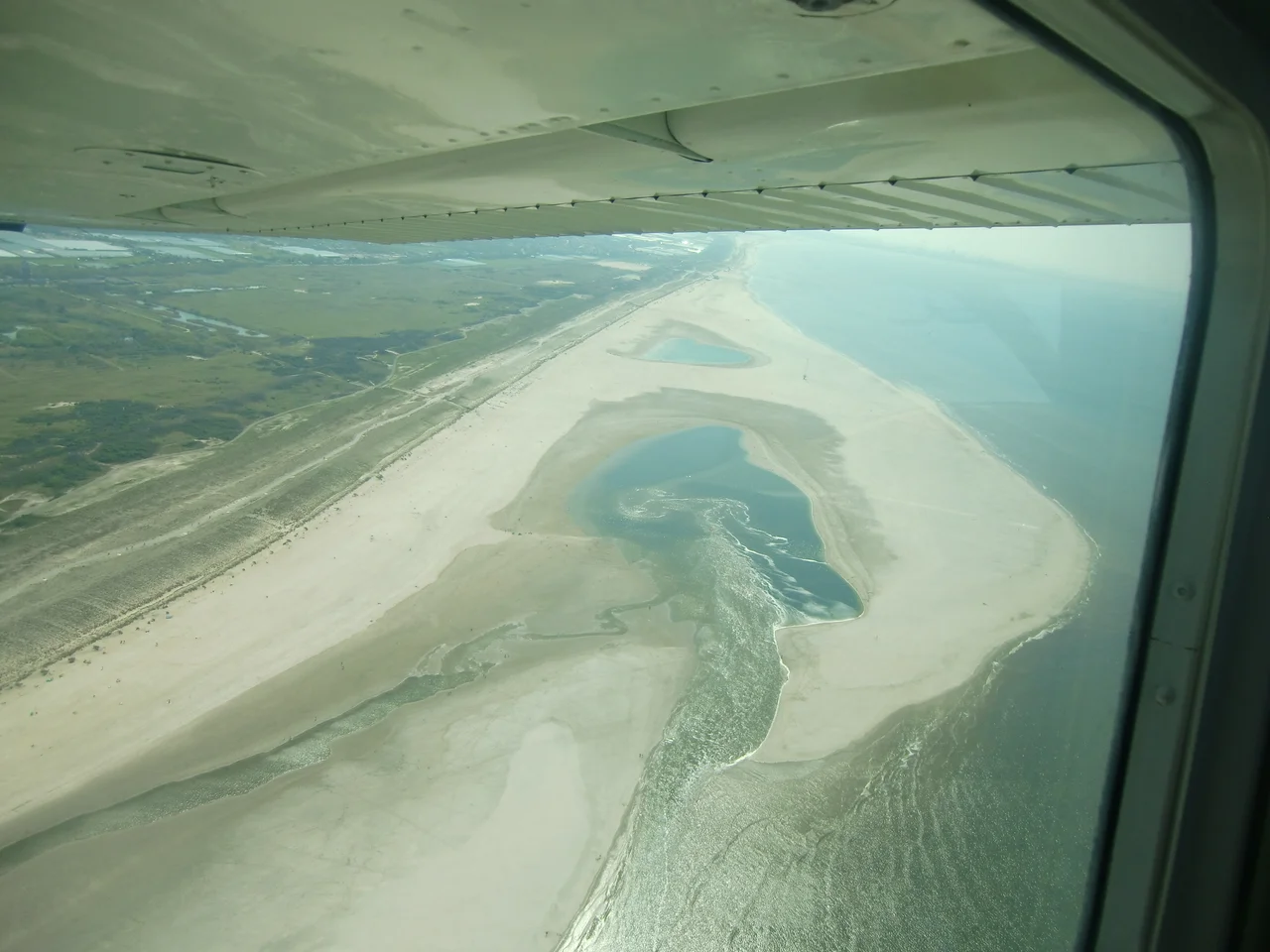
Engineers spent decades fighting the North Sea grain by grain. Every few years, dredgers would arrive off the Dutch coast, pump fresh sand onto eroding beaches, and watch the waves reclaim it. Then in 2011, a small team led by Delft professor Marcel Stive proposed something almost absurd: stop fighting. Build a monstrous hook of sand in a single push, 21.5 million cubic meters of it, and let the same currents that erode the coast do the work of spreading the sand themselves. The result, off the village of Ter Heijde, is visible from low orbit - a curling peninsula the locals call the Zandmotor, the Sand Motor, and it is slowly dissolving on purpose.
A Hook in the Sea
From the air it looks improvised, as if a child had dragged a finger through wet sand. The Sand Engine arcs out from the dunes between Ter Heijde and Kijkduin, reaching 2.4 kilometers along the coast and pushing nearly a kilometer into the water. The shape was not casual. Hydrologists modeled how wind, waves, and longshore currents would attack a sediment bulge of this size, then sculpted the deposit to feed sand northward, toward The Hague, where the coast needs it most. In total it covers 128 hectares - roughly the area of 180 soccer pitches - all of it dredged from five to ten kilometers offshore in a single ten-month campaign that began in January 2011 and finished that October.
Building With Nature
The phrase the Dutch use for this approach is *bouwen met de natuur*: building with nature. Traditional beach nourishments deposit one or two million cubic meters of sand every three to five years, churning up the seabed each time and disturbing the small lives that depend on it. The Sand Engine front-loads a generation of that work into a single deposit. Modeling suggested the peninsula would soften over fifteen to twenty years, with sand drifting steadily north and burying itself into the existing beach profile. The seabed gets one disruption instead of five or six. The cost - 70 million euros for the original build - sounded enormous until the alternative was tallied across two decades of repeat dredging.
Watching It Disappear
More than a coastal defense, the Zandmotor became an outdoor laboratory. Researchers from TU Delft, Deltares, and Utrecht University have been measuring it since the trucks left, tracking how the hook narrows, lengthens, and migrates. Drones map the surface. Sensors log salinity in newly-formed dune lakes. Biologists watch how shorebirds and sand-burrowing invertebrates colonize fresh ground. Within a few years a small freshwater lagoon had formed in the lee of the dune, and rare plants - sea kale, sand couch grass - had taken hold. The peninsula has lost roughly a third of its original height since 2011, exactly as designers predicted. Erosion, in this case, is the success metric.
The Dutch Coastal Mind
Half the Netherlands sits at or below sea level. The country has been holding the ocean back since the medieval drainage boards first started digging canals, and the *Hoogheemraadschap van Delfland*, the water authority that commissioned the Sand Engine, traces its lineage to the 13th century. Building bigger walls is one option; understanding the sea well enough to use its energy is another. Dutch engineers chose option two. State Secretary Joop Atsma presented the project in November 2011 not as a one-off curiosity but as a template, and similar sand-engine concepts have since been explored along the Hondsbossche seawall and at the Bacton Gas Terminal in Norfolk, England, where two million cubic meters of sand were deposited in 2019 to protect a vulnerable stretch of UK coast.
A Beach That Plans Ahead
Stand on the dunes above the Zandmotor on a windy afternoon and you can see the experiment in motion - kitesurfers carving across the lagoon, hikers tracing the hooked spit, plovers darting along the waterline. The peninsula will keep softening for another decade or so, eventually merging back into the regular line of the South Holland coast. Sometime around 2031, if the models hold, the Sand Engine will have vanished as a distinct shape, its 21.5 million cubic meters now smoothly distributed across thirty kilometers of beach. The experiment will not have failed when that happens. It will have succeeded.
From the Air
The Sand Engine lies at 52.05°N, 4.18°E, on the South Holland coast roughly 15 km southwest of The Hague between the villages of Ter Heijde and Kijkduin. The hooked peninsula is most legible from 3,000-5,000 ft on a clear day - look for a pale comma of sand curving south-southwest off an otherwise straight coastline. Nearest airports: Rotterdam The Hague (EHRD) 18 km southeast, Amsterdam Schiphol (EHAM) 45 km northeast. North Sea haze and onshore breezes are common; mid-morning often gives the best visibility before the sea fog re-forms.
Nearby Stories
- Zuid-Kennemerland National Park 3.9 km away
- Alphen aan den Rijn 5.7 km away
- Toren van Goedereede 6.2 km away
- Dordrecht 8.5 km away
- Luchterduinen Offshore Wind Farm 9.2 km away
- SS Elbe 21 km away
- Southern Bight 46 km away
- Battle of Cadzand 55 km away