
Albaniana (Roman fort)
The wood was waterlogged when archaeologists pulled it out of the ground in 2001, and that was the gift. The water that had drowned the timber had also preserved it. From a single beam, dendrochronology - the dating of tree-rings against established climate records - could tell the digging team exactly when the trees were felled. The answer changed how Romanists understood the northern frontier of the empire. The fort had been built right after AD 40 or 41, the year of Caligula's strange state visit to Germania Inferior. The mad emperor, the one his troops would assassinate within weeks of returning to Rome, had stood on the south bank of the Rhine and ordered a line of forts. Albaniana - by the white waters - was one of the first.
The Northern Edge of an Empire
Albaniana sat about forty kilometers upstream from the North Sea, on the southern bank of what the Romans called the Rhine and the Dutch now call the Oude Rijn - the Old Rhine. The river was the limes, the boundary of the empire. North of it, in theory, the Romans did not go. South of it, they built a chain of forts spaced a day's march apart along the entire length of the lower Rhine. The Tabula Peutingeriana, a medieval copy of an ancient Roman road map, places Albaniana between Matilo at Leiden and Praetorium Agrippinae at Valkenburg downstream, and between Nigrum Pullum at Zwammerdam and Fectio at Vechten upstream. The Itinerarium Antonini, a 3rd-century register of Roman roads, mentions the place by name. Each fort was a knot in a single rope of military presence that ran from the North Sea past Cologne and on to the Alps.
What the Soldiers Left Behind
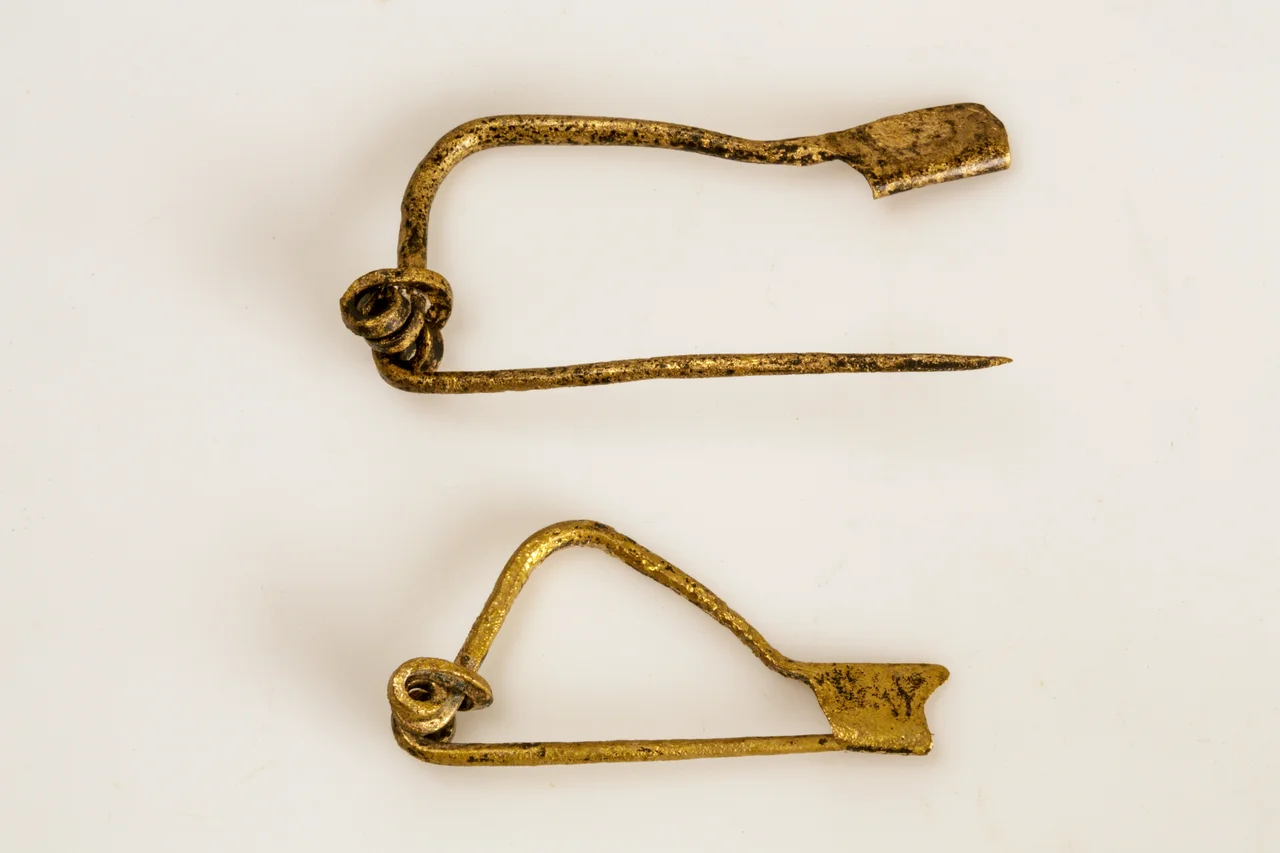
When the castellum was excavated, the finds were extraordinary because they had been sealed below the water table - which means below the oxygen that destroys organic matter. Leather, wood, food remnants, organic textiles survived in conditions that would have rotted them in higher ground. The dig recovered more than eight hundred coins, struck in the reigns of Tiberius, Caligula, Claudius, and Nero, dating the fort's first generation of use roughly 14 to 68 AD. Bronze fibulae, the safety pins that held Roman tunics together. A bronze plume holder from a helmet, the small bracket that mounted a centurion's crest. Armour buckles, scissors, an iron firmer chisel, an iron boathook, a fishing lead, an open handcuff. A nameplate that may have belonged to a centurion named L. Patricius Sabinus. An almost complete hammered-bronze signal horn - the cornu - whose curling shape Roman cavalry used to call orders across battlefields. Stamped roof tiles bore the mark of the Classis Germanica, the Roman fleet that patrolled the Rhine.
The Long Excavation
The Romans were rediscovered here by accident. In 1920, Professor Jan Hendrik Holwerda of the National Museum of Ethnology in Leiden visited a Reformed church construction site in central Alphen and recognised what the workers were turning up. Real archaeology came in waves. Albert Egges van Giffen ran the first systematic work in the early 1950s. Jules Bogaers led the digs from 1959 to 1978. Then from 1978 to 1998, Jan Kees Haalebos took over and finally established the location and ground plan of the fortress itself. Each generation built on the last. The 2001-onwards excavations were the most productive of all, because they reached deep enough into the water-saturated layer where almost two thousand years of preservation had been waiting.
A Town on Top of a Town
Modern Alphen aan den Rijn has about 70,000 residents living over what was once a rural settlement of perhaps a hundred people clustered around a Roman fort. The connection is visible in odd places. The town's main theatre and cinema is called Castellum and stands roughly where the camp once stood. On the Rijnplein, a stone with Roman inscriptions sits near the water, anchoring the modern square in its earlier identity. The Rijksmuseum van Oudheden in Leiden displays a number of the artifacts - the cornu, the centurion's nameplate, the bronze pieces and the more delicate organic finds. Outside town along the N11 provincial road, a large iron statue of a Roman soldier marks the location for drivers who would otherwise miss it. The name Albaniana - by the white waters - referred to the Old Rhine's pale silt-laden flow. The river has shifted since then. The white waters now run somewhere else.
Archeon and the Living Reconstruction
If you want to feel what Albaniana might have been like with people inside it, you go to Archeon. The open-air archaeological museum on the southwest edge of Alphen reconstructs Dutch history from prehistory through the Middle Ages, with a substantial Roman section that recreates frontier life along the limes. Costumed re-enactors drill in legionary kit. The forge runs. The bread oven bakes the kind of coarse bread the soldiers actually ate, milled from the spelt their granaries stored. Visitors can hold weighted replicas of the gladius and the pilum, see a barracks furnished as it would have been when an auxiliary cohort manned the fort. The Wikipedia article about Albaniana is short. The history is not. Eight hundred coins, two thousand years, and a Caligulan beam of oak that started everything.
From the Air
52.1292 N, 4.6614 E in central Alphen aan den Rijn, South Holland, on the south bank of the Oude Rijn. The fort itself is buried beneath the modern town; navigate by the river course and the bridges. Best viewed at 2,000-3,500 feet. Nearest airports: Rotterdam The Hague (EHRD) 28 km southwest, Amsterdam Schiphol (EHAM) 27 km northwest. The Archeon open-air museum sits on the southwest edge of town and is the most visible Roman-themed landmark; the Rijnplein in the city center marks the original castellum location.
Nearby Stories
- Halfweg Sugar Factory 0.3 km away
- Luchterduinen Offshore Wind Farm 5.2 km away
- Kamp Amersfoort 6.4 km away
- Ockenburg 6.6 km away
- Hellevoetsluis Dry Dock 6.9 km away
- Dordrecht 7.3 km away
- Oostvaardersplassen 9.8 km away
- 's-Hertogenbosch 19 km away